Finding the Initial Velocity of a Basketball Shot Using Freefall Equations

VaioZ
Messages
19
Reaction score
0
Hello first time posting in the Physics forum!

1. Homework Statement

A varsity player is attempting to make a shot. The ball leaves the hands of the player at an angle of 50 degrees to the horizontal at an elevation of 2 meters above the floor. The skillful player makes the shot with the ball traveling precisely through the center of the ring (8 meters from the player and 3 meters above the floor). To loud cheers, calculate the speed at which the ball left the hands of the player. Sketch the problem!

Homework Equations


Y=volt-1/2g(t)^2
Voy = Vosintheta
Vox = Vocostheta
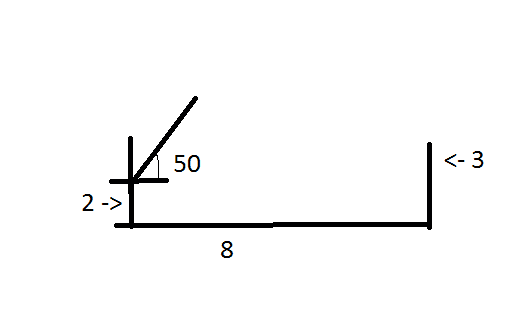
The Attempt at a Solution


ON0PJMy.png

Vox = Vocostheta -> 8=Vocos(50degrees) -> Vo=12.446m/s
Then I plug it to X=volt+1/2at^2 a is always 0 right? So it becomes X=volt -> X=12.446(t) -> t=(0.643s)
Then I plug the time to the y equation of free fall.. Delta Y is 1 right? Because 3-2=1
Y=volt-1/2gt -> 1=Vo(0.643)-1/2(9.8)(0.643)^2 Vo=4.7059m/s
y
I'm not sure if my answer is right.. if not can someone guide me...
If it is wrong sorry If I got a wrong answer.. This is why I post in this forums.
 
Physics news on Phys.org
Hello VZ, welcome to PF :smile: !

Always a good idea to include dimensions in your calculations -- and to check them. In your case, you go off the rails in the very first line (sorry to say):

## 8 \;{\rm m} = V_{0,x} = V_0 \cos\theta \;{\rm m/s}## can never be right !

Thing to do is write expressions for x(t) = 8 m and y(t) = 3 m, and eliminate t. Best to work with symbols until you have an expression for ##\theta##. Then check the dimensions and do the calculator work.

Oh, and: strange you should ask if your answer is right: I see two answers for v0
 
BvU said:
Hello VZ, welcome to PF :smile: !

Always a good idea to include dimensions in your calculations -- and to check them. In your case, you go off the rails in the very first line (sorry to say):

## 8 \;{\rm m} = V_{0,x} = V_0 \cos\theta \;{\rm m/s}## can never be right !

Thing to do is write expressions for x(t) = 8 m and y(t) = 3 m, and eliminate t. Best to work with symbols until you have an expression for ##\theta##. Then check the dimensions and do the calculator work.

Oh, and: strange you should ask if your answer is right: I see two answers for v0

I don't know what you mean by dimension buuuuuuut..
ΔX = Vo(t)
ΔY = Vo(t)-1/2(g)(t)^2

Do you mean that I should experiment with this two formulas? To get Vo? or to get t?
 
VaioZ said:
Vox = Vocostheta -> 8=Vocos(50degrees) -> Vo=12.446m/s
Then I plug it to X=volt+1/2at^2 a is always 0 right? So it becomes X=volt -> X=12.446(t) -> t=(0.643s)
Then I plug the time to the y equation of free fall.. Delta Y is 1 right? Because 3-2=1
Y=volt-1/2gt -> 1=Vo(0.643)-1/2(9.8)(0.643)^2 Vo=4.7059m/s
y
I'm not sure if my answer is right.. if not can someone guide me...
If it is wrong sorry If I got a wrong answer.. This is why I post in this forums.
First - you have equated horizontal velocity to horizontal displacement . This is wrong .
So your second and third equations automatically become wrong .
 
Qwertywerty said:
First - you have equated horizontal velocity to horizontal displacement . This is wrong .
So your second and third equations automatically become wrong .

Yeap I realized that after sir BvU post. Sooooo if it is okay can you guide me in this question?
 
VaioZ said:
Yeap I realized that after sir BvU post. Sooooo if it is okay can you guide me in this question?
Consider two unknowns v and t . Obviously v represents velocity of object , and t the time taken to reach the hoop .

What you'll need to do is form two equations . Use the fact that horizontal velocity of object is v*cos(θ) and vertical v*sin(θ) .

Can you manage the two equations ?
 
Qwertywerty said:
Consider two unknowns v and t . Obviously v represents velocity of object , and t the time taken to reach the hoop .

What you'll need to do is form two equations . Use the fact that horizontal velocity of object is v*cos(θ) and vertical v*sin(θ) .

Can you manage the two equations ?

Okay will do! I'll update you if I'm done. Thank you
 
Qwertywerty said:
Consider two unknowns v and t . Obviously v represents velocity of object , and t the time taken to reach the hoop .

What you'll need to do is form two equations . Use the fact that horizontal velocity of object is v*cos(θ) and vertical v*sin(θ) .

Can you manage the two equations ?

SIR I THINK I GOT IT. Okay here goes

ΔX = Vox(t) right? bc a is always 0
ΔX/Vox = t but we know that Vox=VoCos50 and ΔX = 8
so 8/Vocos50 = t
Voy=Vosin50 right?
So
Δy=Voy(t)-1/2g(t)^2
3-2=(Vosin50)(Vocos50)-1/2(9.8)(Vocos50)^2
 
VaioZ said:
Δy=Voy(t)-1/2g(t)^2
3-2=(Vosin50)(Vocos50)-1/2(9.8)(Vocos50)^2
You need to substitute correctly for t .
 
  • #10
Qwertywerty said:
You need to substitute correctly for t .

typo 8/Vocos50 but it is right the context is still there..
 
  • #11
Yes it is .
 
  • #12
VaioZ said:
I don't know what you mean by dimension buuuuuuut..
ΔX = Vo(t)
ΔY = Vo(t)-1/2(g)(t)^2

Do you mean that I should experiment with this two formulas? To get Vo? or to get t?
No experimenting: you want to manipulate these two equations with two unknowns in such a way that you get one equation with one unknown, namely ##\theta##

The way you write them is confusing -- one Vo with two different meanings, and Vo(t) makes it look as if Vo is a function of t --$$
\Delta X = v_0 \cos\theta\; t \\ \Delta Y = v_0 \sin\theta\; t - {1\over 2} gt^2 $$ is a lot clearer. See also here

[edit] oops, I'm lagging. This is in response to post #3 -- a bit late.
 
  • Like
Likes   Reactions: Qwertywerty

Similar threads

Replies
3
Views
4K
  • · Replies 1 ·
Replies
1
Views
2K
  • · Replies 3 ·
Replies
3
Views
6K
  • · Replies 6 ·
Replies
6
Views
10K
  • · Replies 3 ·
Replies
3
Views
4K
Replies
2
Views
6K
  • · Replies 3 ·
Replies
3
Views
3K
  • · Replies 2 ·
Replies
2
Views
7K
  • · Replies 1 ·
Replies
1
Views
2K
Replies
15
Views
6K