(Fluids) Difference in stress or pressure between setups?

Click For Summary

Discussion Overview

The discussion revolves around the differences in stress and pressure experienced by blood vessels in two experimental setups involving pressure myography. The focus is on understanding how modifications to the experimental technique, particularly the introduction of a continuously refreshed fluid chamber, affect the pressure dynamics and stress on the blood vessel walls.

Discussion Character

  • Exploratory
  • Technical explanation
  • Debate/contested
  • Mathematical reasoning

Main Points Raised

  • A participant describes a modified pressure myography technique and raises questions about potential changes in pressure and stress on the blood vessel due to the experimental setup.
  • Another participant introduces a hypothetical situation to clarify the pressure dynamics and asks for specific details about the pump's placement and the dimensions of the blood vessel.
  • Calculations are presented regarding hydrostatic pressure and gauge pressures in different situations, with specific values provided for pressure differences and hoop tensile stress.
  • There is a discussion about how the placement of the pump affects the pressure in the chamber and consequently the stress on the blood vessel, with calculations showing lower stress in the modified setup.
  • One participant expresses confusion about the implications of the results, questioning the relationship between internal and external pressures and their effects on stress.
  • Another participant clarifies that while radial compressive stress may increase slightly, the hoop tensile stress decreases significantly, emphasizing the difference between compressible and incompressible fluids.

Areas of Agreement / Disagreement

Participants express differing views on the implications of pressure changes in the modified setup, particularly regarding whether stress on the blood vessel increases or decreases. The discussion remains unresolved with multiple competing perspectives on the effects of fluid dynamics in the experimental context.

Contextual Notes

Limitations include assumptions about fluid behavior, the dependence on specific experimental conditions, and the need for further clarification on the effects of fluid flow in the chamber.

MrSmit
Messages
5
Reaction score
0
Hello,

I'm a PhD student in medical biology and am doing experiments with bloodvessels. I've modified an existing technique and getting unexpected results (ofcourse..). I think it is due to a pressure difference but my knowledge of physics is inadequate to be sure. Ill give a short explanation of the techniques and then at the end put a hopefully not too difficult question.

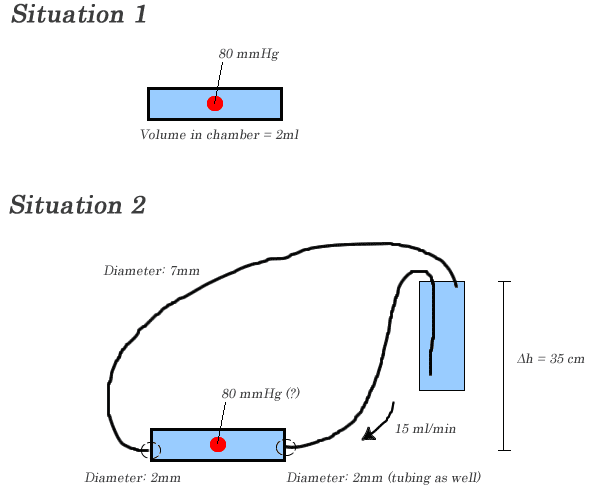
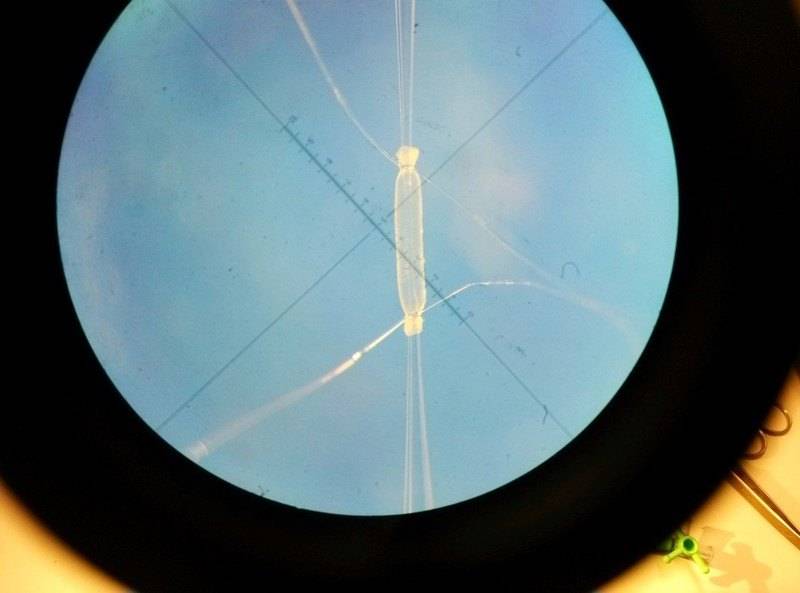
The technique I'm using is pressure myography; we cut a small section of a bloodvessel from tissue and attach each end to a glass cannula in a vessel chamber (see image one). The chamber contains fluid (salt solution) and is closed during the experiment. The chamber is not airtight, there are two open ends at the sides but the water from the chamber does not leak from them. Then, the pressure inside the vessel is raised to ~80 mmHg by closing one of the cannulas and attaching a water column to the the other (which is open at the end).

This is the standard situation (situation 1).

In my modified setup, the fluid inside the chamber is continuously refreshed. Approximately 35cm above the chamber is a fluid reservoir (due to technical reasons). The fluid is then pumped into the chamber by a rolling pump at 15ml/min. The 'excess' volume goes back into the reservoir through a tubing. This is situation two.

My feeling tells me that there is increased pressure, or stress, on the bloodvessel in the second situation. Others however say that the pressure difference between the inside and the outside of the vessel probably becomes smaller and therefore the stress decreases.. I'm definitely in need of someone more experienced in this matter..

My questions are:
- Is there increased pressure in the chamber?
- Is there a possibility that the pressure inside the vessel changes?
- Is there a possibility that the stress on the vessel changes?

Thanks in advance!

Image 1
ipunh5.jpg


Image 2

2cypkk6.png
 
Physics news on Phys.org
I can help you figure this out for yourself. First, here is an intermediate (3rd) situation for you to consider: Suppose that you were somehow able to get all the air out of the tubing, but the pump was not running, so no flow was occurring. So you have a hydrostatic equilibrium situation. Do you remember from freshman physics how to calculate the pressure at the bottom of a 35 cm column of water open at the top to the atmosphere?

While you are mulling this over, please tell me whether the pump is situated before or after the chamber. Also, is that 2mm equal to the inside diameter or the outside diameter of the tubing? Also, when the blood vessel is inflated to 80 mm Hg, do you have a rough idea what the inside diameter and the outside diameter of the blood vessel is?

Chet
 
Hello Chet,

Thank you for this approach. So, the hydrostatic pressure is density of the volume * gravity * height plus atmospheric pressure. So in my case that would be 1012 kg/m3 * 9.81m/s2 * 0.35m + 101325 Pa = 10480 Pa. In mmHg that would be a pressure of 786 mmHg.

As an answer to your questions;
- The pump is placed before the chamber
- The diameters are internal diameters
- A pressurized vessel has an inside diameter of approximately 130 μm and an outside diameter of 150 μm
 
OK. So, if we work with gauge pressures,

Situation 1:
Gauge pressure inside blood vessel = 80 mm Hg
Gauge pressure outside blood vessel = 0 mm Hg
Pressure difference = 80 mm Hg

Situation 3:
Gauge pressure inside blood vessel = 80 mm Hg
Gauge pressure outside blood vessel = 26 mm Hg
Pressure difference = 54 mm Hg

Because of the pressure difference between inside and outside the blood vessel, there will be a hoop tensile stress within the wall of the blood vessel. The hoop stress is given by:
$$σ=\frac{(d_o+d_i)}{(d_o-d_i)}\frac{Δp}{2}$$

Please calculate the hoop tensile stress within the wall of the blood vessel in the two situations.

In the case where water is being pumped (situation 2), the pressure in the chamber is going to be higher than in the static case (situation 3) because of the placement of the pump. So the tensile stress in the blood vessel wall will be still lower. If the pump were situated after the chamber, the pressure in the chamber would be less. We can calculate the additional pressure effect of the pumping to see how it compares with the hydrostatic pressure effect. To do that, we need to know the length of the tubing from the chamber back to the reservoir.

Chet
 
MrSmit said:
Hello Chet,

Thank you for this approach. So, the hydrostatic pressure is density of the volume * gravity * height plus atmospheric pressure. So in my case that would be 1012 kg/m3 * 9.81m/s2 * 0.35m + 101325 Pa = 10480 Pa. In mmHg that would be a pressure of 786 mmHg.

The calculated pressure is actually 104800 Pa.
 
Chestermiller said:
OK. So, if we work with gauge pressures,

Situation 1:
Gauge pressure inside blood vessel = 80 mm Hg
Gauge pressure outside blood vessel = 0 mm Hg
Pressure difference = 80 mm Hg

Situation 3:
Gauge pressure inside blood vessel = 80 mm Hg
Gauge pressure outside blood vessel = 26 mm Hg
Pressure difference = 54 mm Hg

Because of the pressure difference between inside and outside the blood vessel, there will be a hoop tensile stress within the wall of the blood vessel. The hoop stress is given by:
$$σ=\frac{(d_o+d_i)}{(d_o-d_i)}\frac{Δp}{2}$$

Please calculate the hoop tensile stress within the wall of the blood vessel in the two situations.

In the case where water is being pumped (situation 2), the pressure in the chamber is going to be higher than in the static case (situation 3) because of the placement of the pump. So the tensile stress in the blood vessel wall will be still lower. If the pump were situated after the chamber, the pressure in the chamber would be less. We can calculate the additional pressure effect of the pumping to see how it compares with the hydrostatic pressure effect. To do that, we need to know the length of the tubing from the chamber back to the reservoir.

Chet

Ok, so those tensions would be
$$σ1=\frac{(150+130)}{(150-130)}\frac{80}{2}$$
$$σ3=\frac{(150+130)}{(150-130)}\frac{54}{2}$$

Situation 1 = 560 mmHg
Situation 3 = 364 mmHg

The length of the tubing is 50 cm.

So, the stress on the vessel wall indeed becomes lower? Thats so counterintuitive (at least to me!)
 
I did some calculations on the fluid mechanics, and it doesn't seem like the fluid flow is going to contribute significantly to the pressure in the chamber. So the applicable comparison is between situation 1 and situation 3.

Chet
 
MrSmit said:
Ok, so those tensions would be
$$σ1=\frac{(150+130)}{(150-130)}\frac{80}{2}$$ = 560
$$σ2=\frac{(150+130)}{(150-130)}\frac{54}{2}$$ = 364

The length of the tubing is 50 cm.

So, the stress on the vessel wall indeed becomes lower? Thats so counterintuitive (at least to me!)
Yes. And those pressures are in mm Hg. It shouldn't be counter intuitive. Think of blowing up a balloon. The rubber membrane is under tension. If you decrease the pressure inside the balloon or increase the pressure outside the balloon, the stress in the rubber will be less. If you increase the pressure outside enough, you can collapse the balloon.

Chet
 
Yes, but isn't it important that gas is compressable and water practically isn't? My feeling tells me that if the internal pressure stays the same and an external pressure is present, the wall is 'squished' between pressures.

Thank you so much for your patience, I hope I don't come across as stuborn.
 
  • #10
MrSmit said:
Yes, but isn't it important that gas is compressable and water practically isn't?
The rubber doesn't know whether there's air or water inside.
My feeling tells me that if the internal pressure stays the same and an external pressure is present, the wall is 'squished' between pressures.

That's only in the radial direction, and it's a much smaller stress than in the hoop direction. So, yes the average radial compressive stress rises a little. But the hoop tensile stress drops substantially.

Chet
 
  • #11
Alright. Thank you for the explanation Chet. This information makes my interpretation a little bit more difficult, but you can't argue with nature I guess haha!
 

Similar threads

  • · Replies 5 ·
Replies
5
Views
2K
  • · Replies 2 ·
Replies
2
Views
2K
  • · Replies 17 ·
Replies
17
Views
10K
  • · Replies 9 ·
Replies
9
Views
4K
  • · Replies 6 ·
Replies
6
Views
2K
Replies
2
Views
2K
  • · Replies 45 ·
2
Replies
45
Views
6K
  • · Replies 5 ·
Replies
5
Views
18K
Replies
2
Views
3K
  • · Replies 5 ·
Replies
5
Views
15K