Getting the sign right with the work-energy theorem

  • Context: Undergrad 
  • Thread starter Thread starter Rick16
  • Start date Start date
Click For Summary
SUMMARY

The discussion centers on the application of the work-energy theorem as presented in "Conquering the Physics GRE" by Kahn and Anderson. The confusion arises from the use of the equation W = Tinitial - Tfinal, which leads to incorrect results when calculating work done on a rod. The correct formulation should be W = Tfinal - Tinitial, but the text contains a sign error that affects the interpretation of power, P = \mathcal{E}^2/R, which describes the rate of kinetic energy loss. The participant highlights the prevalence of sign errors in their calculations, indicating a common challenge in physics problem-solving.

PREREQUISITES
  • Understanding of the work-energy theorem
  • Familiarity with kinetic energy equations
  • Basic knowledge of power calculations in electrical circuits
  • Ability to interpret and analyze physics problems from textbooks
NEXT STEPS
  • Review the work-energy theorem and its applications in mechanics
  • Study the derivation and implications of power equations in electrical systems
  • Practice solving problems involving kinetic energy and work with a focus on sign conventions
  • Examine common pitfalls in physics problem-solving, particularly regarding negative signs
USEFUL FOR

Students preparing for the Physics GRE, educators teaching mechanics, and anyone seeking to improve their understanding of the work-energy theorem and its applications in physics problems.

Rick16
Messages
158
Reaction score
46
TL;DR
getting the sign right with the work-energy theorem
This is problem 3 in section 2.3.4 from Conquering the Physics GRE by Kahn and Anderson:
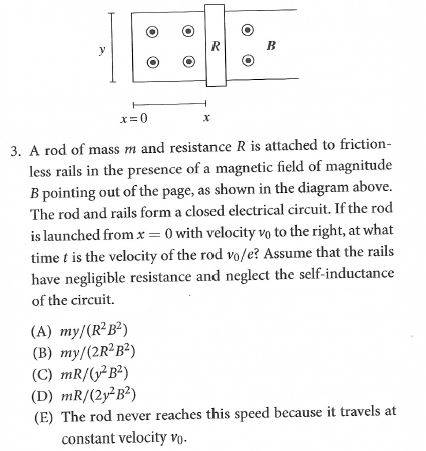
problem.JPG

And here is the solution from the book:
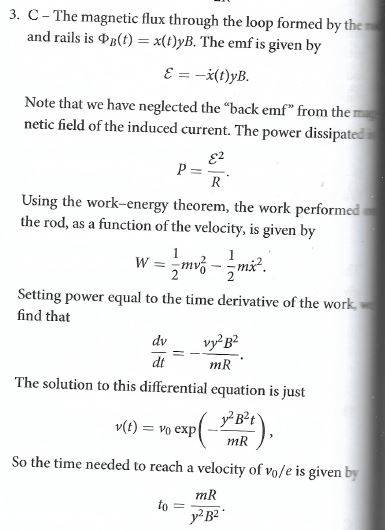
solution.JPG

The point of confusion for me is that they use the work-energy theorem in the form W = Tinitial - Tfinal, instead of the other way around. If I were to do this problem, I would write W = Tfinal - Tinitial, but then I end up with a negative time, which does not make sense. What am I missing?
 
Physics news on Phys.org
You are right that the work performed on the rod should be ##W = \dfrac 1 2 m \dot x^2 - \dfrac 1 2 m \dot x_0^2##. So, the text has a sign error here.

But ##P = \mathcal{E}^2/R## gives the rate at which KE of the rod is transformed into Joule heat in ##R##. So, ##P## equals the rate of loss of KE of the rod. Thus, ##P = -\dfrac {d}{dt} (KE)_{\rm rod}= - \dfrac {dW} {dt}##. So, the text has an additional sign error here that compensates for the first error.

The print in the margin of the image is blurred, so I'm assuming ##W## is the work done on the rod.
 
Last edited:
Thanks a lot! I constantly run into problems with minus signs. I think they make up 98% of all the mistakes that I make. It's very frustrating. And yes, the text says "the work performed on the rod". Sorry about the bad quality of the scan. I scanned the page several times and this is the best that I could do.
 
  • Like
Likes   Reactions: TSny

Similar threads

  • · Replies 8 ·
Replies
8
Views
2K
  • · Replies 1 ·
Replies
1
Views
3K
  • · Replies 11 ·
Replies
11
Views
5K
  • · Replies 3 ·
Replies
3
Views
2K
  • · Replies 18 ·
Replies
18
Views
2K
Replies
4
Views
2K
  • · Replies 1 ·
Replies
1
Views
2K
  • · Replies 3 ·
Replies
3
Views
2K
  • · Replies 77 ·
3
Replies
77
Views
5K
  • · Replies 21 ·
Replies
21
Views
3K