Gravitational Force OR Angular Momentum

Click For Summary
SUMMARY

The discussion centers on calculating the retarding force on a planet of mass M and radius R moving slowly through a dust cloud of density ρ. One participant proposes using the gravitational force formula, resulting in a force of \(-\frac{4GM\rho\pi R}{3}\). Others suggest an angular momentum approach, arguing that the planet interacts with dust particles not just in its immediate path but also those nearby. The complexity of the problem is acknowledged, highlighting the necessity for numerical simulations due to the absence of an analytic solution for gravitational interactions involving multiple bodies, known as the three-body problem.

PREREQUISITES
  • Understanding of gravitational force calculations
  • Familiarity with angular momentum concepts
  • Knowledge of numerical simulation techniques
  • Basic grasp of the three-body problem in physics
NEXT STEPS
  • Study gravitational force equations in multi-body systems
  • Learn about angular momentum conservation in astrophysical contexts
  • Explore numerical methods for simulating gravitational interactions
  • Investigate the three-body problem and its implications in celestial mechanics
USEFUL FOR

Physics students, astrophysicists, and computational scientists interested in gravitational dynamics and numerical simulations of celestial bodies.

mateomy
Messages
305
Reaction score
0
My classmates and I are having a debate on how to solve the following problem. We are told that (and this has been posted on this message board before) that a planet of mass M and radius R is moving SLOWLY through a dust cloud of density (rho). Some of the particles will be attracted to the planet. Find the retarding force on the planet from the dust particles.

I think that if you set up a typical gravitational force problem and solve the smaller mass in terms of the mass of the dust you get something as such:

[tex] \frac{-4GM\rho\pi R}{3}[/tex]

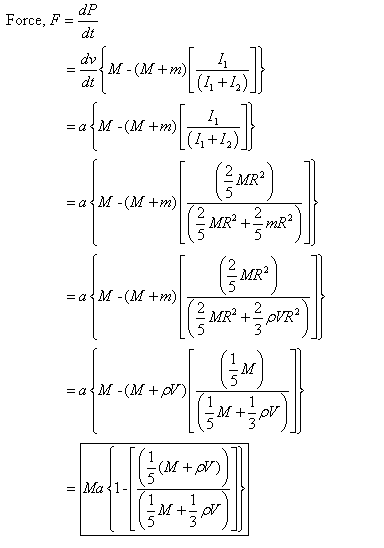
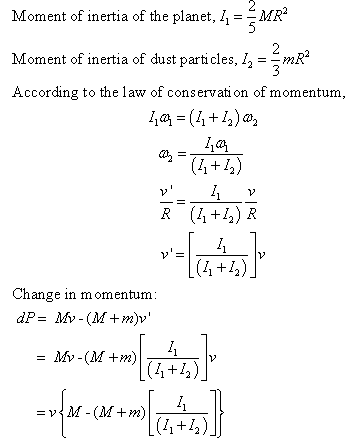
On the other hand a few of the others think that it can be solved using angular momentum….as so:
ScreenShot2011-08-02at103539PM.png


Adding…

ScreenShot2011-08-02at103551PM.png


The argument against my idea is that it only treats the planet as if it were going through a cylinder picking up what was only directly in front of it. I don't see that validity in that argument. Can anybody put in a fresh word on the subject? Please?
 
Physics news on Phys.org
It's an interesting concept. The planet will pick up all of the dust in its path, plus that which is near enough to it that it can be accelerated into the surface before the forward speed of the planet takes it out of reach. But in addition to this, the entire field of particles will be set into motion, accelerated towards the planet, and all left drifting in its wake (each dust particle left with a component of its velocity in the direction of motion of the planet). The planet will lose momentum as it accelerates even distant dust particles.

I think the maths is beyond me., though I can see it will involve an integration from 0 to infinity. :smile:
 
I guess the most correct way to solve this problem would be to simulate billions of tiny dust particles, and to get the acceleration of each particle, you must calculate the gravitational force due to all other dust particles and the planet, and then there's also the contact force with other dust particles.
This would take a lot of computer power though :)

There's no analytic solution to the problem of gravity between 3 or more objects - its called the 3-body problem (in this case there's a lot more than 3). So to solve, you must find the acceleration on all objects, and numerically calculate what happens for each time step
 

Similar threads

  • · Replies 1 ·
Replies
1
Views
2K
  • · Replies 5 ·
Replies
5
Views
2K
Replies
23
Views
2K
Replies
5
Views
3K
  • · Replies 8 ·
Replies
8
Views
2K
  • · Replies 4 ·
Replies
4
Views
2K
Replies
3
Views
1K
Replies
13
Views
2K
Replies
10
Views
3K
  • · Replies 10 ·
Replies
10
Views
2K