Help Understanding a Quantum Circuit Identity

Click For Summary
SUMMARY

The discussion centers on the quantum circuit identity for converting a controlled U gate into a series of CNOT gates and single qubit gates, represented by the equation U = AXA†X, where A is a unitary matrix. Participants emphasize the practicality of using simpler single qubit operations and CNOT gates instead of directly implementing the controlled U gate. The identity allows for the transformation of a 4x4 controlled U matrix into a combination of two CNOTs and two single-qubit operations, maintaining the same quantum state. Understanding the definition of the unitary matrix A is crucial for achieving the desired outcome with the controlled U gate.

PREREQUISITES
  • Quantum mechanics fundamentals
  • Understanding of unitary matrices
  • Familiarity with CNOT gates
  • Basic knowledge of quantum circuit design
NEXT STEPS
  • Study the properties of unitary matrices in quantum mechanics
  • Learn about the implementation of CNOT gates in quantum circuits
  • Explore the derivation and applications of controlled gates in quantum computing
  • Investigate the use of single-qubit operations in quantum algorithms
USEFUL FOR

Quantum computing enthusiasts, researchers in quantum mechanics, and practitioners designing quantum circuits who seek to optimize the implementation of controlled gates using simpler operations.

CMJ96
Messages
50
Reaction score
0
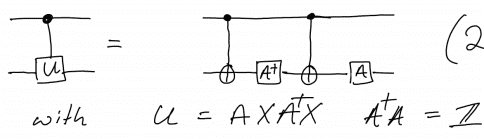
Hello I have the following quantum circuit identity for converting a controlled U gate (4x4 matrix) into a series of CNOT gates and single qubit gates
$$ U= AXA^{\dagger}X$$
where A is a unitary matrix.
Here is a picture of the mentioned identity.
hCYpzW8.png

Can someone help me understand conceptually what is going on here? How do you actually define A?
 

Attachments

  • hCYpzW8.png
    hCYpzW8.png
    6.5 KB · Views: 1,044
Physics news on Phys.org
CMJ96 said:
Can someone help me understand conceptually what is going on here?
The idea is to use a CNOT gate and single qubit operations instead of trying to implement the controlled U. Single qubit operations are simpler to do in real experiments, so that the focus is to implement a CNOT gate and try to use it as much as possible. As you see, the price to pay is that you have to perform two CNOTs and two single-qubit operations instead of a single operation.

CMJ96 said:
How do you actually define A?
Depends on what you want U to achieve. The idea is to find the A that allows you to end up in the same state as with the controlled U gate.
 
So when A is introduced, would it be another 4x4 unitary matrix (assuming the control U gate is a 4x4 matrix)?
 
CMJ96 said:
So when A is introduced, would it be another 4x4 unitary matrix (assuming the control U gate is a 4x4 matrix)?
From ##U= AXA^{\dagger}X##, you see that ##U## and ##A## have the same dimension. You can look at the action of ##U## and ##A## on the lower qubit only, in which case they are 2x2 matrices, but if you want the full controlled gate, which has to be a two-qubit operator, then you have to write them as a 4x4 matrices.
 
  • Like
Likes   Reactions: CMJ96
Hi I've gone away and had a think about this, and now I feel I understand what is happening pretty well, however I'm still struggling with applying it.
$$
\begin{bmatrix}
1 & 0 & 0 & 0 \\
0 & 1 & 0 & 0 \\
0 & 0 & \frac{\sqrt{3}}{2} & \frac{-1}{2} \\
0 & 0 & \frac{1}{2} & \frac{\sqrt{3}}{2}
\end{bmatrix}
$$
Is it appropriate to be using the aforementioned circuit identity to write this controlled U as single qubit gates and CNOT's? I have been trying for a while now to figure out what unitary matrix fits into the equation for A and can't quite get it
 
Last edited:
CMJ96 said:
Hi I've gone away and had a think about this, and now I feel I understand what is happening pretty well, however I'm still struggling with applying it.
$$
\begin{bmatrix}
1 & 0 & 0 & 0 \\
0 & 1 & 0 & 0 \\
0 & 0 & \frac{\sqrt{3}}{2} & \frac{-1}{2} \\
0 & 0 & \frac{1}{2} & \frac{\sqrt{3}}{2}
\end{bmatrix}
$$
What basis are you using for the matrix representation? What matrix is that supposed to be? What is the U you are trying to apply to the second qubit?
 

Similar threads

  • · Replies 6 ·
Replies
6
Views
2K
  • · Replies 3 ·
Replies
3
Views
2K
  • · Replies 8 ·
Replies
8
Views
3K
  • · Replies 1 ·
Replies
1
Views
1K
  • · Replies 1 ·
Replies
1
Views
1K
  • · Replies 5 ·
Replies
5
Views
2K
  • · Replies 16 ·
Replies
16
Views
4K
  • · Replies 2 ·
Replies
2
Views
2K
  • · Replies 1 ·
Replies
1
Views
2K
Replies
1
Views
2K