Help understanding this asynchronous sequential circuit please

  • Context: Engineering 
  • Thread starter Thread starter momentum
  • Start date Start date
  • Tags Tags
    Asynchronous Circuit
Click For Summary

Discussion Overview

The discussion revolves around understanding a sequence transition graph related to an asynchronous sequential circuit. Participants are examining discrepancies between a state diagram and a state transition table provided in a textbook, raising questions about the correctness of specific state labels and transitions.

Discussion Character

  • Debate/contested
  • Technical explanation
  • Conceptual clarification

Main Points Raised

  • One participant questions whether the state labeled "E" in the transition table should actually be "F," based on their interpretation of the state diagram.
  • Another participant argues that the statement regarding sequential behavior cannot be simplified and suggests that waveforms should be drawn to illustrate the states.
  • Several participants express confusion over the definitions of the "present state" letters (A, B, C, etc.) and what they represent in the context of the transitions.
  • One participant notes conflicts between the state diagram and the state transition table, suggesting they may pertain to different problems.
  • Another participant suspects a printing mistake in the state transition table, asserting that the table shows transitions that do not align with the state diagram.
  • A participant mentions that the notation in the table is unclear, particularly regarding the meaning of "-,-" and how it relates to the transitions.

Areas of Agreement / Disagreement

Participants do not reach a consensus on the correctness of the state labels or the transitions. Multiple competing views remain regarding the interpretation of the state diagram and the transition table, as well as the presence of potential errors in the textbook.

Contextual Notes

There are unresolved questions about the definitions of the state labels and the notation used in the transition table. Participants have not fully matched the descriptions of the system to the diagram or table, leaving ambiguity in understanding the relationships between them.

momentum
Messages
111
Reaction score
0
Homework Statement
fundamental mode circuit
Relevant Equations
NA
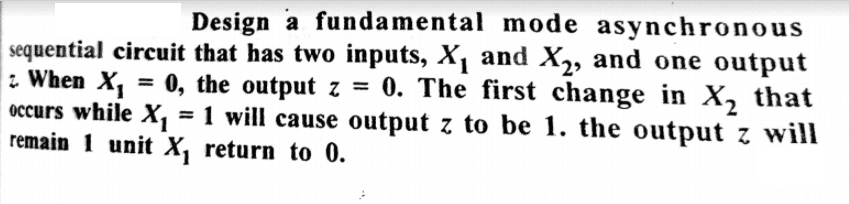
I am finding difficulty in understanding the sequence transition graph
EGpCtQv.png


My Book has given solution like this

cLw4UUM.png


Question : I have marked red circle in the above table. ...book has given E but I think it should be F ...What is correct here E or F ?

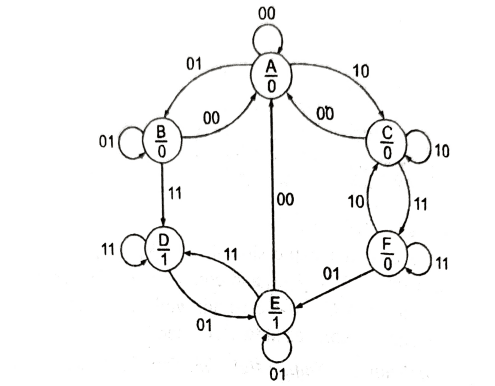
Here is the state diagram given in the book
P2oqvJ4.png
 
Last edited:
Physics news on Phys.org
I don't see how statement #2 can be simplified. It is a very straight-forward description of sequential behavior.

Perhaps you are confused because one can't do a simple truth table for states in sequential transitions. Those are for static circuits where sequencing doesn't enter into it. In this case you'll have to draw waveforms (squarewaves) showing the various possible states.
 
phinds said:
It is a very straight-forward description of sequential behavior.

I have edited my question and defined the problem area now. Could you please take a look at it again ?
 
momentum said:
I have edited my question and defined the problem area now. Could you please take a look at it again ?
And do what?

EDIT: Oh, sorry. I see there IS a question in there.
 
phinds said:
And do what?

I have marked red circle in the above table. ...book has given E but I think it should be F ...What is correct here E or F ?
 
I don't see any definition of what those "present state" letters stand for
 
phinds said:
I don't see any definition of what those "present state" letters stand for
A,B,C etc...these are just usual transitions states.
 
momentum said:
A,B,C etc...these are just usual transitions states.
Sorry, I don't have no idea what that means, "usual transition" states. How are they defined? What, for example, is "present state C" ?
 
phinds said:
Sorry, I don't have no idea what that means, "usual transition" states.

No problem. I'll figure out the solution. thanks
 
Last edited:
  • #10
Yes, there are conflicts between the state diagram and the state transition table. It looks like they are for different problems?
 
  • Like
Likes   Reactions: berkeman
  • #11
DaveE said:
Yes, there are conflicts between the state diagram and the state transition table. It looks like they are for different problems?

I suspect that this is a printing mistake in state transition table. Can you please confirm this ?

my book shows E (red circle) in the table but I think it should be F ( as per the state diagram).

I am fine with the state transition diagram.

It seems book has printed mistakenly E ( instead of F) in the table... right ?
 
  • #12
momentum said:
I suspect that this is a printing mistake in state transition table. Can you please confirm this ?

my book shows E (red circle) in the table but I think it should be F ( as per the state diagram).

I am fine with the state transition diagram.

It seems book has printed mistakenly E ( instead of F) in the table... right ?
I suppose yes, but there are other discrepancies in addition to that. I'm not too motivated to find all of the errors. Frankly it is easier to just make the correct table from the diagram (or vice-versa) than it is to analyze how someone else did it wrong.

What I haven't done is match either the diagram or the table up to the words, I suspect that would be the best approach. You have three descriptions of the system, and I know two don't agree.
 
  • #13
The table shows direct transitions C→E, D→C, E→C, F→A, and F→D. None of these are shown in the state diagram.

I guess "-,-" in the table means you are suppose to fill those in? Otherwise, I don't understand that notation.
 

Similar threads

  • · Replies 3 ·
Replies
3
Views
2K
  • · Replies 59 ·
2
Replies
59
Views
5K
  • · Replies 31 ·
2
Replies
31
Views
4K
  • · Replies 8 ·
Replies
8
Views
2K
  • · Replies 10 ·
Replies
10
Views
4K
  • · Replies 3 ·
Replies
3
Views
2K
  • · Replies 1 ·
Replies
1
Views
2K
Replies
5
Views
2K
  • · Replies 12 ·
Replies
12
Views
2K
Replies
5
Views
4K