Help with relaxation oscillator

  • Thread starter Thread starter JFS321
  • Start date Start date
  • Tags Tags
    Oscillator
Click For Summary

Discussion Overview

The discussion centers around the functioning of a capacitive relaxation oscillator, particularly focusing on the behavior of the neon bulb within the circuit. Participants explore the charging dynamics of the capacitor, the role of the neon bulb, and the overall oscillation process.

Discussion Character

  • Technical explanation
  • Conceptual clarification
  • Debate/contested

Main Points Raised

  • One participant expresses confusion about why the lamp does not light instantly despite being in parallel with the capacitor.
  • Another participant explains that the neon bulb has a minimum strike voltage, which must be reached by the capacitor before it can conduct, leading to a cycle of charging and discharging.
  • A participant suggests that the capacitor acts like a voltage sink, preventing the battery voltage from reaching the bulb initially.
  • Further clarification is provided that at the start, the capacitor behaves like a short circuit, and the voltage across it rises until it reaches the neon bulb's threshold voltage.
  • One participant identifies the relaxation circuit as a negative resistance oscillator, referencing the operational characteristics of the neon bulb.
  • A later post mentions a semiconductor component, the DIAC, which behaves similarly but lacks the visual effect of the neon bulb.

Areas of Agreement / Disagreement

Participants present multiple viewpoints on the operation of the circuit, with some clarifying aspects of the capacitor's behavior while others introduce different components and their characteristics. The discussion remains unresolved regarding the nuances of the circuit's operation.

Contextual Notes

Participants discuss the capacitor's charging time and the threshold voltage of the neon bulb, but there are no explicit resolutions to the assumptions or conditions affecting these behaviors.

JFS321
Messages
75
Reaction score
6
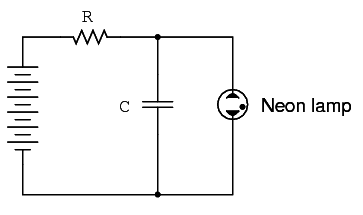
All, I am confused as to exactly how the capacitive relaxation oscillator works.
upload_2015-2-22_18-37-10.png

From the diagram above: Because the lamp is in parallel, why is it not immediately receiving the voltage necessary to light instantly? Thanks.
 
Engineering news on Phys.org
hi there

The neon globe has a minimum strike voltage ... let's say ~ 80V ( 75 - 90V common)
This is the neon's threshold voltage. That voltage will only be reached when the capacitor is charged to that threshold voltage
The neon will then conduct with a flash of light and the voltage across the capacitor will drop to well below the threshold voltage.
The capacitor will then start charging again till that voltage is reached and the neon then discharges again.
this cycle continues on and on ...

The cap doesn't charge instantly ( or near) because of the series resistor limiting current to the capacitor causing it to take time to charge
but when threshold is reached it discharges almost instantly ... ie. it oscillates with a sawtooth pattern

cheers
Dave
 
Ahhh ok...so a capacitor acts like a voltage sink of sorts...instead of this being like a regular parallel circuit, the voltage across both legs is initially zero because the capacitor must first charge? Or maybe to reword, the battery voltage does not initially reach the bulb because it is being taken by the capacitor? Thanks-
 
  • Like
Likes   Reactions: davenn
Yes, initially, at time T=0, the capacitor "looks" like a short circuit, charge is flowing onto one plate and out of the other plate
as the charge builds up, the voltage potential difference across the capacitor also does. Only when that voltage potential equals the
discharge ( threshold ) voltage of the neon globe will current flow across the gap in the neon

JFS321 said:
Or maybe to reword, the battery voltage does not initially reach the bulb because it is being taken by the capacitor? Thanks-

The same voltage that is across the capacitor is also across the neon globe, from the time the capacitor starts charging,
that voltage slowly rises as the capacitor charges up
have a look at this ...

relaxation oscillation.jpg
cheers
Dave
 
The Neon bulb (gas discharge tube) relaxation circuit is a negative resistance oscillator.
350px-Neon_bulb_relaxation_oscillator_hysteresis_curve.svg.png


The operational voltage and currents are normally designed to be in the unstable portion of the bulbs VI curve.
http://www.g3ynh.info/disch_tube/intro.html
 
Thank you.
 
Curiously, there is a semiconductor component that behaves like this, the DIAC.
http://en.wikipedia.org/wiki/DIAC

Unfortunately, it lakes the charming flash-flash-flash of the neon bulb.
 

Similar threads

Replies
36
Views
4K
  • · Replies 14 ·
Replies
14
Views
2K
  • · Replies 41 ·
2
Replies
41
Views
8K
  • · Replies 2 ·
Replies
2
Views
2K
  • · Replies 27 ·
Replies
27
Views
3K
  • · Replies 6 ·
Replies
6
Views
2K
  • · Replies 43 ·
2
Replies
43
Views
9K
  • · Replies 3 ·
Replies
3
Views
3K
Replies
1
Views
2K
  • · Replies 31 ·
2
Replies
31
Views
5K