Thecat123
- 5
- 3
- TL;DR
- Ive spent hours troubleshooting and looking at the motors of my peers to find the culprit to no avail. Wont even get going even though there is a current and the commutator timings are on point. Absolutely clueless, any suggestions considered.
Possible problems that ive already hopefully solved:
.The commutator timings which previously prevented the motor from turning
.The coils are both wrapped in the same direction, continuously wound turns
.short circuits due to the brushes(Paper clips in this case) touching both split rings
.strength of magnets(ive tried both large ferrite magnets and smaller neodymium magnets with smaller surface area)
.Friction has been minimised
Possible issues from my perspective:
.too few turns on coils(50 each side)
.wire too thin(0.3mm) hence too much resistance(the coils get very hot very quickly)
.iron core too heavy/too little torque
.too little voltage(ive tried both 6volt supply and 9volt)
.magnets pulling on iron core preventing spinning(armature getting stuck by permanent magnetic field)
Other things which may be a factor:
Ive cut the iron core into 3 pieces(insulated with tape) trying to reduce eddy current, which may have made the iron core too small and fat increasing its inertial mass, hence too difficult for the induced magnetic field to move. Just a thought.
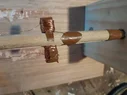
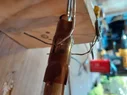
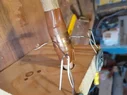
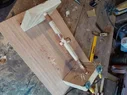
Ive included the pictures below as references:
.The commutator timings which previously prevented the motor from turning
.The coils are both wrapped in the same direction, continuously wound turns
.short circuits due to the brushes(Paper clips in this case) touching both split rings
.strength of magnets(ive tried both large ferrite magnets and smaller neodymium magnets with smaller surface area)
.Friction has been minimised
Possible issues from my perspective:
.too few turns on coils(50 each side)
.wire too thin(0.3mm) hence too much resistance(the coils get very hot very quickly)
.iron core too heavy/too little torque
.too little voltage(ive tried both 6volt supply and 9volt)
.magnets pulling on iron core preventing spinning(armature getting stuck by permanent magnetic field)
Other things which may be a factor:
Ive cut the iron core into 3 pieces(insulated with tape) trying to reduce eddy current, which may have made the iron core too small and fat increasing its inertial mass, hence too difficult for the induced magnetic field to move. Just a thought.
Ive included the pictures below as references:
 , proper stator connection and I used 12volts power supply. Made it move but still some improvements to make!