wannab said:
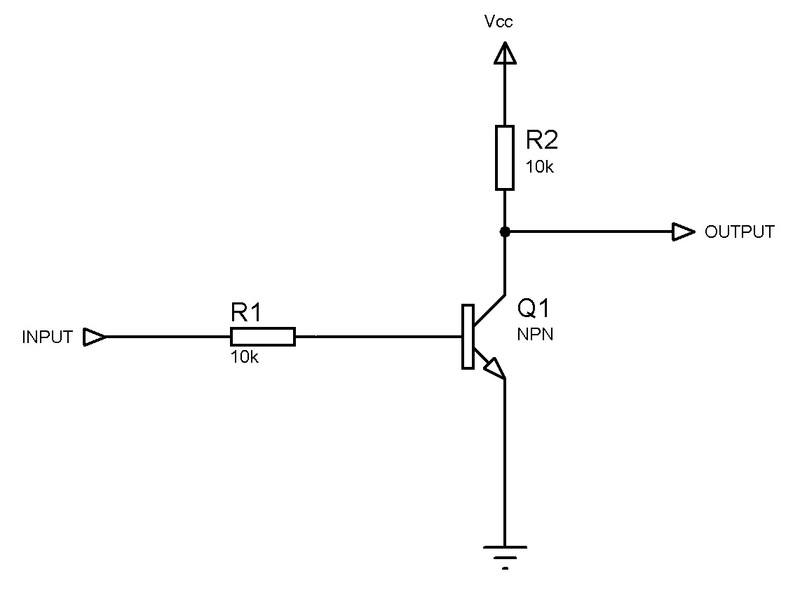
Because the electricity has no incentive to flow to ground, it will always take the shortest route which will either be to the output or the ground depending on the resistances and lengths of the wires. By putting a resistor at the output I'm ensuring that the current will flow to ground once the base of the transistor is active.
First of all, in this circuit, there is nothing connected to the output (it is open) so current can't go that way anyway. But even if there were a load connected to the output, you are suffering from a common misconception. Current always splits up and takes
all paths to ground. The amount of current on each path is inversely proportional to the resistance of that path. What we mean when we say that "current takes the path of least resistance" is that, if there is one path whose resistance is drastically lower than any of the others, then the vast majority of the current will take that path and not the others.
Second, the reason why your circuit doesn't work is as follows. In this regime, the transistor acts somewhat like a switch. If the base voltage is low, there will be no connection between the collector and emitter: the transistor does not conduct. If the base voltage is high, the transistor conducts between collector and emitter. It acts kind of like a switch. In fact, to see what's going on conceptually, you could just replace the BJT with a switch that is closed when Vin is high, and open when Vin is low, So, in your version of the circuit, where you have no resistor between Vcc and the collector, when the transistor conducts, it's like the switch closes, connecting Vcc directly to ground through a negligible resistance. You've shorted your power supply. So, a tremendous amount of current will be drawn. Can you see why this is a tremendously bad idea, as phinds already alluded to? EDIT: Also at that point, your resistor R2 actually does nothing at all, because it has literally been shorted out of the circuit.