How is the orientation of EM waves related to the wavelength and antenna height?

Click For Summary

Discussion Overview

The discussion revolves around the relationship between the orientation of electromagnetic (EM) waves, their wavelength, and the height of antennas. Participants explore concepts related to wave propagation, antenna design, and the implications of wavelength on various phenomena, including the behavior of lasers and radio waves.

Discussion Character

  • Exploratory
  • Technical explanation
  • Debate/contested
  • Mathematical reasoning

Main Points Raised

  • Some participants express confusion regarding the visualization of EM waves in relation to antenna height, noting that the wave's path is oriented 90 degrees to the antenna.
  • It is suggested that the wave depicted in a video may represent a standing wave within the antenna, which induces oscillating electric and magnetic fields in space.
  • Some participants mention that not all antennas are full wave; they can also be half-wave or quarter-wave, affecting their design and function.
  • One participant discusses the relationship between wavelength and the ability of waves to pass through holes, referencing the process in DVDs and the need for shorter wavelengths for higher storage capacity.
  • Another participant describes the concept of polarization, noting that the orientation of the EM waves can vary and that the energy of the wave is primarily aligned with the horizontal orientation.
  • Mathematical representations of EM wave behavior are introduced, including references to the Hertzian dipole radiation and the nature of transverse waves.
  • There is a discussion about the amplitude of waves at different angles and how this affects the reception of signals by antennas.

Areas of Agreement / Disagreement

Participants express various viewpoints and uncertainties regarding the relationship between antenna height, wavelength, and wave orientation. No consensus is reached, and multiple competing views remain throughout the discussion.

Contextual Notes

Participants highlight limitations in understanding the visualizations of EM waves and the assumptions underlying the relationship between wavelength and antenna design. There are unresolved questions regarding the implications of polarization and the behavior of waves in different contexts.

Daniel Petka
Messages
147
Reaction score
16
A while ago, I saw an explanation of radio waves. Overall, it's a decent vid. I bumped into some nasty problems.
IMG_9551.JPG


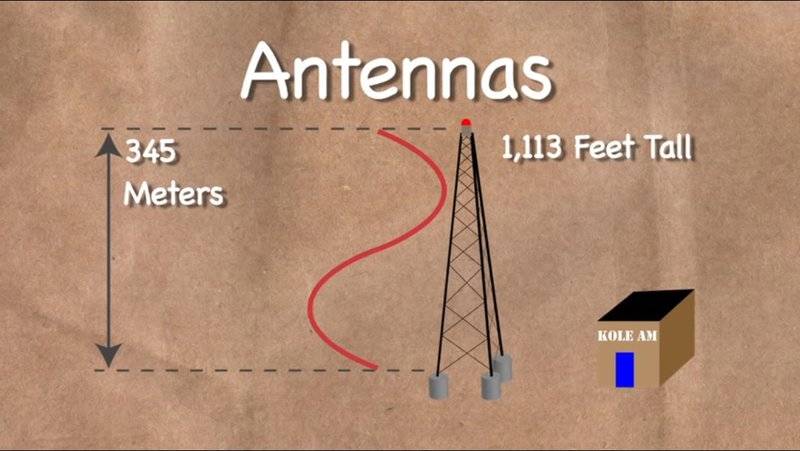
Basically, the image shows that the wavelength of a EM-wave corresponds to the height of the antenna. The visualisation however can't be right since the wave cannot go upwards- the wave's path is oriented 90 degrees to the antenna. So... How.. How the heck should I combine these statements?!
It just keeps bugging me to figure out the right image of a EM wave cause it's extremely counter intuitive and I can't find anything on the net.

This wasn't the first time I came across this problem. Remember the process in a DVD? The red laser passes through holes. It cannon pass holes smaller than its wavelength (hole~antenna). Thus, you need a shorter wavelength- for example violet with 405nm in a BluRay.

Again I have trouble with this phenomenon. Please show me some useable sources if you've found some.
 
Physics news on Phys.org
Do you have the link for this video? The wave that they are depicting, is the standing wave inside the antenna. This will induce an oscillating wave of changing electric and magnetic fields in space (outside the antenna). Not all antennas are full wave. Some are half-wave or quarter wave. You may find the following guide, useful. http://www.phy.davidson.edu/instrum...opagation Transmission Lines and Antennas.pdf

There is a whole series of books that the Navy has published, on different electrical/electronic topics. They are available to the public. One of the places who hosts them is Davidson College. http://www.phy.davidson.edu/instrumentation/NEETS.htm
 
Daniel Petka said:
A while ago, I saw an explanation of radio waves. Overall, it's a decent vid. I bumped into some nasty problems.

View attachment 208574

Basically, the image shows that the wavelength of a EM-wave corresponds to the height of the antenna. The visualisation however can't be right since the wave cannot go upwards- the wave's path is oriented 90 degrees to the antenna. So... How.. How the heck should I combine these statements?!
It just keeps bugging me to figure out the right image of a EM wave cause it's extremely counter intuitive and I can't find anything on the net.

This wasn't the first time I came across this problem. Remember the process in a DVD? The red laser passes through holes. It cannon pass holes smaller than its wavelength (hole~antenna). Thus, you need a shorter wavelength- for example violet with 405nm in a BluRay.

Again I have trouble with this phenomenon. Please show me some useable sources if you've found some.
To produce radiation, we need to make electrons accelerate back and forth, as in a wire carrying high frequency AC. Then the maximum radiation takes place at right angles to the wire. The wire represents the antenna tower, and we can get the best effect by making the tower a resonant (or tuned) length, like an organ pipe. This usually means it will be a quarter or half a wavelength in length, so that a transmission line type of resonance occurs on the radiating conductor. This makes it easy to give the electrons high acceleration.
 
  • Like
Likes   Reactions: scottdave
Daniel Petka said:
It just keeps bugging me to figure out the right image of a EM wave cause it's extremely counter intuitive and I can't find anything on the net.

From wikipedia's article on radio antennas:

Felder_um_Dipol.jpg


This represents a slice of the E and B fields emanating from a dipole antenna. Rotate the E field by 180 degrees about the vertical axis of the antenna so that it forms a spherical shape and you'll have an idea of what the expanding wavefront looks like. The next image shows how the wavefront propagates over time (hopefully it animates correctly).

310px-Dipole_xmting_antenna_animation_4_408x318x150ms.gif


The orientation of the EM waves (polarization) is vertical in this case, as the field lines are vertically oriented.

Daniel Petka said:
This wasn't the first time I came across this problem. Remember the process in a DVD? The red laser passes through holes. It cannon pass holes smaller than its wavelength (hole~antenna). Thus, you need a shorter wavelength- for example violet with 405nm in a BluRay.

That's a different issue. The size of the spot that you can focus a laser down to ultimately depends on the wavelength. A shorter wavelength (plus a few other changes) allows you to make the spot size smaller and to fit more pits onto a DVD, increasing the storage capacity. Given a hole of some arbitrary size, an EM wave of any wavelength can pass through. The smaller the wavelength, the better the wave passes through (higher amplitude after passing through to the other side).
See here: https://en.wikipedia.org/wiki/Blu-ray#Laser_and_optics
 
  • Like
Likes   Reactions: davenn, vanhees71 and scottdave
Daniel Petka said:
Basically, the image shows that the wavelength of a EM-wave corresponds to the height of the antenna.

and that is what they are showing you ... that antenna happens to be a wavelength long
it is NOT showing your the radiation pattern from the antenna
@Drakkith 's post has a really good animation for that

Daniel Petka said:
The visualisation however can't be right since the wave cannot go upwards- the wave's path is oriented 90 degrees to the antenna. So... How.. How the heck should I combine these statements?!

well waves can go up if the antenna is a horizontal one and not a vertical one :smile:
But again ... refer to my first comment
 
  • Like
Likes   Reactions: scottdave
Drakkith said:
The orientation of the EM waves (polarization) is vertical in this case, as the field lines are vertically oriented.
I notice that the polarisation is not entirely vertical in your diagram. At the top and bottom of your loops the arrows point radially towards or away from the source. How does this work for a transverse wave?
 
The most simple harmonic solution of the free Maxwell equations is the Hertzian dipole radiation. The vector potential is given by
$$\vec{A}(t,\vec{x})=-\frac{\mathrm{i} \omega}{4 \pi r c} \vec{p} \exp \left [\frac{\mathrm{i} \omega}{c} (r-c t) \right].$$
Then you get
$$\vec{B}=\vec{\nabla} \times \vec{A}, \quad \vec{E}=\frac{\mathrm{i} c}{\omega} \vec{\nabla} \times \vec{B}.$$
You'll see that both the electric and magnetic field are transverse, i.e., ##\vec{\nabla} \cdot \vec{E}=\vec{\nabla} \cdot \vec{B}=0##.

Note that it is not a plane but a spherical wave! Only in the far-field region, i.e., ##r \gg \lambda##, the fields are locally nearly plane waves moving radially out from the place of the dipole, and indeed in this region ##\vec{x} \cdot \vec{E}=\vec{x} \cdot \vec{B} \simeq 0##.

At least qualitatively the field looks like shown in #4.
 
tech99 said:
I notice that the polarisation is not entirely vertical in your diagram. At the top and bottom of your loops the arrows point radially towards or away from the source.

True, but the amplitude of the wave at this angle is extremely low. Most of the energy of the wave lies closer to the horizontal and a receiver oriented such that it responds maximally to vertically polarized EM waves (such as an identical antenna to the transmitter) would show the highest amplitude when oriented vertically. Twisting it 90 degrees would cause the receiver to read nearly zero amplitude.

Technically I suppose calling the wave "vertically polarized" assumes the receiver is placed near to the horizontal and is in reference to the Earth's surface. A satellite receiving a signal would be free to call its polarization anything it wants since there is no horizontal or vertical in space.
 
scottdave said:
Do you have the link for this video? The wave that they are depicting, is the standing wave inside the antenna. This will induce an oscillating wave of changing electric and magnetic fields in space (outside the antenna). Not all antennas are full wave. Some are half-wave or quarter wave. You may find the following guide, useful. http://www.phy.davidson.edu/instrum...opagation Transmission Lines and Antennas.pdf

There is a whole series of books that the Navy has published, on different electrical/electronic topics. They are available to the public. One of the places who hosts them is Davidson College. http://www.phy.davidson.edu/instrumentation/NEETS.htm

Of course
 
  • #10
[QUOTE="Drakkith, post: 5818370, member:

The smaller the wavelength, the better the wave passes through (higher amplitude after passing through to the other side).

Higher amplitude = more energy ... how the heck is that possible? Did you mean the probability amplitude?

Btw thanks for help, Drakkith
See here: https://en.wikipedia.org/wiki/Blu-ray#Laser_and_optics[/QUOTE]
 
  • #11
Daniel Petka said:
Higher amplitude = more energy ... how the heck is that possible? Did you mean the probability amplitude?

No, we're talking about classical EM here, not quantum EM, so there are no probability amplitudes. When the wavefront impinges on the surface containing the hole, part of the energy of the wave is absorbed or reflected and part is transferred through the hole to the other side. If the wavelength of the wave is much larger than the size of the hole, then very little of the wave makes it through. The wave acts as if the hole almost doesn't exist. If the wavelength is roughly the the size of the hole or smaller, then the section of the wavefront at the hole passes through with almost no loss of energy. Note that the size of the wavefront is not equal to the wavelength of the wave.
 
  • #12
vanhees71 said:
The most simple harmonic solution of the free Maxwell equations is the Hertzian dipole radiation. The vector potential is given by
$$\vec{A}(t,\vec{x})=-\frac{\mathrm{i} \omega}{4 \pi r c} \vec{p} \exp \left [\frac{\mathrm{i} \omega}{c} (r-c t) \right].$$
Then you get
$$\vec{B}=\vec{\nabla} \times \vec{A}, \quad \vec{E}=\frac{\mathrm{i} c}{\omega} \vec{\nabla} \times \vec{B}.$$
You'll see that both the electric and magnetic field are transverse, i.e., ##\vec{\nabla} \cdot \vec{E}=\vec{\nabla} \cdot \vec{B}=0##.

Note that it is not a plane but a spherical wave! Only in the far-field region, i.e., ##r \gg \lambda##, the fields are locally nearly plane waves moving radially out from the place of the dipole, and indeed in this region ##\vec{x} \cdot \vec{E}=\vec{x} \cdot \vec{B} \simeq 0##.

At least qualitatively the field looks like shown in #4.
vanhees71 said:
The most simple harmonic solution of the free Maxwell equations is the Hertzian dipole radiation. The vector potential is given by
$$\vec{A}(t,\vec{x})=-\frac{\mathrm{i} \omega}{4 \pi r c} \vec{p} \exp \left [\frac{\mathrm{i} \omega}{c} (r-c t) \right].$$
Then you get
$$\vec{B}=\vec{\nabla} \times \vec{A}, \quad \vec{E}=\frac{\mathrm{i} c}{\omega} \vec{\nabla} \times \vec{B}.$$
You'll see that both the electric and magnetic field are transverse, i.e., ##\vec{\nabla} \cdot \vec{E}=\vec{\nabla} \cdot \vec{B}=0##.

Note that it is not a plane but a spherical wave! Only in the far-field region, i.e., ##r \gg \lambda##, the fields are locally nearly plane waves moving radially out from the place of the dipole, and indeed in this region ##\vec{x} \cdot \vec{E}=\vec{x} \cdot \vec{B} \simeq 0##.

At least qualitatively the field looks like shown in #4.
If I place a convex lens in the path I can obtain a parallel beam for a certain distance. We have a truly plane wave. So what does the field look like in this parallel beam? If there are no radial components, how are loops obtained?
 
  • #13
tech99 said:
If I place a convex lens in the path I can obtain a parallel beam for a certain distance. We have a truly plane wave. So what does the field look like in this parallel beam? If there are no radial components, how are loops obtained?
Regarding the supposed radial components of an EM wave, it seems unlikely to me that, in the Radiation Far Region, an electron in the path of the wave would execute an elliptical path. I feel sure it simply moves back and forth across the wavefront. Any comments please?
 
  • #14
tech99 said:
If I place a convex lens in the path I can obtain a parallel beam for a certain distance. We have a truly plane wave. So what does the field look like in this parallel beam? If there are no radial components, how are loops obtained?

There is no such thing as a truly plane wave. Even with perfect optics, diffraction will prevent the wave from being perfectly plane. As to what the wave looks like, I cannot say.

tech99 said:
Regarding the supposed radial components of an EM wave, it seems unlikely to me that, in the Radiation Far Region, an electron in the path of the wave would execute an elliptical path. I feel sure it simply moves back and forth across the wavefront. Any comments please?

I haven't taken E&M at this level yet, but I'm curious as to what the magnetic aspect of the wave does to the motion of a free charge.
 
  • #15
Drakkith said:
I haven't taken E&M at this level yet, but I'm curious as to what the magnetic aspect of the wave does to the motion of a free charge.
If, using reciprocity, we look at the transmitting case, it looks as if the radiation arises due to the distortion of the electric field when the electron accelerates. The radiated E-wave will be observed as having an accompanying magnetic field when it passes an observer. I do not know any other mechanism for radiation of a magnetic wave by an accelerating charge, but may be mistaken.
At the receiver, the incoming E-wave will accelerate the electron. This will cause it to radiate an opposing EM wave, which will reduce both the incoming E and H components in the vicinity, as energy is extracted.
 

Similar threads

  • · Replies 33 ·
2
Replies
33
Views
4K
  • · Replies 21 ·
Replies
21
Views
3K
  • · Replies 4 ·
Replies
4
Views
2K
  • · Replies 5 ·
Replies
5
Views
4K
  • · Replies 2 ·
Replies
2
Views
2K
  • · Replies 2 ·
Replies
2
Views
2K
  • · Replies 17 ·
Replies
17
Views
3K
  • · Replies 1 ·
Replies
1
Views
3K
  • · Replies 19 ·
Replies
19
Views
12K
  • · Replies 3 ·
Replies
3
Views
3K