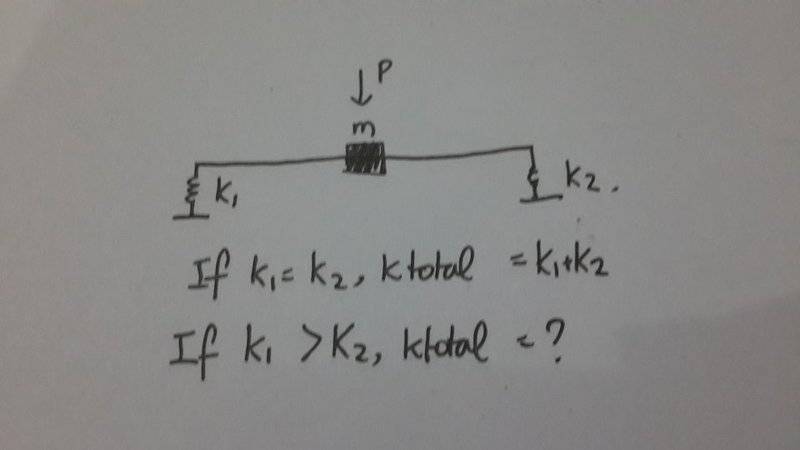
How to find beam spring stiffness coefficient?

Click For Summary

Discussion Overview

The discussion revolves around determining the beam spring stiffness coefficient, focusing on the relationships between forces and displacements in a beam with springs. The scope includes theoretical considerations and mathematical reasoning related to spring constants in a beam system.

Discussion Character

  • Technical explanation, Debate/contested, Mathematical reasoning

Main Points Raised

  • One participant suggests using the relationships Ktotal = F/Δtotal and Δtotal = ½(Δ1 + Δ2) for a general solution, assuming the mass is at mid-span.
  • Another participant questions the assumption that K1 = K2, indicating that the stiffness of the beam should also be considered in the overall stiffness calculation.
  • A participant asserts that the equivalent spring constant Ktot = k1 + k2 applies regardless of the values of k1 or k2, likening the situation to resistors in parallel and series.
  • Another participant disagrees with the parallel springs formula, arguing that the springs will displace differently to maintain equilibrium, suggesting that a unique formula must be derived for this scenario.

Areas of Agreement / Disagreement

Participants express differing views on the application of spring constant formulas, with no consensus reached on the correct approach to calculate the beam spring stiffness coefficient.

Contextual Notes

There are unresolved assumptions regarding the displacement of the springs and the influence of the beam's stiffness on the overall system. The discussion highlights the complexity of deriving a unique formula for the specific configuration presented.

cognosco123
Messages
1
Reaction score
0
The problem is attached.
2015-09-13 22.58.08.jpg
 
Engineering news on Phys.org
I think you can solve it generally using the relationships:
Ktotal =F/Δtotal
Δtotal = ½(Δ1 + Δ2)

assuming the mass is located at mid-span.
 
Last edited:
The statement "If K1 = K2, Ktotal = K1 + K2" implies that there is no flexibility in the beam. The post title suggest that you want the stiffness to reflect the stiffness of the beam as well. Which is it?
 
Daniel Sadlier said:
The equivalent spring constant Ktot = k1 + k2 no matter the values of k1 or k2.
I'll disagree on this. The parallel springs formula assumes that both springs displace the same. Here, however, the springs will displace differently to maintain equilibrium. Therefore, a unique formula needs to be derived.
 

Similar threads

  • · Replies 3 ·
Replies
3
Views
14K
  • · Replies 3 ·
Replies
3
Views
2K
Replies
4
Views
2K
Replies
6
Views
6K
  • · Replies 9 ·
Replies
9
Views
2K
Replies
6
Views
4K
  • · Replies 16 ·
Replies
16
Views
4K
  • · Replies 1 ·
Replies
1
Views
3K
  • · Replies 9 ·
Replies
9
Views
2K
  • · Replies 7 ·
Replies
7
Views
5K