Integral of 1/sqrt(x)exp(-ix) dx using integration by parts

Click For Summary
SUMMARY

The integral of 1/sqrt(x)exp(-ix) dx was evaluated using the Residue Theorem, and the discussion explored the possibility of using integration by parts as an alternative method. The main focus was on determining the convergence of the resulting series when evaluated for n=1. Participants suggested that the series might be expressed as an integral and referenced the use of 2D polar coordinates as a potential technique, although it was acknowledged that this approach could be overly complex. The consensus indicated that if the integral's value is known, the series should converge to that same value, assuming no algebraic errors are present.

PREREQUISITES
  • Understanding of complex analysis, specifically the Residue Theorem.
  • Familiarity with integration techniques, particularly integration by parts.
  • Knowledge of series convergence criteria.
  • Basic concepts of polar coordinates in multi-dimensional calculus.
NEXT STEPS
  • Research the application of the Residue Theorem in evaluating complex integrals.
  • Study integration by parts in the context of complex functions.
  • Explore series convergence tests and their implications for integral evaluations.
  • Learn about the use of polar coordinates in evaluating integrals, particularly in two dimensions.
USEFUL FOR

Mathematicians, physics students, and anyone interested in advanced calculus techniques, particularly those dealing with complex integrals and series convergence.

VVS
Messages
85
Reaction score
0
Hi,

Homework Statement


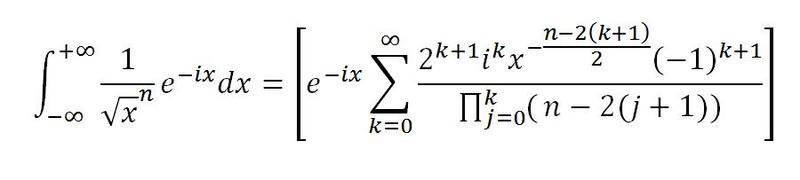
I have already evaluated the integral 1/sqrt(x)exp(-ix) using The Residue Theorem and now I was looking for another method. So I thought of applying integration by parts and I got this attached formula.
integral.jpg


Now I am wondering how to evaluate this series. My first doubt is whether it converges or not.
Actually I just want to evaluate it for n=1.
Does anyone have any ideas? Can this sum be expressed as an integral?


Thank you
 
Physics news on Phys.org
I don't see much hope with that series, but how about applying the 2D polar coordinates trick used to calculate the integral of exp(-x2) from 0 to ∞?
 
Hey,

Yeah I know it is way to complicated.
But one question: If I know the answer of the integral doesn't that mean that that series should converge to that answer?
 
VVS said:
Yeah I know it is way to complicated.
But one question: If I know the answer of the integral doesn't that mean that that series should converge to that answer?
Assuming no algebraic errors, yes. But it could be that the easiest way to sum the series is by reversing the steps to the integral and solving that.
 

Similar threads

  • · Replies 3 ·
Replies
3
Views
2K
Replies
7
Views
2K
  • · Replies 105 ·
4
Replies
105
Views
7K
  • · Replies 14 ·
Replies
14
Views
2K
  • · Replies 3 ·
Replies
3
Views
2K
  • · Replies 44 ·
2
Replies
44
Views
6K
Replies
3
Views
2K
  • · Replies 4 ·
Replies
4
Views
2K
  • · Replies 22 ·
Replies
22
Views
3K
  • · Replies 9 ·
Replies
9
Views
3K