Is the Faulty Velocity Equation for Projectile Launch Valid?

Click For Summary

Discussion Overview

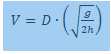
The discussion centers on the validity of a specific equation used to calculate the launch velocity of a projectile from a table, based solely on the horizontal distance traveled and the height of the table, without incorporating time or other velocity variables. The scope includes conceptual understanding and mathematical reasoning related to projectile motion.

Discussion Character

  • Exploratory
  • Technical explanation
  • Debate/contested
  • Mathematical reasoning

Main Points Raised

  • Some participants question the validity of the equation that calculates velocity using only horizontal distance and height, suggesting it seems overly simplistic.
  • There is a discussion about the units of the expression ##\sqrt{g/2h}##, with some participants attempting to clarify what the units represent.
  • One participant provides specific values for height and distance to illustrate the application of the equation.
  • Concerns are raised about the difficulty of measuring time accurately in practical scenarios, which may affect the verification of the equation.
  • Another participant points out that the expression ##\sqrt{g/2h}## actually represents a time component, which relates to the time it takes for an object to fall a distance h.
  • There is a suggestion to test the equation with various values for velocity and height to see if it holds true in specific cases.

Areas of Agreement / Disagreement

Participants express differing views on the equation's validity, with no consensus reached. Some agree on the importance of the time component in the equation, while others remain skeptical about its simplicity and applicability.

Contextual Notes

There are unresolved questions regarding the assumptions made in the equation, particularly the omission of time and other factors typically considered in projectile motion analysis.

Who May Find This Useful

This discussion may be of interest to students and enthusiasts of physics, particularly those exploring projectile motion and the mathematical relationships involved in calculating velocity.

DAB
Messages
6
Reaction score
0
I have seen this equation used to calculate the velocity of a projectile being launched off a table top.
upload_2018-2-24_11-51-5.png
Where D=horizontal distance travelled, h=table height, and g=gravitational acceleration. Nowhere else can I find a calculation of velocity based on only two distances and GA. Everything I see has a time component or one of the velocity variables (V-i, V-f). Is this equation valid? It seems too simple. I don't care about exploring air resistance or drag coefficients, just a simple velocity at lauch calculation.
 

Attachments

  • upload_2018-2-24_11-51-5.png
    upload_2018-2-24_11-51-5.png
    662 bytes · Views: 1,005
Physics news on Phys.org
DAB said:
Everything I see has a time component
What are the units of ##\sqrt{g/2h}##
 
D and h in meters, g= -9.8 m/sec squared
 
So what are the units of ##\sqrt{g/2h}##
 
I guess I'm not understanding your question. g is the GA constant of -9.8 meter/second squared and h is the height of the table. Do you want a measurement for h? One measurement I have for this is h= -1.25 meters and D= 2.4 meters. That's all the information that seems to be required to calculate V (velocity at launch).
 
He is asking for the units of the expression. Here is a hint:

##\sqrt\frac{\Big(\frac{m}{s^2}\Big)}{m}##

When cancellations are done, what units do you have left?
 
  • Like
Likes   Reactions: Dale
The answer (V) is expressed in m/s. meters/second
 
DAB said:
I have seen this equation used to calculate the velocity of a projectile being launched off a table top. View attachment 220987 Where D=horizontal distance travelled, h=table height, and g=gravitational acceleration. Nowhere else can I find a calculation of velocity based on only two distances and GA. Everything I see has a time component or one of the velocity variables (V-i, V-f). Is this equation valid? It seems too simple. I don't care about exploring air resistance or drag coefficients, just a simple velocity at lauch calculation.
Can you check whether the equation is true in an example case?
 
How would I know for sure? I'd have to be able to measure the time and the time measurement would be so small that I'd not be able to accurately measure it. I guess I could quesstimate it, but it would be under a second, so pretty hard to measure accurately.
 
  • #10
DAB said:
How would I know for sure? I'd have to be able to measure the time and the time measurement would be so small that I'd not be able to accurately measure it. I guess I could quesstimate it, but it would be under a second, so pretty hard to measure accurately.

I meant try some ##v## and ##h##. Calculate ##D## and check the formula.

I assume your algebra isn't good enough to prove or disprove the general case. The next best thing is to try a few examples.
 
  • #11
This was a simple question. I just wanted to know if anyone had ever seen this equation before. It seems too simple to calculate velocity especially when other equations have one calculating both horizontal and vertical components to arrive at an answer.
Maybe you can answer one last question for me. Tell me if my algebra is correct in calculating that
upload_2018-2-24_11-51-5-png.png
is equal to
upload_2018-2-24_15-24-38.png
 

Attachments

  • upload_2018-2-24_15-24-38.png
    upload_2018-2-24_15-24-38.png
    872 bytes · Views: 507
  • upload_2018-2-24_11-51-5-png.png
    upload_2018-2-24_11-51-5-png.png
    662 bytes · Views: 502
  • #12
What people were hinting to earlier is that the units of the expression with the radical are ##\frac{1}{seconds}##. So that is the time aspect you were wondering about.

Specifically, the expression

##\sqrt\frac{2h}{g}##

is the time it takes an object to fall a distance h. So if D is the distance traveled horizontally when the object first touches the floor and this is divided by the travel time, we should get an expression for the horizontal velocity when the object left the table.
 
  • Like
Likes   Reactions: PeroK
  • #13
DAB said:
I guess I'm not understanding your question.
Apparently not. The quantity ##\sqrt{g/2h}## has units of ##1/s## in SI units. So in your OP when you said “Everything I see has a time component” it turns out that ##\sqrt{g/2h}## is the time component you are used to seeing.
 

Similar threads

  • · Replies 4 ·
Replies
4
Views
2K
  • · Replies 25 ·
Replies
25
Views
4K
  • · Replies 4 ·
Replies
4
Views
2K
  • · Replies 6 ·
Replies
6
Views
2K
  • · Replies 3 ·
Replies
3
Views
2K
  • · Replies 2 ·
Replies
2
Views
1K
Replies
14
Views
2K
  • · Replies 3 ·
Replies
3
Views
16K
  • · Replies 3 ·
Replies
3
Views
9K
  • · Replies 15 ·
Replies
15
Views
2K