Is the Work Done by a Variable Force Non-Conservative?

Join the discussion
Ask a follow-up here, or get your own question answered by working scientists, mathematicians and engineers — people, not an autocomplete.
Real named experts · corrections over time · the nuance an AI answer skips
59 replies · 4K views
MatinSAR
Messages
673
Reaction score
207
Homework Statement
How can I find work done by variable force using F.dr When the equation of path is x=(2a) sinθ and y=(a) cosθ and F=(x^2) y i + x(y^2) j? If you can guide me how to write the integral relation so that I can calculate it, I would be grateful.
Relevant Equations
W=Int(F.dr)
Can anyone tell me if my answer is wrong ?!
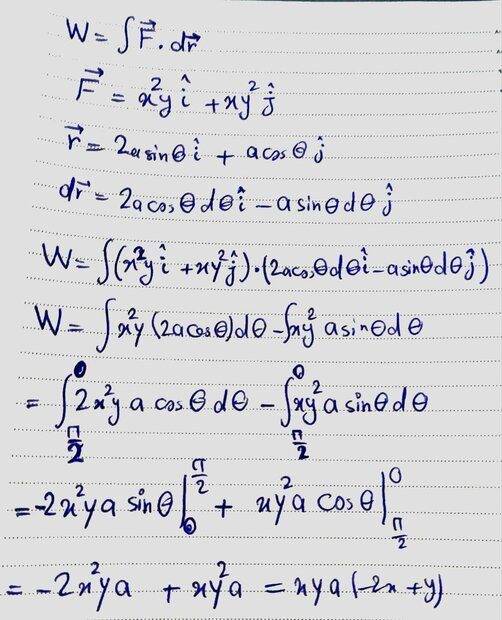
photo_2022-11-15_15-51-30.jpg
 
Last edited:
Physics news on Phys.org
Just to clear things up:

$$r(t) = x ~\mathbf{\hat{i} } + y ~\mathbf{\hat{j} } = 2 a \sin t ~ \mathbf{ \hat{i}} + a \cos t ~ \mathbf{\hat{j}}$$

$$ F(t) = x^2 y ~\mathbf{ \hat{i} } + x y^2 ~\mathbf{ \hat{j} }= ( 2 a \sin t )^2 a \cos t ~\mathbf{ \hat{i} } + 2 a \sin t (a \cos t )^2 ~\mathbf{ \hat{j} } $$

Correct?
 
Last edited:
Reply
  • Like
Likes   Reactions: topsquark and MatinSAR
Assuming that you are asked to find the work done by the force from ##t=0## to some arbitrary time ##t##, you can write $$W=\int_0^t \mathbf{F}(t')\cdot d\mathbf{r}=\int_0^t \mathbf{F}(t')\cdot \frac{d[\mathbf{r}(t')]}{dt'}dt'$$which you can easily integrate because you are given both the force and the position vector as functions of time.
 
Reply
  • Like
Likes   Reactions: topsquark, erobz and MatinSAR
Chestermiller said:
What is F equal to in terms of "a" and ##\theta##?
photo_2022-11-15_17-16-03.jpg

erobz said:
Just to clear things up:

$$r(t) = x \, \rm{\hat i} + y \, \rm{\hat j} = 2 a \sin t \, \rm{ \hat i} + a \cos t \, \rm{\hat j}$$

$$ F(t) = x^2 y \, \rm{\hat i }+ x y^2 \, \rm{\hat j} = ( 2 a \sin t )^2 a \cos t \, \rm{\hat i} + 2 a \sin t (a \cos t )^2 \, \rm{\hat j } $$

Correct?
Yes.
 
Reply
  • Like
Likes   Reactions: topsquark
kuruman said:
Assuming that you are asked to find the work done by the force from ##t=0## to some arbitrary time ##t##, you can write $$W=\int_0^t \mathbf{F}(t')\cdot d\mathbf{r}=\int_0^t \mathbf{F}(t')\cdot \frac{d[\mathbf{r}(t')]}{dt'}dt'$$which you can easily integrate because you are given both the force and the position vector as functions of time.
Thanks a lot. I have seen a formula like this before.
I think my mistake is that I did not consider the unit vector tangent to the direction of movement.
Can you please tell me what is that t' ?!

And we have position vector as functions of θ ...
 
MatinSAR said:
Thanks a lot. I have seen a formula like this before.
I think my mistake is that I did not consider the unit vector tangent to the direction of movement.
Can you please tell me what is that t' ?!
Its just a "dummy variable" so the variable of integration is not the integration limits variable. Alternatively you could leave the force and position in terms of ##t## and switch the limits to ##0 ## and ##t'## or ##0## and ##t_f## is quite common
 
Reply
  • Like
Likes   Reactions: topsquark and MatinSAR
That ##t'## is a dummy variable of integration that distinguishes it from "any time ##t##" that appears as an upper limit. It's a rigorous way to show what one is integrating with respect to. For example, $$\int_0^t 2t'dt'=\left . t'^2 \right |_0^t=t^2.$$
 
Reply
  • Like
Likes   Reactions: topsquark, erobz and MatinSAR
MatinSAR said:
Homework Statement:: How can I find work done by variable force using F.dr When the equation of path is x=(2a) sinθ and y=(a) cosθ and F=(x^2) y i + x(y^2) j? If you can guide me how to write the integral relation so that I can calculate it, I would be grateful.
Relevant Equations:: W=Int(F.dr)

Can anyone tell me if my answer is wrong ?!

View attachment 317187
Please don't edit your original post to change the statement of the problem. In the original version, the force and postion vectors were explicit functions of time. Now they are not. What is going on?
 
Reply
  • Like
Likes   Reactions: topsquark and MatinSAR
kuruman said:
Please don't edit your original post to change the statement of the problem. In the original version, the force and postion vectors were explicit functions of time. Now they are not. What is going on?
I am so sorry I didn't know that editing the original post is not allowed ...
I was trying to write theta but I couldn't. I have sent a picture and in that picture x and y are functions of θ.
 
MatinSAR said:
I am so sorry I didn't know that editing the original post is not allowed ...
I was trying to write theta but I couldn't. I have sent a picture and in that picture x and y are functions of θ.
It would be better if you could just learn to use the math formatting available to you on the site: Latex
 
Reply
  • Like
Likes   Reactions: topsquark and MatinSAR
kuruman said:
Assuming that you are asked to find the work done by the force from ##t=0## to some arbitrary time ##t##, you can write $$W=\int_0^t \mathbf{F}(t')\cdot d\mathbf{r}=\int_0^t \mathbf{F}(t')\cdot \frac{d[\mathbf{r}(t')]}{dt'}dt'$$which you can easily integrate because you are given both the force and the position vector as functions of time.
Can I replace θ with t' ?!
 
MatinSAR said:
Can I replace θ with t' ?!
Yeah, you replace it with whatever variable you want.
 
Reply
  • Like
Likes   Reactions: topsquark and MatinSAR
MatinSAR said:
the equation of path is x=(2a) sinθ and y=(a) cosθ
What is ##\theta## here? It can't be the argument parameter of the polar representation of (x,y) since we would deduce ##\tan^2(\theta)=\frac 12##. So I assume it is an arbitrary parameter unrelated to polar coordinates. But then, where do the integration bounds come from?
I see no diagram.
MatinSAR said:
Can I replace θ with t' ?!
I guess you mean replace t' with ##\theta##.
 
Reply
  • Like
Likes   Reactions: MatinSAR and topsquark
kuruman said:
given both the force and the position vector as functions of time.
Don't know what post #1 said originally (helps if the first responder always uses 'reply'), but it now gives force as a function of position.
@MatinSAR , to use kuruman's approach you will need to find force as a function of theta.
 
Reply
  • Like
Likes   Reactions: MatinSAR and topsquark
haruspex said:
What is θ here?
Thank you ...

x and y are the equations of a part of an ellipse. We are going from a to c.

1.png


I have tried to use that integral but I failed and My teacher said that my answer is wrong again ...
He suggusted using polar coordinates to answer the question.

12.png
We can convert F to polar coordinates like this : https://www.physicsforums.com/threads/work-done-by-variable-force.1047266/post-6821666
Then we can find it's magnitude ...
Magnitude of dr is rdθ ...

But I don't know what is cosθ here... Can you please guide me about this ?!
 
Last edited:
Draw a line from the origin to any point on the ellipse. Try to figure out what angle ( w.r.t the axes) ##\theta## must be such that the ##x## coordinate is given by ##2 a \sin \theta##.
 
Reply
  • Like
Likes   Reactions: MatinSAR
erobz said:
Draw a line from the origin to any point on the ellipse. Try to figure out what angle ( w.r.t the axes) ##\theta## must be such that the ##x## coordinate is given by ##2 a \sin \theta##.
I have tried to find a similar example in many Classical Dynamics and Physics books but I didn't find anything similar ... I have searched the web also ... Do you know a bookthat has a question like this ?!
 
MatinSAR said:
I have tried to find a similar example in many Classical Dynamics and Physics books but I didn't find anything similar ... I have searched the web also ... Do you know a bookthat has a question like this ?!
1668612950552.png


## \vec r ## is the position vector. Which ##\theta## ( above ## \vec r ## or below it ) reconciles with ##x = 2 a \sin \theta## ?
 
Last edited:
Reply
  • Like
Likes   Reactions: MatinSAR
MatinSAR said:
Thank you but what do you mean by this ?! I didn't understand.

View attachment 317261
This one should be Theta ...
Using that angle if you plug in ##\theta = 0 ## what does ##x## equal?
 
Reply
  • Like
Likes   Reactions: MatinSAR
erobz said:
Using that angle if you plug in ##\theta = 0 ## what does ##x## equal?
Theta=0 means x=0 and y=a
 
MatinSAR said:
Theta=0 means x=0 and y=a
Does that seem correct to you?
 
Reply
  • Like
Likes   Reactions: MatinSAR
erobz said:
Does that seem correct to you?
According to the diagram no it's wrong ... so the other one is theta and I have chose the wrong one ...
 
Reply
  • Like
Likes   Reactions: erobz
MatinSAR said:
I have tried to find a similar example in many Classical Dynamics and Physics books but I didn't find anything similar ... I have searched the web also ... Do you know a bookthat has a question like this ?!
I recommend that you try to reason your way through this one instead of trying to find one like it. You'll end up getting higher test scores.
 
Reply
  • Like
Likes   Reactions: MatinSAR
Forget ##\theta## as a variable. Try this. You have $$x=2a\sin\theta~;~~2y=2a\cos\theta.$$It follows that $$x^2+4y^2=4a^2 \implies xdx+4ydy=0 \implies dx=-\frac{4y}{x}dy$$ Now $$\mathbf{F}\cdot d\mathbf{r}=(x^2y~\mathbf{\hat x}+xy^2~\mathbf{\hat y})\cdot(dx~\mathbf{\hat x}+dy~\mathbf{\hat y})
=x^2ydx+xy^2dy.$$ Substitute the expression for ##dx## and integrate over ##y##.
 
Reply
  • Like
Likes   Reactions: MatinSAR
Mister T said:
I recommend that you try to reason your way through this one instead of trying to find one like it. You'll end up getting higher test scores.
Thank you but I was looking for a similar question that has an answer to understand how to solve these kind of questions.
 
kuruman said:
Forget ##\theta## as a variable. Try this. You have $$x=2a\sin\theta~;~~2y=2a\cos\theta.$$It follows that $$x^2+4y^2=4a^2 \implies xdx+4ydy=0 \implies dx=-\frac{4y}{x}dy$$ Now $$\mathbf{F}\cdot d\mathbf{r}=(x^2y~\mathbf{\hat x}+xy^2~\mathbf{\hat y})\cdot(dx~\mathbf{\hat x}+dy~\mathbf{\hat y})
=x^2ydx+xy^2dy.$$ Substitute the expression for ##dx## and integrate over ##y##.
Thanks a lot !
I have done this before but I didn't know anything about the substitution. I will try thank you ...
Chestermiller said:
If you are going from A to C, the limits of integration are from ##\theta=0## to ##\theta = \frac{\pi}{2}##. From the equations for F and dr that I gave in post #16, what is the equation for F dotted with dr?
Thank you.
I will try to answer the problem using this method and compare with the method that Mr.kuruman said ...
 
Reply
  • Like
Likes   Reactions: kuruman