Line integral across a vector field

Click For Summary
SUMMARY

The discussion centers on evaluating a line integral across a vector field where Green's theorem is not applicable due to the vector field being undefined at the origin. The user seeks guidance on how to approach the problem, specifically noting that the region D is not simply connected. A suggested method involves breaking the integral into two separate integrals, evaluating each path independently, and then summing the results to obtain the final answer.

PREREQUISITES
  • Understanding of line integrals in vector calculus
  • Familiarity with Green's theorem and its conditions
  • Knowledge of vector fields and their properties
  • Ability to evaluate integrals along different paths
NEXT STEPS
  • Study the application of Green's theorem in various contexts
  • Learn techniques for evaluating line integrals in non-simply connected regions
  • Explore the concept of path independence in vector fields
  • Investigate alternative theorems such as Stokes' theorem for vector fields
USEFUL FOR

Students and professionals in mathematics, particularly those studying vector calculus, as well as educators seeking to enhance their understanding of line integrals and vector fields.

clandarkfire
Messages
31
Reaction score
0
I've attached the problem as a picture.
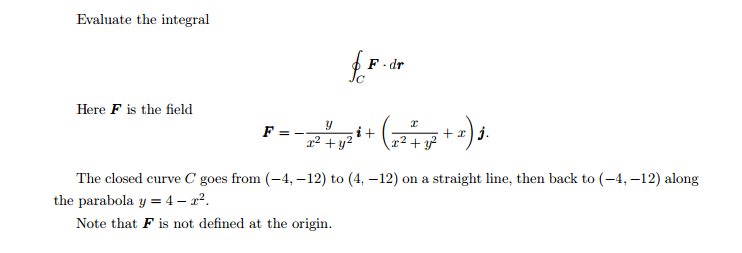
Capture.PNG

Generally, this would be a simple problem if I were to apply Green's theorem. But I can't use Green because D would not be a simply connected closed region; the vector field isn't defined at the origin.
Could someone please give me an idea of where to start?
 
Physics news on Phys.org
clandarkfire said:
I've attached the problem as a picture.
View attachment 52525
Generally, this would be a simple problem if I were to apply Green's theorem. But I can't use Green because D would not be a simply connected closed region; the vector field isn't defined at the origin.
Could someone please give me an idea of where to start?

Break it up into two integrals and evaluate each path separately and then add them together.
 

Similar threads

  • · Replies 21 ·
Replies
21
Views
4K
Replies
3
Views
2K
  • · Replies 2 ·
Replies
2
Views
4K
  • · Replies 6 ·
Replies
6
Views
2K
  • · Replies 7 ·
Replies
7
Views
3K
  • · Replies 5 ·
Replies
5
Views
2K
Replies
12
Views
2K
  • · Replies 3 ·
Replies
3
Views
1K
Replies
12
Views
5K