Linear expansion of steel versus copper with increasing temperature

Click For Summary

Homework Help Overview

The discussion revolves around the linear expansion of steel and copper as temperature increases. Participants are exploring the implications of temperature changes on the lengths of these materials, specifically in the context of a problem involving engine components.

Discussion Character

  • Exploratory, Assumption checking, Problem interpretation

Approaches and Questions Raised

  • Participants are attempting to apply the linear expansion formula and are questioning the initial conditions provided in the problem. There is uncertainty about the implied initial temperature and length of the materials.

Discussion Status

Some participants have offered suggestions for testing the problem with specific lengths and temperatures, while others are interpreting the problem's requirements and discussing how to combine given information. The discussion is active with various interpretations being explored.

Contextual Notes

There is a noted ambiguity regarding the initial temperature and length of the materials, which may affect the approach to solving the problem. Participants are considering how to interpret the information provided in the task.

Eerik
Messages
1
Reaction score
0
Homework Statement
Two engine components, made of steel and copper, are each 10 cm in length and are fixed so that they are only free to expend towards one another, so closing the gap between them as temperature rises. Calculate the clearance between them when the engine is at 15°C if there is to be a gap of 1 mm between them when the engine is at its running temperature of 150°C.

Linear expansivity of steel = 11 * 10^-6 per kelvin
Linear expansivity of copper = 17 * 10^-6 per kelvin
Relevant Equations
ẟL / Lo = α * ẟT
L = Lo (1+ α * ẟT)

ẟL = change in length
Lo = original length
L = new length
α = linear expansivity
ẟT = change in temperature
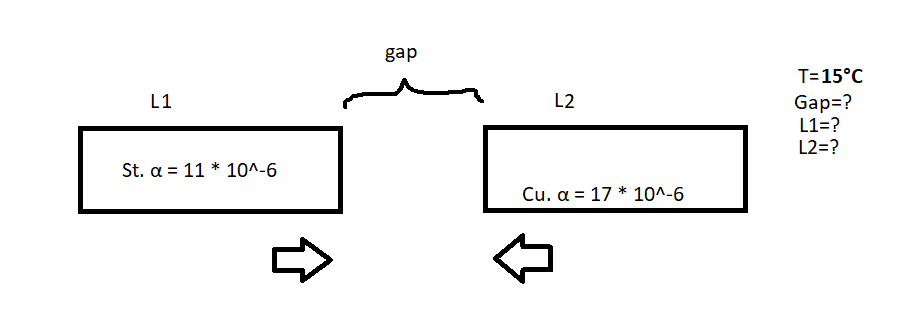
Here I'm going to show all that I've understood -
1.
Zx6JB80.png

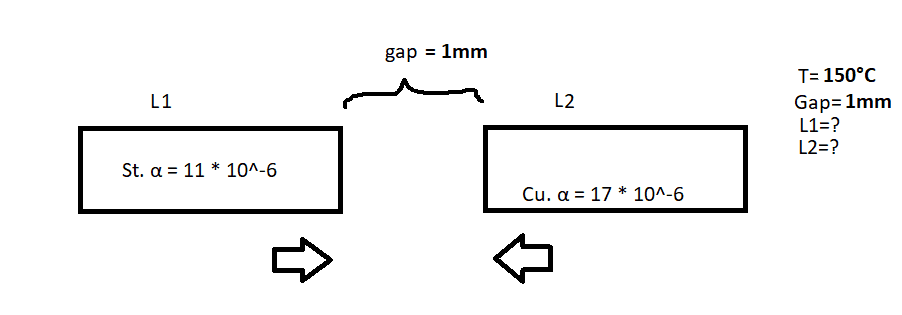
2.
5n0MHBN.png

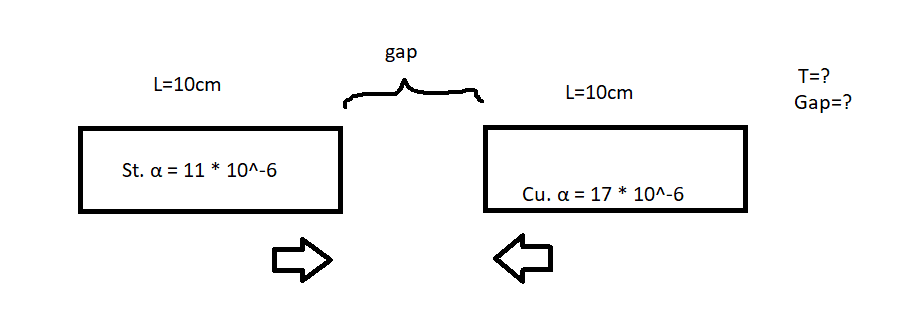
3.
q9lv1zo.png


What I've attempted -

L = Lo (1+ α * ẟT)

ẟT = 150°C - 15°C = 135°C
(Steel) L = ẟL (1 + 11 * 10^-6 * 135)
(Copper) L = ẟL (1 + 17 * 10^-6 * 135)
This doesn't get me anywhere, obviously.

Am I supposed to understand from the task that the temperature is 15°C when the two engine components are 10cm length? Because then the task is rather simple. But I don't see it being implied in any way.

Thanks!
 
Last edited by a moderator:
Physics news on Phys.org
Try it with L = 10 cm at 15°C, and again with L = 10 cm at 150°C. See if there is any significant difference in the answer.
 
Eerik said:
What I've attempted -

L = Lo (1+ α * ẟT)

This equation is correct. But it’s easier to write

##\delta L=L_0\alpha \delta T##
 
Last edited:
  • Like
Likes   Reactions: Eerik
My reading of the problem is that you should combine the first and second diagrams (known initial length + known initial temperature). Generally, with simple questions like this, you have all the information for one condition and partial information for another condition.
 
  • Like
Likes   Reactions: Eerik

Similar threads

  • · Replies 6 ·
Replies
6
Views
2K
  • · Replies 3 ·
Replies
3
Views
2K
  • · Replies 5 ·
Replies
5
Views
2K
  • · Replies 6 ·
Replies
6
Views
3K
Replies
2
Views
1K
Replies
3
Views
4K
Replies
3
Views
2K
  • · Replies 6 ·
Replies
6
Views
2K
  • · Replies 2 ·
Replies
2
Views
2K
  • · Replies 7 ·
Replies
7
Views
2K