JJ91
- 40
- 0
Hello everyone,
I'm currently at third year of EPE and this software is totally new for me so i would to ask a few questions.
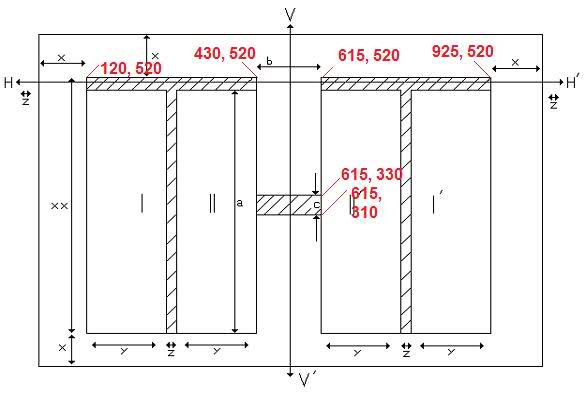
I have been asked to use infolytica MagNet using Field Sampler tool to analyse a flux behavior in the air-gaps and in the transformer core for 2 different core materials, 2 different coil materials and 5 different current ratings (2,4,6,8,10 amps).
The design shows as follows:
I've got most of my graphs and its now coming to write conclusion but there is 1 graph where I think something went wrong:
(the graphs represent the flux in the airgap or the 'c' point from the above diagram measured from TOP to bottom)
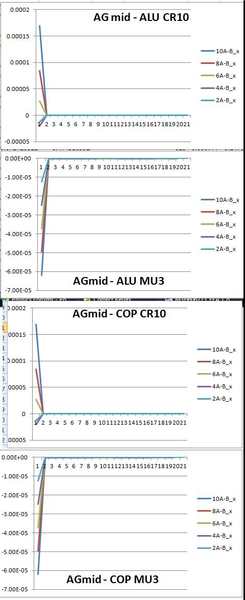
AGmid - Airgap in the middle of the core (between secondary winding)
ALU - aluminium (coil material)
COP - copper (coil material)
MU3 - Core material (lower than CR10)
CR10 - Core material (higher permeability than MU3)
http://www.2shared.com/file/WrczYYFS/Correct_Reults.html"
The air-gap in the middle of the transformer core and the B_x line is straight where I'm afraid it shouldn't be.
1. So I would to ask what went wrong and where should I look for mistake ?
2. Why there is a difference of direction between MU3 and CR10 from the above graphs ?
3. What else can I say from the graphs apart what is the strength, leakage, direction and magnitude of the flux in specific area ?
I'm asking here because report is due to in Monday,
Thanks a lot for any additional information
I'm currently at third year of EPE and this software is totally new for me so i would to ask a few questions.
I have been asked to use infolytica MagNet using Field Sampler tool to analyse a flux behavior in the air-gaps and in the transformer core for 2 different core materials, 2 different coil materials and 5 different current ratings (2,4,6,8,10 amps).
The design shows as follows:
I've got most of my graphs and its now coming to write conclusion but there is 1 graph where I think something went wrong:
(the graphs represent the flux in the airgap or the 'c' point from the above diagram measured from TOP to bottom)
AGmid - Airgap in the middle of the core (between secondary winding)
ALU - aluminium (coil material)
COP - copper (coil material)
MU3 - Core material (lower than CR10)
CR10 - Core material (higher permeability than MU3)
http://www.2shared.com/file/WrczYYFS/Correct_Reults.html"
The air-gap in the middle of the transformer core and the B_x line is straight where I'm afraid it shouldn't be.
1. So I would to ask what went wrong and where should I look for mistake ?
2. Why there is a difference of direction between MU3 and CR10 from the above graphs ?
3. What else can I say from the graphs apart what is the strength, leakage, direction and magnitude of the flux in specific area ?
I'm asking here because report is due to in Monday,
Thanks a lot for any additional information
Last edited by a moderator: