Math Challenge - July 2020
- Topic: Challenge
- Thread starter fresh_42
- Start date
-
- Tags
- Challenge Math challenge
Join the discussion
Registration is free. Start your own thread to ask a follow-up.
137 replies · 25K views
Physics news on Phys.org
member 587159
nuuskur said:Assume for a contradiction [itex]\sigma (V,V')[/itex] is metrisable. The Banach space [itex]V'[/itex] is infinite dimensional. Since [itex]\sigma (V,V')[/itex] is a metrisable locally convex topology, its neighborhood basis of zero is generated by a sequence of seminorms [itex]p_{\varphi _n}[/itex], where [itex]\varphi _n\in V', n\in\mathbb N[/itex]. Wo.l.o.g this basis can be expressed as
[tex] S_{n} := \bigcap _{k=1}^n \varphi _k^{-1} (B(0,1)),\quad n\in\mathbb N.[/tex]
Take [itex]\varphi \in V'[/itex]. Fix [itex]\varepsilon >0[/itex]. Due to continuity w.r.t [itex]\sigma (V,V')[/itex] we have [itex]S_{N_\varepsilon} \subseteq \varphi ^{-1}(B(0,\varepsilon))[/itex] for some [itex]N_\varepsilon\in\mathbb N[/itex]. Put [itex]N := \min _\varepsilon N_\varepsilon[/itex]. Then [itex]x\in \bigcap _{k=1}^N \mathrm{Ker}\varphi _k[/itex] implies [itex]x\in \mathrm{Ker}\varphi[/itex]. Equivalently, [itex]\varphi \in \mathrm{span}(\varphi _1,\ldots, \varphi _N)[/itex]. Thus, [itex]V'[/itex] admits a countable spanning set, which is impossible. Therefore, [itex]\sigma (V,V')[/itex] cannot be metrisable.
I guess the idea is correct, but it is unclear to me why you work with the ##\epsilon## and the minimum? Doesn't the following work instead?
Let ##\varphi \in V^*##. Then there exists ##n## with ##S_n = \bigcap_{k=1}^n \varphi_k^{-1}(B(0,1)) \subseteq \varphi^{-1}(B(0,1))##. This implies that ##\bigcap_{k=1}^n \ker \varphi_k \subseteq \ker \varphi##: indeed if ##\varphi_k(x)=0## for ##k=1, \dots, n##, then also ##\varphi_k(tx)=0## for all ##t\in \Bbb{R}## and thus ##tx\in S_n\subseteq \varphi^{-1}(B(0,1))##, so that ##t\varphi(x) \in B(0,1)##. Since this holds for all ##t \in \Bbb{R}##, this forces ##\varphi(x)=0##. You then can conclude like you did.
I think it is non-trivial that you can choose the basis like you did: I agree that the topology ##\sigma(V,V')## is generated by the seminorms ##\{p_f: f \in V^*\}##. But then the following two questions remain:
(1) How does metrizability imply that you can choose ##(f_n)_n## such that the family of seminorms ##\{p_{f_n}: n \geq 1\}## still generate the topology? (Provide proof or a reference).
(2) Why can we choose the basis in this particular form: i.e. as inverse images of the unit ball?
Last edited by a moderator:
Science Advisor
- 1,442
- 191
This is what I got so far, but my expertise here is lacking to say the least, if you've any skills here please correct what I've got (or anybody really) as Topology is really new to me, thanks.fresh_42 said:Summary:: Functional Analysis, Topology, Differential Geometry, Analysis, Physics
Authors: Math_QED (MQ), Infrared (IR), Wrobel (WR), fresh_42 (FR).
9. Let ##(X,d)## be a compact metric space and ##f:X\to X## be a mapping onto. Assume that ##d(f(x),f(y))\le d(x,y),\quad \forall x,y\in X.## Show that ##d(f(x),f(y))= d(x,y),\quad \forall x,y\in X.## (WR)
Work: ##f:X\to X## is continuous by Munkres' Topology Theorem 21.1, pg 129 which is the ##\epsilon -\delta## definition of continuity of ##f:X\to Y## for metric spaces ##X## and ##Y## with respective metrics ##d_X## and ##d_Y##, here taking ##X=Y## and metrics ##d_X (x,y) = d_Y (x,y) :=d(x,y)## since given ##x\in X## and ##\epsilon >0, \forall n\in \mathbb{N}## choose ##\delta_n = \epsilon +\tfrac{1}{n}## such that ##d_X(x,y)<\delta _n = \epsilon +\tfrac{1}{n}\implies d_Y(f(x), f(y)) \leq d_X (x,y) < \epsilon +\tfrac{1}{n}\implies d_X(f(x),f(y)) < \epsilon## where the business with adding the ##\tfrac{1}{n}## term I'm not certain is quite right but was intended to deal with the strictness of the inequalities.
Last edited:
Science Advisor
- 1,407
- 1,164
sure it is continuous ,moreover it is Lipschitzbenorin said:ork: is continuous by Munkres' Topology Theorem 21.1, pg 129 which
Science Advisor
- 929
- 1,226
It does work. I don't really understand your objection, though. Similarly, one could ask why you would work with the following if some other method is also sufficient. I think it's apples and oranges. I might be wrong.Math_QED said:I guess the idea is correct, but it is unclear to me why you work with the ##\epsilon## and the minimum? Doesn't the following work instead?
Let ##\varphi \in V^*##. Then there exists ##n## with ##S_n = \bigcap_{k=1}^n \varphi_k^{-1}(B(0,1)) \subseteq \varphi^{-1}(B(0,1))##. This implies that ##\bigcap_{k=1}^n \ker \varphi_k \subseteq \ker \varphi##: indeed if ##\varphi_k(x)=0## for ##k=1, \dots, n##, then also ##\varphi_k(tx)=0## for all ##t\in \Bbb{R}## and thus ##tx\in S_n\subseteq \varphi^{-1}(B(0,1))##, so that ##t\varphi(x) \in B(0,1)##. Since this holds for all ##t \in \Bbb{R}##, this forces ##\varphi(x)=0##. You then can conclude like you did.
I think it is non-trivial that you can choose the basis like you did: I agree that the topology ##\sigma(V,V')## is generated by the seminorms ##\{p_f: f \in V^*\}##. But then the following two questions remain:
(1) How does metrizability imply that you can choose ##(f_n)_n## such that the family of seminorms ##\{p_{f_n}: n \geq 1\}## still generate the topology? (Provide proof or a reference).
(2) Why can we choose the basis in this particular form: i.e. as inverse images of the unit ball?
Nh basis of zero for [itex]\sigma (V,V')[/itex] is given by the family
[tex] B_{\varepsilon, f_1,\ldots,f_n} := \left\{ x\in V \mid \max\limits_{1\leq j\leq n} |f_j(x)| \leq \varepsilon \right\},\quad \varepsilon > 0,\quad f_1,\ldots,f_n\in V',\quad n\in\mathbb N.[/tex]
Since [itex]V'[/itex] is a vector space, we can instead take [itex]\frac{1}{\varepsilon}f_j[/itex] and obtain a basis
[tex] B_{1,f_1,\ldots,f_n} = \left\{ x\in V \mid \max\limits _{1\leq j\leq n} |f_j(x)| \leq 1 \right\} = \bigcap _{k=1}^n f_k^{-1}(B(0,1)),\quad f_1,\ldots,f_n\in V',\quad n\in\mathbb N.[/tex]
The second equality is clear, I think.
[tex] B_{\varepsilon, f_1,\ldots,f_n} := \left\{ x\in V \mid \max\limits_{1\leq j\leq n} |f_j(x)| \leq \varepsilon \right\},\quad \varepsilon > 0,\quad f_1,\ldots,f_n\in V',\quad n\in\mathbb N.[/tex]
Since [itex]V'[/itex] is a vector space, we can instead take [itex]\frac{1}{\varepsilon}f_j[/itex] and obtain a basis
[tex] B_{1,f_1,\ldots,f_n} = \left\{ x\in V \mid \max\limits _{1\leq j\leq n} |f_j(x)| \leq 1 \right\} = \bigcap _{k=1}^n f_k^{-1}(B(0,1)),\quad f_1,\ldots,f_n\in V',\quad n\in\mathbb N.[/tex]
The second equality is clear, I think.
Given a locally convex topology its nh basis of zero can be assumed to consist of closed absolutely convex subsets. Let the topology be metrisable, then this basis can be assumed to be countable. Suppose such a basis is [itex]S_n,\ n\in\mathbb N[/itex]. Its generating family of seminorms can be picked as the Minkowski functionals [itex]p_{S_n}[/itex] of basis elements. By Hahn-Banach, there exists [itex]\varphi _n\in V'[/itex] s.t [itex]|\varphi _n | \leq p_{S_n},\quad n\in\mathbb N[/itex].
More generally, nh basis of zero generated by seminorms is given as
[tex] B_{\varepsilon, n} = \left\{ x\in V \mid \max\limits_{1\leq j\leq n} p_{S_j}(x) \leq \varepsilon \right\},\quad \varepsilon >0,\quad n\in\mathbb N.[/tex]
Now, given [itex]n\in\mathbb N[/itex] and [itex]\varepsilon >0[/itex], we can find [itex]\varepsilon _0 >0[/itex] s.t
[tex] \left\{ x\in V \mid \max\limits_{1\leq j\leq n} |\varphi _n(x)| \leq \varepsilon _0 \right\} \subseteq B_{\varepsilon,n}.[/tex]
Thus, the sequence of functionals [itex]\varphi _n[/itex] also generates a nh basis of zero.
More generally, nh basis of zero generated by seminorms is given as
[tex] B_{\varepsilon, n} = \left\{ x\in V \mid \max\limits_{1\leq j\leq n} p_{S_j}(x) \leq \varepsilon \right\},\quad \varepsilon >0,\quad n\in\mathbb N.[/tex]
Now, given [itex]n\in\mathbb N[/itex] and [itex]\varepsilon >0[/itex], we can find [itex]\varepsilon _0 >0[/itex] s.t
[tex] \left\{ x\in V \mid \max\limits_{1\leq j\leq n} |\varphi _n(x)| \leq \varepsilon _0 \right\} \subseteq B_{\varepsilon,n}.[/tex]
Thus, the sequence of functionals [itex]\varphi _n[/itex] also generates a nh basis of zero.
Last edited:
etotheipi
12. Given a positive integer in decimal representation without zeros. We build a new integer by concatenation of the number of even digits, the number of odd digits, and the number of all digits (the sum of the former two). Then we proceed with that number.
Determine whether this algorithm always comes to a halt. What is or should be the criterion to stop?
I don't really know if this is what you're after, but for any given integer with 4 or more digits there will be either at least 2 even digits or at least 2 odd digits, and the next pass of the algorithm will always reduce the length of that string by at least one digit. You can just keep doing this until you get down to 3 digits, which are either
##\{\text{even}, \text{even}, \text{even}\} \implies 303 \implies 123##
##\{\text{even}, \text{even}, \text{odd}\} \implies 213 \implies 123##
##\{\text{even}, \text{odd}, \text{odd}\} \implies 123##
##\{\text{odd}, \text{odd}, \text{odd}\} \implies 033 \implies 123##
And I guess if you start off with an integer with 1 or 2 digits, the next pass gives you a 3 digit number and we're back to the above.
Last edited by a moderator:
- 20,819
- 28,467
I had a more formal argument in mind, but ok. I think you mistyped 013. Also I guess is a bit thin. And you could have actually answered the questions. However, these are only formal deficits.etotheipi said:I don't really know if this is what you're after, but for any given integer with 4 or more digits there will be either at least 2 even digits or at least 2 odd digits, and the next pass of the algorithm will always reduce the length of that string by at least one digit. You can just keep doing this until you get down to 3 digits, which are either
##\{\text{even}, \text{even}, \text{even}\} \implies 303 \implies 123##
##\{\text{even}, \text{even}, \text{odd}\} \implies 213 \implies 123##
##\{\text{even}, \text{odd}, \text{odd}\} \implies 123##
##\{\text{odd}, \text{odd}, \text{odd}\} \implies 013 \implies 123##
And I guess if you start off with an integer with 1 or 2 digits, the next pass gives you a 3 digit number and we're back to the above.
Science Advisor
- 929
- 1,226
Point of http://ssdnm.mimuw.edu.pl/pliki/wyklady/PlebanekAbstrakt_us.pdf
Assume for a contradiction [itex]C[0,1][/itex] is isomorphic to a dual Banach space.
Take a sequence of functions with norm [itex]1[/itex] in [itex]C[0,1][/itex] and with pairwise disjoint support. For instance, pick a sequence of pairwise disjoint intervals in [itex][0,1][/itex] and pick a function whose support is that interval. The linear span of this sequence is dense in [itex]c_0[/itex]: match the sequence with the canonical basis in [itex]c_0[/itex].
The space [itex]C[0,1][/itex] is separable. By Theorem 3.1 (Sobczyk), the closed copy of [itex]c_0[/itex] is complemented in [itex]C[0,1][/itex]. By assumption [itex]c_0[/itex] is complemented in a dual Banach space. Dual Banach spaces are complemented in their second dual, therefore [itex]c_0[/itex] is complemented in its second dual, which is [itex]\ell _\infty[/itex]. But this contradicts Theorem 3.2 (Phillips-Sobczyk), by which [itex]c_0[/itex] can't be complemented in [itex]\ell _\infty[/itex]. Thus, [itex]C[0,1][/itex] can't be isomorphic to a dual Banach space.
Take a sequence of functions with norm [itex]1[/itex] in [itex]C[0,1][/itex] and with pairwise disjoint support. For instance, pick a sequence of pairwise disjoint intervals in [itex][0,1][/itex] and pick a function whose support is that interval. The linear span of this sequence is dense in [itex]c_0[/itex]: match the sequence with the canonical basis in [itex]c_0[/itex].
The space [itex]C[0,1][/itex] is separable. By Theorem 3.1 (Sobczyk), the closed copy of [itex]c_0[/itex] is complemented in [itex]C[0,1][/itex]. By assumption [itex]c_0[/itex] is complemented in a dual Banach space. Dual Banach spaces are complemented in their second dual, therefore [itex]c_0[/itex] is complemented in its second dual, which is [itex]\ell _\infty[/itex]. But this contradicts Theorem 3.2 (Phillips-Sobczyk), by which [itex]c_0[/itex] can't be complemented in [itex]\ell _\infty[/itex]. Thus, [itex]C[0,1][/itex] can't be isomorphic to a dual Banach space.
Last edited:
Science Advisor
- 1,407
- 1,164
I have already stuck at here:
please provide detailsnuuskur said:Take a sequence of functions with norm in and with pairwise disjoint support. For instance, pick a sequence of pairwise disjoint intervals in and pick a function whose support is that interval. The linear span of this sequence is dense in : match the sequence with the canonical basis in .
Science Advisor
- 929
- 1,226
wrobel said:I have already stuck at here:
please provide details
Firstly, we want the sequence to be linearly independent, hence pairwise disjoint supports. So, denote it [itex]f_n\in C[0,1],\ n\in\mathbb N[/itex]. We also want an isometry, so pick the [itex]f_n[/itex] with norm [itex]1[/itex] i.e make sure [itex]f_n[/itex] reaches the unit sphere. Let the [itex]f_n[/itex] span the subspace [itex]K\subseteq C[0,1][/itex]. Then put [itex]\varphi (f_n) = e_n\in c_0[/itex] where [itex]e_n = (\underbrace{0,\ldots,1}_{n},0,\ldots),\ n\in\mathbb N[/itex]. The disjointness of supports guarantees we have an isometry.
Let [itex]a:=\sum _{k=1}^\infty \lambda _ke_k\in c_0[/itex] and [itex]\varepsilon >0[/itex]. Take [itex]N\in\mathbb N[/itex] such that [itex]\left \|\sum _{k>N} \lambda _ke_k \right \| <\varepsilon[/itex]. So [itex]a[/itex] is close to [itex]\varphi \left ( \sum _{k=1}^N \lambda _kf_k \right )[/itex]. Now [itex]\overline{\varphi (K)} = c_0[/itex] implies [itex]\overline{K} \cong c_0[/itex].
Let [itex]a:=\sum _{k=1}^\infty \lambda _ke_k\in c_0[/itex] and [itex]\varepsilon >0[/itex]. Take [itex]N\in\mathbb N[/itex] such that [itex]\left \|\sum _{k>N} \lambda _ke_k \right \| <\varepsilon[/itex]. So [itex]a[/itex] is close to [itex]\varphi \left ( \sum _{k=1}^N \lambda _kf_k \right )[/itex]. Now [itex]\overline{\varphi (K)} = c_0[/itex] implies [itex]\overline{K} \cong c_0[/itex].
Science Advisor
- 1,407
- 1,164
ok
please explain the next step:
please explain the next step:
nuuskur said:By assumption is complemented in a dual Banach space.
Science Advisor
- 929
- 1,226
wrobel said:ok
please explain the next step:
Remark. Formally, the terminology is ".. is a complemented subspace of ..", but I'm used to saying " .. is complemented in ..".
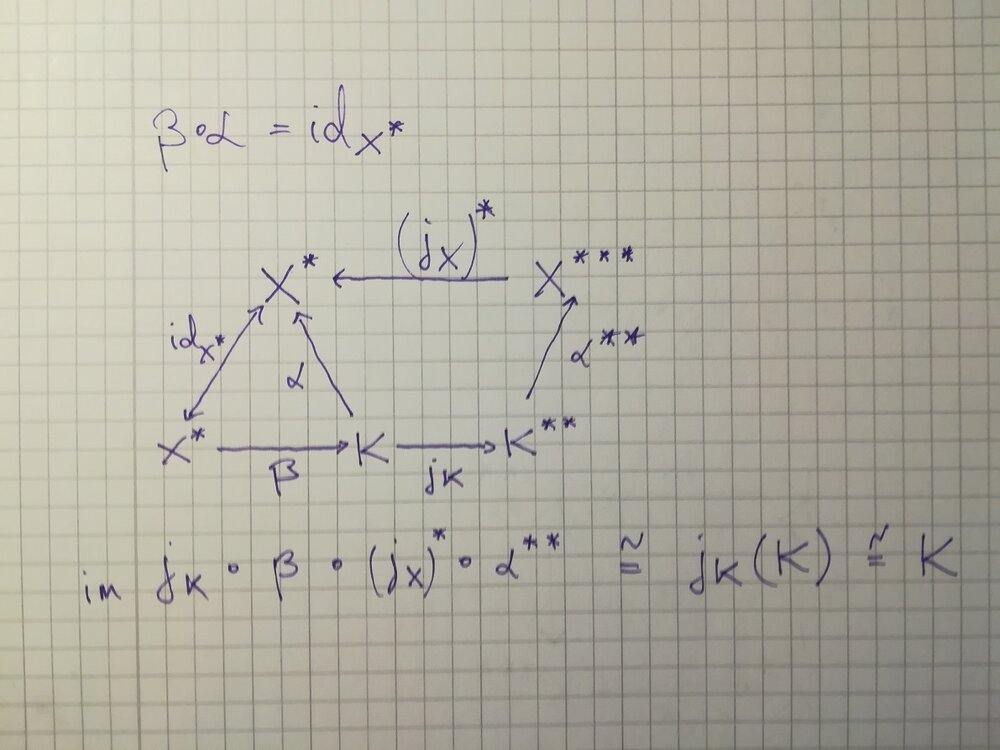
Let a closed subspace [itex]K\subseteq X^*[/itex] be complemented in [itex]X^*[/itex]. In other words, there exist continuous maps [itex]\alpha : K \to X^*[/itex] and [itex]\beta : X^* \to K[/itex] such that [itex]\beta\circ \alpha = \mathrm{id}_{K}[/itex]. Denote [itex]j_X :X\to X^{**}[/itex] the canonical embedding, then we have a projection [itex]j_{K}\circ\beta\circ (j_X)^*\circ\alpha ^{**}[/itex] onto [itex]j_K(K)\cong K[/itex]. One can show the following diagram (there's a typo - it should read [itex]\beta\circ \alpha = \mathrm{id}_K[/itex]) is commutative
 ..it's a routine check, but it takes some time and I'm too tired right now.
Let a closed subspace [itex]K\subseteq X^*[/itex] be complemented in [itex]X^*[/itex]. In other words, there exist continuous maps [itex]\alpha : K \to X^*[/itex] and [itex]\beta : X^* \to K[/itex] such that [itex]\beta\circ \alpha = \mathrm{id}_{K}[/itex]. Denote [itex]j_X :X\to X^{**}[/itex] the canonical embedding, then we have a projection [itex]j_{K}\circ\beta\circ (j_X)^*\circ\alpha ^{**}[/itex] onto [itex]j_K(K)\cong K[/itex]. One can show the following diagram (there's a typo - it should read [itex]\beta\circ \alpha = \mathrm{id}_K[/itex]) is commutative
Science Advisor
- 929
- 1,226
Alright, I'm recharged now.nuuskur said:Remark. Formally, the terminology is ".. is a complemented subspace of ..", but I'm used to saying " .. is complemented in ..".
Let a closed subspace [itex]K\subseteq X^*[/itex] be complemented in [itex]X^*[/itex]. In other words, there exist continuous maps [itex]\alpha : K \to X^*[/itex] and [itex]\beta : X^* \to K[/itex] such that [itex]\beta\circ \alpha = \mathrm{id}_{K}[/itex]. Denote [itex]j_X :X\to X^{**}[/itex] the canonical embedding, then we have a projection [itex]j_{K}\circ\beta\circ (j_X)^*\circ\alpha ^{**}[/itex] onto [itex]j_K(K)\cong K[/itex].
[tex] \begin{align*}<br /> (j_{X^*} \circ \alpha)(k)(x^{**}) &=j_{X^*}(\alpha (k))(x^{**}) \\<br /> &= x^{**}(\alpha(k)) \\<br /> &=\alpha ^* (x^{**})(k) \\<br /> &= j_K(k)(\alpha ^*(x^{**})) \\<br /> &=\alpha ^{**}(j_K(k))(x^{**}) \\<br /> &= (\alpha ^{**} \circ j_K)(k)(x^{**}).<br /> \end{align*}[/tex]
Last edited:
Science Advisor
- 1,407
- 1,164
In which dual space c_0 is complemented? By which assumption?nuuskur said:By assumption is complemented in a dual Banach space.
Science Advisor
- 929
- 1,226
The assumption is [itex]C[0,1][/itex] (which is separable) is isomorphic to a dual Banach space [itex]X^*[/itex]. By Sobczyk's theorem [itex]c_0[/itex] is complemented in [itex]X^* \cong C[0,1][/itex].wrobel said:In which dual space c_0 is complemented? By which assumption?
Science Advisor
- 1,407
- 1,164
Oh now I see. It looks correct. But by the Krein–Milman theorem it would be easier
Similar threads
Challenge
Math Challenge - July 2023
- Infrared
- · Replies 69 ·
- Math Proof Training and Practice
- Replies
- 69
Challenge
Math Challenge - July 2021
- fresh_42
- · Replies 93 ·
- Math Proof Training and Practice
- Replies
- 93
Challenge
Math Challenge - July 2019
- fresh_42
- · Replies 101 ·
- Math Proof Training and Practice
- Replies
- 101
Challenge
Intermediate Math Challenge - July 2018
- fresh_42
- · Replies 16 ·
- Math Proof Training and Practice
- Replies
- 16
Challenge
Math Challenge - June 2020
- fresh_42
- · Replies 156 ·
- Math Proof Training and Practice
- Replies
- 156
Challenge
Math Challenge - June 2023
- Infrared
- · Replies 80 ·
- Math Proof Training and Practice
- Replies
- 80
Challenge
Math Challenge - August 2020
- fresh_42
- · Replies 104 ·
- Math Proof Training and Practice
- Replies
- 104
Challenge
Math Challenge - January 2020
- fresh_42
- · Replies 64 ·
- Math Proof Training and Practice
- Replies
- 64
Challenge
Math Challenge - October 2020
- fresh_42
- · Replies 33 ·
- Math Proof Training and Practice
- Replies
- 33
Challenge
Math Challenge - June 2021
- fresh_42
- · Replies 61 ·
- Math Proof Training and Practice
- Replies
- 61