Maxwell Boltzmann distribution

Click For Summary
SUMMARY

The discussion centers on the Maxwell-Boltzmann (M.B) distribution as presented in the Aschcroft & Mermin solid state book. Key points include the distinction between velocity and speed distributions, with the M.B distribution showing a maximum at zero velocity and a peak speed defined by the equation vmp=(2kT/m)1/2. The energy distribution follows the form E1/2e-E/kT, and it is clarified that as temperature (T) increases, the distribution broadens, leading to a decrease in the probability of low velocities. Figure 2.1 is critiqued for its misleading representation of the relationship between velocity and energy/kT.

PREREQUISITES
  • Understanding of Maxwell-Boltzmann distribution
  • Familiarity with kinetic theory of gases
  • Basic knowledge of statistical mechanics
  • Ability to interpret mathematical equations related to physics
NEXT STEPS
  • Study the derivation of the Maxwell-Boltzmann distribution
  • Learn about the differences between velocity and speed distributions
  • Explore the implications of temperature on particle distributions
  • Investigate the role of the v2 factor in the M.B distribution
USEFUL FOR

Students and professionals in physics, particularly those studying thermodynamics and statistical mechanics, as well as researchers interested in the behavior of gas particles at varying temperatures.
Rzbs
Messages
52
Reaction score
11
TL;DR
Difference between Maxwell Boltzmann and fermi dirac distribution
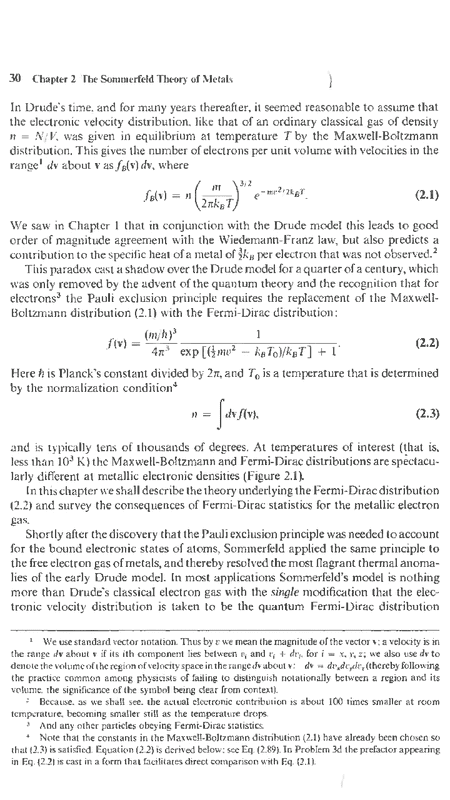
In the Aschcroft & Mermin solid state book there is a curve to compare F.D and M.B distribution. I can't understand the concept of M.B curve; what does mean exactlly when x =0? It means the probability of zero energy for particles is most or ...?

Screenshot_20200907-134217.png
Screenshot_20200907-134145.png
 
Physics news on Phys.org
Figure 2.1 seems odd; it appears to be plotting the distribution of velocity (note, velocity, not speed) versus kinetic energy. The energy distribution does not have a maximum at zero. Look up the MB distribution; observe its forms for the distribution of velocity, speed and energy.

Equation 2.1 is the distribution of vectorial velocity, i.e. with a particular direction as well as magnitude (or alternatively, a particular set of components {vx, vy, vz}). It has a maximum at zero velocity. The distribution of the speed is found by summing Eq. 2.1 over all directions (or all sets of {vx, vy, vz} that give the same magnitude v), and is given by
f(v) = 4πv2f(v)
This has a value of zero at v=0, and a maximum at a finite v. The energy distribution goes as E1/2e-E/kT
 
Thanks so much for your simple description.
Now I can understand the difference between graph for speed, energy and velocity.

But I can't understand "what fig2.1 try to say", it shows if x decreases then the probability increases. The plot is Ae^(-x). The meaning of x=0 is have zero velocity.
Does it mean if T increases then x decreases and the probability for have less velocity increases?
 
Last edited:
Figure 2.1 is a very bad graph. It is plotting the probability of one variable (velocity) against a different variable (energy/kT). All it really shows, qualitatively, is that MB and FD are very different.
If T increases, the distribution broadens, and the probability at low velocities decreases. The x-axis in Fig 2.1 is E/kT, and the distribution of (E/kT) is independent of temperature.
 
  • Like
Likes   Reactions: Rzbs
Thanks. I thought so but I wasn't sure. You really help me to understand this. Thanks so much.
 
Last edited:
Usually there is a ## v^2 ## factor on the Maxwell-Boltzmann distribution, and the peak speed (## v_{mp}=##most probable speed) occurs at ## v_{mp}=(2kT/m)^{1/2} ##.
 
Last edited:
  • Like
Likes   Reactions: Rzbs

Similar threads

  • · Replies 7 ·
Replies
7
Views
3K
  • · Replies 1 ·
Replies
1
Views
3K
  • · Replies 0 ·
Replies
0
Views
1K
  • · Replies 17 ·
Replies
17
Views
2K
  • · Replies 11 ·
Replies
11
Views
3K
  • · Replies 4 ·
Replies
4
Views
2K
  • · Replies 4 ·
Replies
4
Views
3K
  • · Replies 6 ·
Replies
6
Views
1K
  • · Replies 1 ·
Replies
1
Views
4K
  • · Replies 10 ·
Replies
10
Views
3K