Minimum Spanning Tree of a Graph Solutions

Click For Summary
SUMMARY

This discussion centers on the implementation of a modified version of Prim's Algorithm to determine the Minimum Spanning Tree (MST) of a graph. The user reports that their program consistently produces a single solution with a total distance of 32, despite claims from their professor that multiple solutions exist. The user is encouraged to evaluate all possible configurations for total distance and connectedness to validate their findings and challenge the professor's assertion.

PREREQUISITES
  • Understanding of Prim's Algorithm for Minimum Spanning Trees
  • Familiarity with graph theory concepts, including nodes and edges
  • Knowledge of algorithmic complexity and evaluation techniques
  • Proficiency in programming to implement and test algorithms
NEXT STEPS
  • Research the properties of Minimum Spanning Trees and their uniqueness conditions
  • Learn about graph traversal algorithms and their applications
  • Explore alternative algorithms for finding MSTs, such as Kruskal's Algorithm
  • Investigate tools for visualizing graph structures and their spanning trees
USEFUL FOR

Computer science students, software developers, and anyone interested in algorithm design and optimization in graph theory.

whoareyou
Messages
162
Reaction score
2
I recently wrote a program that implements a slightly modified version of Prim's Algorithm to find a minimal spanning tree and it seems to work correctly. However, I am doubtful because my prof claims that this certain tree has more than 1 solution but my program gives only one solution. Note that a different solution means that different edges are used to visit every node. Using the same edges in a different order is not a different solution. Can someone please confirm this:

GRAPH:
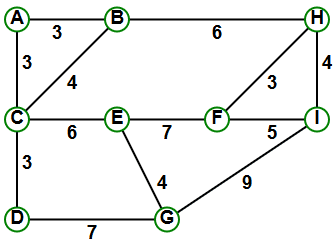
yah0OL0.png


SOLUTIONS (in each case, all the links are the same, ∴ only 1 solution):
Code:
A -> B: 3
A -> C: 3
C -> D: 3
B -> H: 6
H -> F: 3
H -> I: 4
C -> E: 6
E -> G: 4

TOTAL DISTANCE: 32

B -> A: 3
A -> C: 3
C -> D: 3
B -> H: 6
H -> F: 3
H -> I: 4
C -> E: 6
E -> G: 4

TOTAL DISTANCE: 32

C -> A: 3
C -> D: 3
A -> B: 3
C -> E: 6
E -> G: 4
B -> H: 6
H -> F: 3
H -> I: 4

TOTAL DISTANCE: 32

D -> C: 3
C -> A: 3
A -> B: 3
C -> E: 6
E -> G: 4
B -> H: 6
H -> F: 3
H -> I: 4

TOTAL DISTANCE: 32

E -> G: 4
E -> C: 6
C -> A: 3
C -> D: 3
A -> B: 3
B -> H: 6
H -> F: 3
H -> I: 4

TOTAL DISTANCE: 32

F -> H: 3
H -> I: 4
H -> B: 6
B -> A: 3
A -> C: 3
C -> D: 3
C -> E: 6
E -> G: 4

TOTAL DISTANCE: 32

G -> E: 4
E -> C: 6
C -> A: 3
C -> D: 3
A -> B: 3
B -> H: 6
H -> F: 3
H -> I: 4

TOTAL DISTANCE: 32

H -> F: 3
H -> I: 4
H -> B: 6
B -> A: 3
A -> C: 3
C -> D: 3
C -> E: 6
E -> G: 4

TOTAL DISTANCE: 32

I -> H: 4
H -> F: 3
H -> B: 6
B -> A: 3
A -> C: 3
C -> D: 3
C -> E: 6
E -> G: 4

TOTAL DISTANCE: 32
 
Physics news on Phys.org
bump, no one can confirm this?
 
To confirm that your solution is the only one, evaluate every possible configuration for total distance and connectedness. Then call your professor's bluff (you should).
 

Similar threads

  • · Replies 4 ·
Replies
4
Views
2K
  • · Replies 8 ·
Replies
8
Views
3K
  • · Replies 21 ·
Replies
21
Views
3K
  • · Replies 1 ·
Replies
1
Views
2K
  • · Replies 3 ·
Replies
3
Views
3K
  • · Replies 1 ·
Replies
1
Views
2K
  • · Replies 5 ·
Replies
5
Views
3K
  • · Replies 5 ·
Replies
5
Views
4K
  • · Replies 8 ·
Replies
8
Views
2K
  • · Replies 4 ·
Replies
4
Views
2K