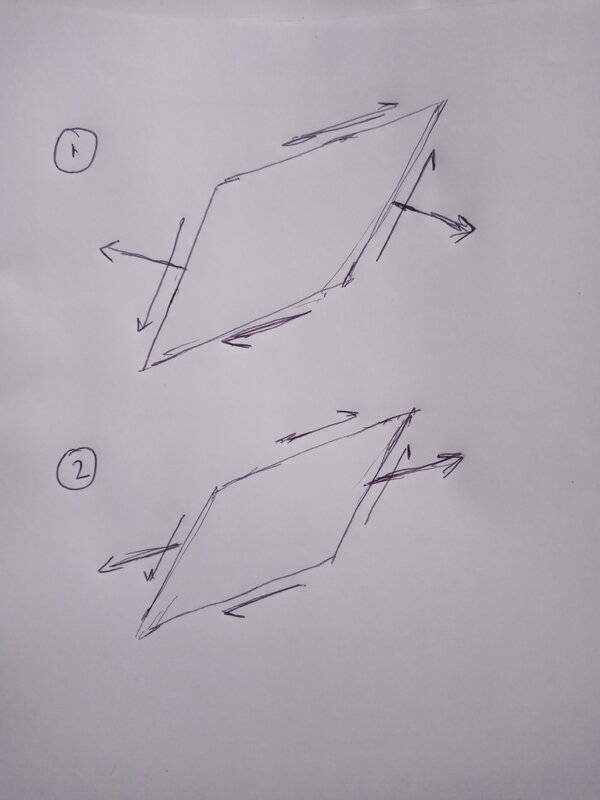
My apology for the late response.
Chestermiller said:
It just dawned on me...Is it possible that you are talking about situations involving small displacements and small strains, like deformation of solids?
Yes. I'm thinking of solids specifically. I'm also thinking of small displacements in order to ensure stress and strain relations are linear.
Chestermiller said:
That would only be for the components in a change of coordinate system. The stress tensor, the normal to a surface, and the corresponding traction vector are invariant entities, independent of any specific coordinate system and of the components resolved on that coordinate system. Thinking of them in terms of a matrix with rows and columns automatically implies a specific coordinate system.
Yes, although I did have a sense that the stress tensor is independent of coordinate system, I realized that using a matrix does imply a specific coordinate system.
Using dyadics, the stress tensor is a sum of dyadics. Instead of doing matrix multiplication, the tensor is dotted with the normal vector, producing the traction vector. Using the equation you had in your post: $$(\bf v_1 v_2)\cdot v3=v_1(v_2\cdot v_3)$$ In order to ensure that this product is nonzero, ##v_2## must not be orthogonal to ##v_3##, or for unit basis vectors they must be equivalent.
For the question I have though, I'm thinking specifically about change of coordinate systems though.
I thought about my question a bit more. I want to use a bit more of a specific, concrete example. Let's say there's a rod under pure tension in the x direction and you apply a 45 degree cut. There would be a normal and shear stress both half of the normal stress in the x direction. If the material deforms under tension however, the angle changes (let's say to a 30 degree angle). In order to maintain force balance, this would be equivalent to a 30 degree cut:
This seems to mean that if you take a section of a material under some stress, the stresses on that section would change if the elasticity modulus changes.