Obtaining Lagrange-Euler's equations for a system

  • Context: Graduate 
  • Thread starter Thread starter Elwin.Martin
  • Start date Start date
  • Tags Tags
    System
Click For Summary

Discussion Overview

The discussion revolves around the Lagrangian formulation of mechanics, specifically focusing on the derivation of the Lagrange-Euler equations and the principle of stationary action. Participants explore foundational concepts, proofs, and the implications of using generalized coordinates in the context of mechanics.

Discussion Character

  • Exploratory
  • Technical explanation
  • Conceptual clarification
  • Debate/contested

Main Points Raised

  • One participant questions the proof of the least action principle and whether the condition for an extremum leading to Lagrange's equations is obvious.
  • Another participant clarifies that Hamilton's Principle is more accurately described as the "principle of stationary action" rather than the "principle of least action," emphasizing that the action need not be a minimum.
  • It is proposed that the Euler-Lagrange equations can be derived from D'Alembert's Principle, which relates forces and accelerations in a system.
  • Some participants discuss the relationship between the principle of stationary action and quantum mechanics, suggesting that particles take all possible paths characterized by phases, leading to constructive and destructive interference.
  • There is a focus on understanding how generalized coordinates (q and q-dot) specify a system entirely, with references to the existence and uniqueness theorem for differential equations.
  • A participant expresses a desire to understand the implications of using q and q-dot in terms of determining a system's state based on initial conditions.

Areas of Agreement / Disagreement

Participants express varying levels of understanding regarding the foundational principles of the Lagrangian formulation. While some concepts are clarified, there remains uncertainty about the implications of generalized coordinates and the nature of the action principle, indicating that multiple views and interpretations exist.

Contextual Notes

Participants mention the fundamental lemma of the calculus of variations and its proof, but there is no consensus on the clarity or completeness of the derivations discussed. The discussion also touches on the relationship between classical mechanics and quantum mechanics without resolving the complexities involved.

Elwin.Martin
Messages
202
Reaction score
0
I've been trying to learn the basics of the Lagrangian formulation of Mechanics and I skipped over something that I'd like to ask about (I basically just took it for granted and did problems assuming it to be true).

Most of the books I've looked at introduce action as the integral of the Lagrangian for a given interval. I've read that q and [itex]\dot{q}[/itex] are enough to define a system's Lagrangian. Is there a proof for the least action principle or am I just missing something really obvious?

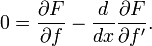
I have another question too, this one is math related though. Most of the resources I've looked at state that the condition for an extremum is that the first variation should be zero. This leads to an integral of the Lagrangian that simplifies to [see attached image] and this leads to Lagrange's equations (something along the lines of
9e97a5aca50b007f0328471e9d1420f8.png


Wiki says that the last step is a result of the "Fundamental Lemma of Calculus of Variations" but I'm just missing something that is supposed to be obvious here, again.

Thank you for your time, any and all help is greatly appreciated.

Elwin
 

Attachments

  • Lagrangian variation.png
    Lagrangian variation.png
    3.9 KB · Views: 519
Physics news on Phys.org
Hamilton's Principle is often mistakenly referred to as the "principle of least action"; to be more accurate it is actually the "principle of stationary action", for the value of the action need not be a minimum.

The Euler-Lagrange equations can actually be derived from D'Alembert's Principle:
[tex]\sum_{i} (F_{i} - m_{i} a_{i})\cdot \delta r_{i} = 0[/tex]

Well, we can easily show that Euler-Lagrange equations (& consequently the principle of stationary action) are consistent with Newton's Second Law. If you want to go deeper though, the origin of the principle of stationary action can be traced back to quantum mechanics. To put it simply, it turns out that the particle actually takes all possible paths from one point to another. Each path is characterised by a phase. Destructive interference occurs when the action is non-stationary while constructive interference happens when the action is at a stationary value, hence that is the path that we observe.

The fundamental lemma of the calculus of variations states that for a functional
[tex]J[f(x)] = \int_{a}^{b} f(x) g(x) dx = 0[/tex]
if g (a) = g (b) = 0 ie. g (x) = 0 at the endpoints, then it follows that f (x) must be equal to 0 over the interval [a,b]. The proof is available in most texts and online sources.
 
Fightfish said:
Hamilton's Principle is often mistakenly referred to as the "principle of least action"; to be more accurate it is actually the "principle of stationary action", for the value of the action need not be a minimum.

The Euler-Lagrange equations can actually be derived from D'Alembert's Principle:
[tex]\sum_{i} (F_{i} - m_{i} a_{i})\cdot \delta r_{i} = 0[/tex]

Well, we can easily show that Euler-Lagrange equations (& consequently the principle of stationary action) are consistent with Newton's Second Law. If you want to go deeper though, the origin of the principle of stationary action can be traced back to quantum mechanics. To put it simply, it turns out that the particle actually takes all possible paths from one point to another. Each path is characterised by a phase. Destructive interference occurs when the action is non-stationary while constructive interference happens when the action is at a stationary value, hence that is the path that we observe.

The fundamental lemma of the calculus of variations states that for a functional
[tex]J[f(x)] = \int_{a}^{b} f(x) g(x) dx = 0[/tex]
if g (a) = g (b) = 0 ie. g (x) = 0 at the endpoints, then it follows that f (x) must be equal to 0 over the interval [a,b]. The proof is available in most texts and online sources.

I'm aware of the distinction, but I understand that in most cases this is a minimum, hence the name (I've read the sections in Goldstein, Landau and Marion).

I'm less concerned about how to derive the equations (I have a functional understanding [no pun intended] I've solved the problems in Landau and in Marion), and more concerned with understanding why using q and q-dot specifies the system entirely (I'm also familiar with the basics of path integral formulation, so I know where the equations come from in this sense too [via A. Zee's text]).

Is this like knowing the momentum and position of a particle and knowing it's evolution from then on? (This is something else that I've been told but I haven't actually seen, I just know it to be true). I am just having some sort of basic problem here.

If I understand correctly, the goal of most mechanics problems is to determine the state of a system at a given time based on some initial conditions and the equations of motion that we derive from the information given. In a basic one dimensional case, this could be discovering that springs oscillate harmonically (or in a more complicated setting showing the the path of the end of the string with some sort of dampening). But the equation comes down to
something in the form of
x(t)= ___ or A(x,t)=___ some actual description of the systems position for a given time (or time and x coordinate)
Do you see what I'm asking about? I'm just not sure what is meant by the q and q-dot representing the system. (I understand these are generalized coordinates, too)

I guess I'll just Google a proof for the fundamental lemma, then.

Edited for clarity**
 
Last edited:
Elwin.Martin said:
more concerned with understanding why using q and q-dot specifies the system entirely
The key part of that is that the E-L equations, just like Newton's second law, is a differential equation of the form [tex]x''(t)=f(x(t),x'(t),t)[/tex] where f is a nice enough function to ensure that we can use the existence and uniqueness theorem that says that such an equation has exactly one solution for each initial condition of the form [itex]x(t_0)=x_0,\ x'(t_0)=v_0[/itex].
 

Similar threads

  • · Replies 12 ·
Replies
12
Views
2K
  • · Replies 13 ·
Replies
13
Views
3K
Replies
5
Views
2K
  • · Replies 1 ·
Replies
1
Views
1K
  • · Replies 25 ·
Replies
25
Views
3K
  • · Replies 4 ·
Replies
4
Views
2K
  • · Replies 18 ·
Replies
18
Views
2K
  • · Replies 25 ·
Replies
25
Views
3K
  • · Replies 1 ·
Replies
1
Views
1K
  • · Replies 23 ·
Replies
23
Views
4K