SUMMARY
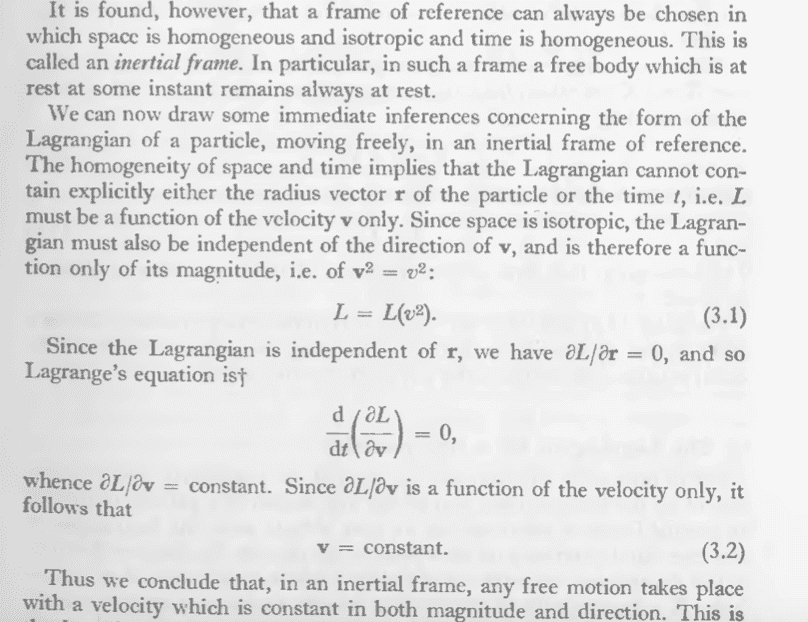
The discussion centers on the derivation of the conclusion that velocity (v) is constant when the Lagrangian (L) is dependent solely on v. The participants clarify that if the derivative of L with respect to v is a function of v, then the time derivative of that function must equal zero, leading to the conclusion that the rate of change of velocity with respect to time (dv/dt) is zero. This establishes that v remains constant under the given conditions.
PREREQUISITES
- Understanding of Lagrangian mechanics
- Familiarity with calculus, specifically derivatives
- Knowledge of the relationship between velocity and time
- Basic concepts of classical mechanics
NEXT STEPS
- Study the principles of Lagrangian mechanics in detail
- Explore the implications of constant velocity in classical mechanics
- Learn about the role of derivatives in physics
- Investigate the relationship between Lagrangian and Hamiltonian formulations
USEFUL FOR
Students of physics, particularly those studying classical mechanics, as well as educators and researchers interested in Lagrangian dynamics.