Our Beautiful Universe - Photos and Videos
Join the discussion
Registration is free. Ask a follow-up in this thread, or start your own.
2,450 replies · 334K views
Astronomy news on Phys.org
- 7,832
- 4,174
I've been working on creating a few panoramas of various nebulae in the constellation Cygnus for the past few weeks- I'm hoping the final results are print-worthy. The star density in Cygnus is amazing; the large diffuse emission nebulae like IC 1318 and Tulip nebula are tricky to bring out. Last night I took a break from the region near the Tulip nebula and instead imaged NGC 6819; here's the result: first the entire image and then a 1:1 crop:
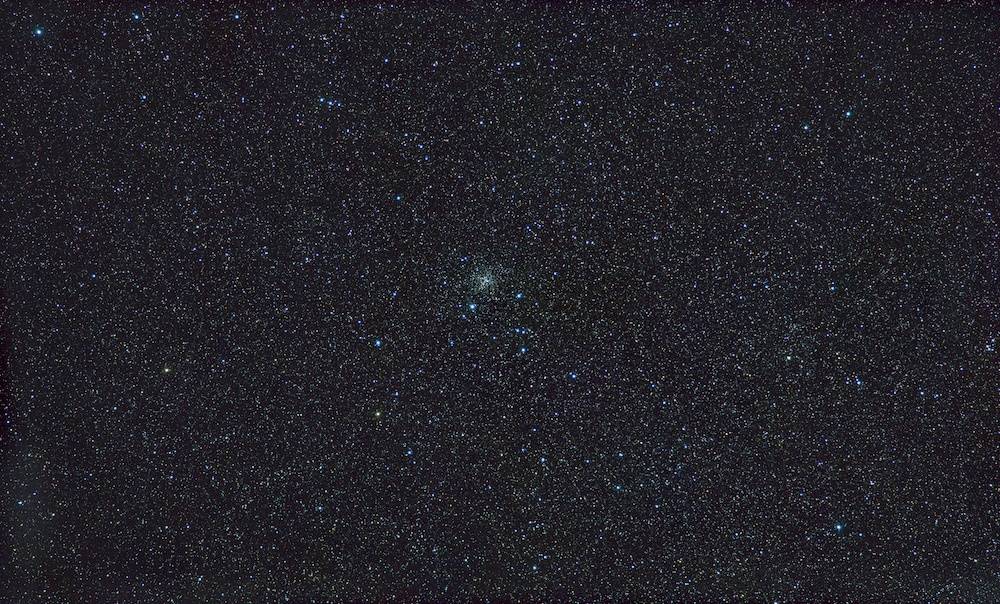
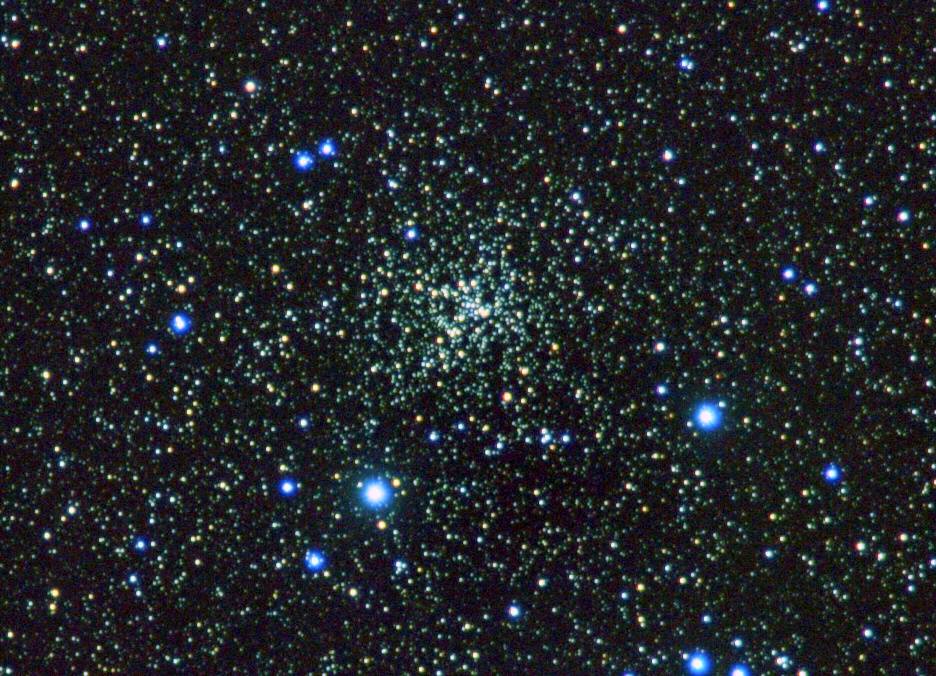
Deets: 45 minutes total integration @400/2.8 ISO 64, acquired 15 seconds at a time. I am particularly pleased that almost 50% of the acquired images were 'stackable'.
Deets: 45 minutes total integration @400/2.8 ISO 64, acquired 15 seconds at a time. I am particularly pleased that almost 50% of the acquired images were 'stackable'.
- 7,832
- 4,174
Here's a preliminary panorama of the Milky Way, scaled down to 6%:
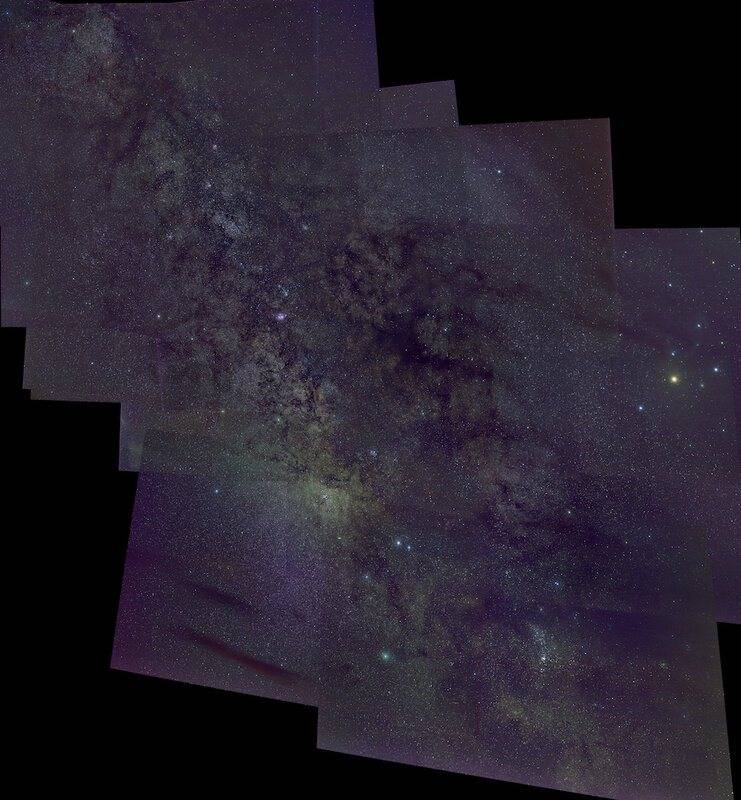
Images taken at 105/1.4, 2s @ ISO 64, about 40 images per stack. No tracking mount- took these images while on vacation. There is some trailing apparent at 100%, but very tolerable:
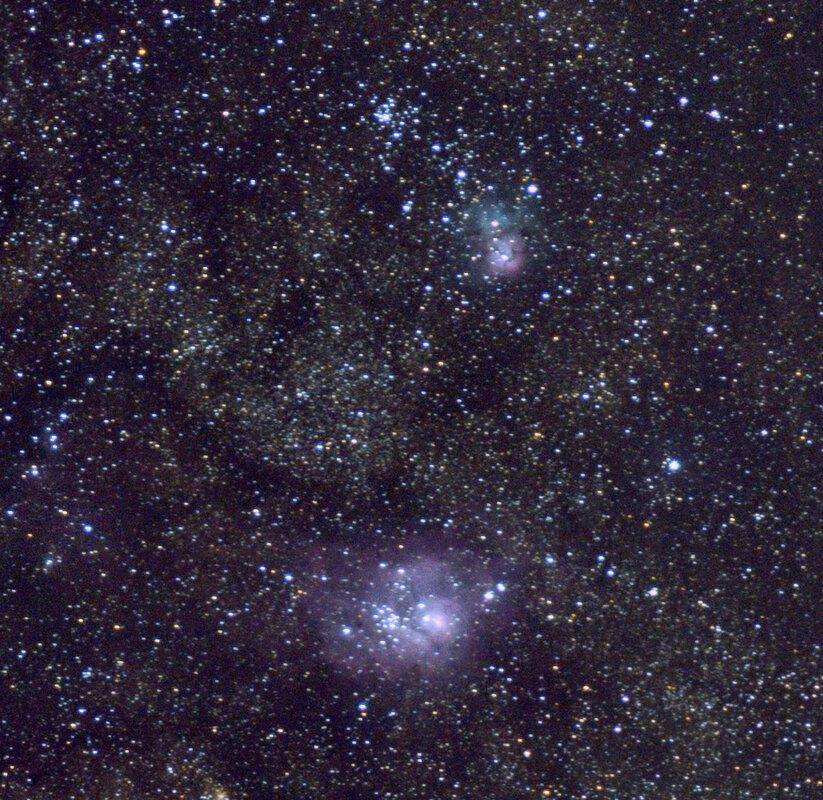
Images taken at 105/1.4, 2s @ ISO 64, about 40 images per stack. No tracking mount- took these images while on vacation. There is some trailing apparent at 100%, but very tolerable:
Mentor
- 23,212
- 7,701
Monochrome image of NGC 3324 in Hydrogen-Alpha taken several years ago that I only processed just now due to not having any other color data. And since it's in the southern sky I'd have to rent an online telescope to get more data, which I can't do at the moment.
@phinds I think I see your face in here!
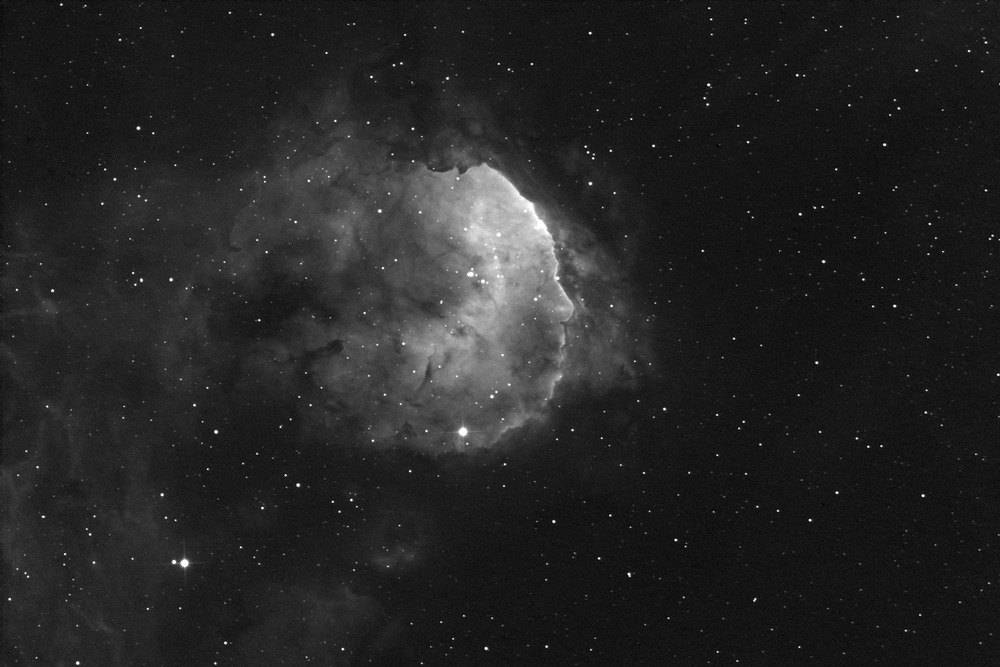
@phinds I think I see your face in here!
- 19,385
- 15,622
bruha
- 395
- 532


Mentor
- 23,212
- 7,701
bruha said:Can I ask what is online telescope ..? I never heard about this...
Check out: https://www.itelescope.net/
You can rent time to use their telescopes if you don't have your own gear or if you want to image a portion of the sky you can't see from your location.
Science Advisor
Homework Helper
- 3,447
- 3,743
Here's an image of Saturn from last Wednesday night (Thursday morning UT) that I was diligently babysitting the processing for the last couple of days. It started out as 1/3 terabyte of data. This is the final result.

(Midpoint time: 2020-08-20 05:38.0 UT)
It was originally captured with the intent on de-rotation with WinJUPOS, in case there was any weather to be seen other than the usual bands. Which I did originally did, but there wasn't any non-band weather, at least not with what my system is able to resolve. So this image is one that I just stacked without de-rotation to avoid any side effects.
--- Acquisition details --------
Telescope: Meade 10" LX200-ACF on equatorial wedge
Camera: ZWO ASI290MM
TeleVue 2x Powermate (to bring optical system to f/20, 5000 mm)
ZWO Atmospheric Dispersion Corrector (ADC)
ZWO Electronic Filter Wheel
Astronomic Deep-Sky RGB filter set
Taken with a series of 9 individual 4 minute videos in the order of RGBRGBRGB, for 36 minutes of capture data.
As mentioned previously, no de-rotation was done, and the data was stacked using Autostakkert. 50% of frames were kept.
Registax wavelet sharpening was performed indivudually for each Red, Green, and Blue channels.
Color channels were combined in Gimp, where final color balance and contrast adjustments were performed.
--- Special bonus: Jupiter and Callisto ----

(Midpoint time: 2020-08-20 04:10.2 UT)
Same process as above except data captured in 1 minute videos making a total capture time of 9 minutes (RGBRGBRGB). WinJUPOS de-rotation was used for this image.
Unlike images from my previous posts, I did not do any "nudging" in Gimp to Jupiter's moons. So, as you can see, Callisto is not much more than a color fringe in the above image (to the lower left of Jupiter).
(Midpoint time: 2020-08-20 05:38.0 UT)
It was originally captured with the intent on de-rotation with WinJUPOS, in case there was any weather to be seen other than the usual bands. Which I did originally did, but there wasn't any non-band weather, at least not with what my system is able to resolve. So this image is one that I just stacked without de-rotation to avoid any side effects.
--- Acquisition details --------
Telescope: Meade 10" LX200-ACF on equatorial wedge
Camera: ZWO ASI290MM
TeleVue 2x Powermate (to bring optical system to f/20, 5000 mm)
ZWO Atmospheric Dispersion Corrector (ADC)
ZWO Electronic Filter Wheel
Astronomic Deep-Sky RGB filter set
Taken with a series of 9 individual 4 minute videos in the order of RGBRGBRGB, for 36 minutes of capture data.
As mentioned previously, no de-rotation was done, and the data was stacked using Autostakkert. 50% of frames were kept.
Registax wavelet sharpening was performed indivudually for each Red, Green, and Blue channels.
Color channels were combined in Gimp, where final color balance and contrast adjustments were performed.
--- Special bonus: Jupiter and Callisto ----
(Midpoint time: 2020-08-20 04:10.2 UT)
Same process as above except data captured in 1 minute videos making a total capture time of 9 minutes (RGBRGBRGB). WinJUPOS de-rotation was used for this image.
Unlike images from my previous posts, I did not do any "nudging" in Gimp to Jupiter's moons. So, as you can see, Callisto is not much more than a color fringe in the above image (to the lower left of Jupiter).
Mentor
- 23,212
- 7,701
@collinsmark Amazing Saturn photo!
DennisN
Gold Member
- 2,197
- 10,329
Absolutely gorgeous photos of Jupiter and Saturn, @collinsmark !collinsmark said:Taken from my back patio a few nights ago. Jupiter, Ganymede and Io
After I saw your first Jupiter photo I was about to ask if you have shot Saturn too, and then you posted one with Saturn.
 It's very cool and inspiring to see your photos with such amounts of color and detail; to me, who has been looking at Jupiter and Saturn mostly as yellow blobs in my scope lately, your photos come across to me as quite 3D even though they are 2D.
If I understood correctly, you shot individual sequences/films for each channel (RGB), correct? A funny thing is that I've been thinking about that a while ago, but I hadn't put it to test.
Have you tried shooting Mars with this technique?
In my cheap scope, Mars appears like a small, sad, red blob with heavy atmospheric and/or chromatic abberation.
 I haven't been able to get even a basic, decent photo of it.
Gorgeous!Drakkith said:C34-Western Veil Nebula in HA and OIII
My cheap noname Chinese scope.davenn said:ohh ? which scope ?
Andy Resnick said:I've been working on creating a few panoramas of various nebulae in the constellation Cygnus
Very nice! The amount of stars visible is just stunning!Andy Resnick said:Here's a preliminary panorama of the Milky Way
Science Advisor
Homework Helper
- 3,447
- 3,743
Thank you!DennisN said:Absolutely gorgeous photos of Jupiter and Saturn, @collinsmark !
I take the red, green and blue sequences separately (each with their corresponding red, green or blue filter) because my camera is monochrome. This allows me to not deal with the Bayer matrix of a color camera. The Bayer matrix on the camera blocks some light and effectively reduces the resolution of the image.After I saw your first Jupiter photo I was about to ask if you have shot Saturn too, and then you posted one with Saturn.
If I understood correctly, you shot individual sequences/films for each channel (RGB), correct? A funny thing is that I've been thinking about that a while ago, but I hadn't put it to test.
On the other hand, dealing with filters and the filter wheel and combining the colors in post-processing is not without its headaches either. Using a color camera is easier. I have a color camera that I use for certain occasions. But when trying to eke out the best image with something relatively stable in the sky (like most celestial objects) I'll choose the monochrome camera and filter wheel.
(Oh, and just so we're clear, I wouldn't use color filters together with a color camera. With a color camera, the only filters I would use is a UV/IR blocking filter and/or a light pollution filter. If you have a color camera, by all means take all three color channels together at the same time!)
For the images I posted of Saturn and Jupiter, I used a technique called "Lucky Imaging." Here's an article on it. By the way, as a rule of thumb, I pretty much always use 50% of images for stacking.
https://skyandtelescope.org/astronomy-blogs/imaging-foundations-richard-wright/lucky-imaging/
I used FireCapture (free software) to control the camera and filter wheel when actually taking the data from the camera. The individual frames were stored in the form of .ser video files. I could have used .avi files, but .ser is becoming more standard for astrophotography these days.
http://www.firecapture.de/
The stacking software was Autostakkert! (this is done later, like maybe the next morning or day).
https://www.autostakkert.com/
The wavelet sharpening (this is where the images goes from a somewhat blurry blob to something quite sharp) was done with Registax. In the future, I might do this step in Pixinsight. But I wanted to do all the planetary images I posted here with free software, so I used Registax and that does a good job. If you've never used Registax before, it's also capable of stacking (and was the first widely available program to do it). But I do my stacking with Autostakkert! If you want to use Registax just for the wavelet sharpening, just open your image file (like something in .tif filetype) and it will jump straight into the wavelet sharpening.
https://www.astronomie.be/registax/
And finally, instead of using Photoshop (I used to use Photoshop until they switched over to their subscription only platform) I use Gimp for color adjustments, contrast adjustments, and final editing. Gimp is free and pretty capable.
https://www.gimp.org/
Not yet, but I'm planning on it. Mars opposition is October 13 (in 2020) so any night around that time, even roughly, would be a good time to image it.Have you tried shooting Mars with this technique?
Here's my planetary imaging setup (laptop and cables not shown):
I adjust the atmospheric dispersion corrector (ADC) by removing the filter wheel and camera and putting in a 1.25" diagonal and eyepiece in their place, which just happens to be nearly parfocal, in my case. Either that, or I'll swap out the monochrome camera with the color camera for the ADC adjustments.
It's easier to do ADC adjustments in color where you can see the chromatic fringing. Otherwise it's difficult to tell the difference between focusing problems and ADC problems.
Then I put the filter wheel and monochrome camera back in place and image.
Here's a cropped part of the a single frame that I took of Saturn (this particular frame was one of many that had the Red filter in the optical train):
It looks pretty noisy, huh. It's supposed to be that way!
(Well, I should say it's at least expected to be that way.) My goal is to get as many frames per second, as fast as possible (within reason -- it can't be all noise; the planet has to be clear enough such that the software like Autostackkert! is able to perform its image stabilization). So my camera (USB3.0 capable) is chugging away at about ~78 fps, which limits my shutter speed to be around 12-13 ms. The dominant noise source under those conditions is the camera's CMOS sensor's read noise. Those are the reasons I chose the ZWO ASI290MM for planetary imaging: it's USB3.0 capable for fast frame rate downloads, it has a fairly decent read noise, and it doesn't break the bank (compared to other astrophotography cameras). By the way, if you're choosing a camera for planetary imaging only, don't bother with a cooled camera (unless you already have one, or want the same camera for both planetary and deep sky); thermal noise is not the dominant noise source in planetary imaging, it's read noise that matters here (to be thorough, some of the noise you see in the above frame is Shot noise of individual photons coming from the planet itself -- but it's not thermal noise, is my point). Cooling the camera doesn't really help much here.From there you let the magic of the Central Limit Theorem get rid of the noise for you. That's what the stacking is all about. Noise, whether it be read noise, Shot noise, or from some other source, is in the form of variation, or standard deviation about the mean. It's the mean of the signal that we're looking for. The standard deviation is what we are trying to minimize. And, per the central limit theorem, if you stack (i.e., average) [itex]N[/itex] individual frames, the standard deviation is multiplied by a factor or [itex]\frac{1}{\sqrt{N}}[/itex], meaning your signal to noise ratio (SNR) increases by [itex]\sqrt{N}[/itex].
For reference, that image of Saturn in post #879 start with raw data at around 56,000 frames per color channel. Half of those were thrown away (per Lucky Imaging), meaning that roughly 28,000 frames or so were stacked for each color channel. That corresponds to an SNR increase of roughly 168 (or roundabouts).
Last edited:
- 13,926
- 16,805
That kind of thing is what put a friend of mine off astronomical instrumentation research. She really doesn't like spiders and someone emailed round a similar photo taken at one of the big telescopes in Chile, only it was a cigarette packet providing scale instead of a USB cable.

DennisN
Gold Member
- 2,197
- 10,329
Speaking of Mars...
Amazing photos in Mars Reconnaissance Orbiter celebration (EarthSky.org)
"NASA has posted a sampling of some of the most awe-inspiring photos of Mars, to celebrate the 15th anniversary of the launch of Mars Reconnaissance Orbiter. They are proof that Mars is a very photogenic world."
Examples:


Amazing photos in Mars Reconnaissance Orbiter celebration (EarthSky.org)
"NASA has posted a sampling of some of the most awe-inspiring photos of Mars, to celebrate the 15th anniversary of the launch of Mars Reconnaissance Orbiter. They are proof that Mars is a very photogenic world."
Examples:
bruha
- 395
- 532


Science Advisor
Homework Helper
Gold Member
- 3,954
- 777
The Moon tonight. Taken with my vintage Montgomery Wards 60mm f/11 “Kohoutek” scope circa 1973 using a Bushnell 20X50 eyepiece with my old prism diagonal. Right out of the iPhone using Procamera. 1/503 sec, ISO 200.


Mentor
- 23,212
- 7,701
chemisttree said:The Moon tonight. Taken with my vintage Montgomery Wards 60mm f/11 “Kohoutek” scope circa 1973 using a Bushnell 20X50 eyepiece with my old prism diagonal. Right out of the iPhone using Procamera. 1/503 sec, ISO 200.
Very nice. Just goes to show how not to judge a book by its cover. Or a scope by its dust.
Science Advisor
Homework Helper
Gold Member
- 3,954
- 777
The Lunar ‘X’ tonight. I got to it a little late and it looks more like a ‘K’ but it’s there. 60mm X 700 scope with a Celestron 9mm ortho (0.965”). Sooo difficult to get a good shot with an exit pupil < 1mm (78X on a 60mm is 0.77mm exit pupil).

Last edited:
Mentor
- 23,212
- 7,701
A quick word of advice for all of you astrophotographers out there: Take care of your gear! I've been having increasingly worsening problems with the connection between my filter wheel and my camera (SBIG ST-2000XM and CFW8) over the past few weeks. I emailed Bill Lynch over at SBIG support and was getting ready to send my camera and filter wheel into get looked at when I finally took a very close look at the pins on the connector. They were corroded! A little bit of acetone and a cheap plastic paintbrush to scrub with seems to have solved all of my connector problems.
Science Advisor
Homework Helper
Gold Member
- 3,954
- 777
Were your pins gold coated when new? I hear spider urine is tough on connection pins. 
DennisN
Gold Member
- 2,197
- 10,329
It reminds me of the spider in the telescope in the comic book "Tintin - The Shooting Star":Drakkith said:If I have spiders in my connectors, I'm quitting this hobby!
Mentor
- 23,212
- 7,701
DennisN said:It reminds me of the spider in the telescope in the comic book "Tintin - The Shooting Star":
Reminds me of the time I had a moth fly into my Schmidt-Newt right before an imaging session. Both ends of the tube are sealed, and the only way for anything to get in is to fly down the focuser assembly in the 30 seconds between taking the cover off and inserting my camera. And that's exactly what happened. Luckily the moth got bored pretty quickly and settled down on the side/bottom of the tube and didn't cause a problem.
DennisN
Gold Member
- 2,197
- 10,329
One step closer to a motorized focusing mechanism...DennisN said:I've also been toying with the idea of building a motorized focusing mechanism, using a small dc motor (in some way attached to the focuser) which then is controlled by a hand control with four buttons...(coarse focus +/- and fine focus +/-).
I might try doing it some day.
...today I got 10 small DC motors and a kit with small gears and shafts etc. which I ordered on Amazon:
DC Motors (they are quite small, about 2-3 cm)
Gears and Shafts kit:
- 7,832
- 4,174
A preliminary panorama of a portion of Cygnus inspired by this image:

this is 8% of the original size. It's not bad, but the nebulosity is really hard to pull out: I had to take flat-field correction to a whole new level- if I understand the program output, the background level of the 32-bit FITS image is flat to an RMS of 1 part in 10^11.
Some image information: the image referenced in the link corresponds to a field of view of about (35mm equivalent) 300mm focal length, I used a 400mm lens to assemble this. If instead I image the region with a 105mm lens, it just doesn't work as well:

this is 8% of the original size. It's not bad, but the nebulosity is really hard to pull out: I had to take flat-field correction to a whole new level- if I understand the program output, the background level of the 32-bit FITS image is flat to an RMS of 1 part in 10^11.
Some image information: the image referenced in the link corresponds to a field of view of about (35mm equivalent) 300mm focal length, I used a 400mm lens to assemble this. If instead I image the region with a 105mm lens, it just doesn't work as well:
Mentor
- 23,212
- 7,701
@Andy Resnick You using a DSLR?
- 7,832
- 4,174
Drakkith said:@Andy Resnick You using a DSLR?
Yep- Nikon D810.
Mentor
- 23,212
- 7,701
Well, I just bit the bullet and bought an Atik One 9.0 to replace my nearly twenty-year-old SBIG ST-2000XM. I feel a bit guilty, as I had to use my credit card and probably shouldn't have spent the money, but I've been putting off an upgrade for the better part of a decade while I tried to do the college thing and now the family thing and I just couldn't wait any longer. Especially since SBIG isn't even sure they have the parts to repair the ST-2000 and its accessories anymore.
I chose the Atik One 9.0 because it was the most affordable option for a camera & filter wheel with the ICX814 sensor. When binned 2x2 the sensor has almost exactly the same pixel size as my ST-2000 but with more than double the sensitivity in parts of the spectrum (especially the HA & SII bands), a slightly larger FOV, half the read noise, and about 1% the dark current* (according to Atik's specs). A substantial improvement.
*Atik's website lists the dark current at 0.0002 e-/p/s at -10°c, while Diffraction Limited lists their camera with the same sensor as 0.025 e-/p/s at 0°c, so I'm not sure which one is more accurate. At worst, it's still less than half the dark current.
I chose the Atik One 9.0 because it was the most affordable option for a camera & filter wheel with the ICX814 sensor. When binned 2x2 the sensor has almost exactly the same pixel size as my ST-2000 but with more than double the sensitivity in parts of the spectrum (especially the HA & SII bands), a slightly larger FOV, half the read noise, and about 1% the dark current* (according to Atik's specs). A substantial improvement.
*Atik's website lists the dark current at 0.0002 e-/p/s at -10°c, while Diffraction Limited lists their camera with the same sensor as 0.025 e-/p/s at 0°c, so I'm not sure which one is more accurate. At worst, it's still less than half the dark current.
Last edited: