Paddle Wheel Torque Calculations

Click For Summary

Discussion Overview

The discussion revolves around the calculations needed for the design and propulsion of a paddle wheel drive houseboat. Participants explore the power requirements, torque calculations, and the efficiency of the proposed system, including the characteristics of the hull and paddle design.

Discussion Character

  • Technical explanation, Exploratory, Debate/contested

Main Points Raised

  • Bert outlines the specifications of his paddle wheel drive houseboat, including dimensions, desired RPM, and expected speed.
  • One participant emphasizes the importance of calculating the power required to propel the boat, suggesting that the power output from the hydraulic motors may be insufficient for the estimated displacement of the hulls.
  • Another participant introduces a formula relating horsepower to speed and displacement, providing a calculated power requirement for the boat.
  • Questions arise regarding the empirical coefficient 'k' used in the horsepower formula, with participants seeking clarification on its meaning and application.
  • Further discussion reveals that 'k' varies based on hull design, with specific values provided for hard chine and rounded hulls.
  • Participants express interest in determining the appropriate value of 'k' for pontoon hulls, noting that it may depend on the hull's section and operational speed.

Areas of Agreement / Disagreement

There is no consensus on the adequacy of the proposed propulsion system, as participants have differing views on the power requirements and the characteristics of the hull design. The discussion remains unresolved regarding the specific value of 'k' for pontoon hulls.

Contextual Notes

Participants acknowledge potential limitations in their estimates, such as assumptions about hull displacement and the empirical nature of the coefficient 'k'. The discussion also reflects uncertainty regarding the applicability of certain formulas to the specific design of the houseboat.

bertbcfm
Messages
1
Reaction score
0
I'm designing a paddle wheel drive house boat and need to do some calculations to see if the parts I have on hand can do the job.

Paddle wheels will be 6' dia. with 8 paddles by 3' long . Paddles will be 3' long by 10" and will have the tops of the paddles submerged by 2" to 3" when the paddle is vertical.

I want the mid to high end RPM to be about 56 Rpm. I figure this will give me about 10 Mph with 20% loss from the hull and paddle efficiency loses. Hull is 3 - 25' aluminum pontoons no more than 50% submerged.

I'll be driving the paddle wheels with 2 Hydraulic motors that will Rpm at 556 with 458 lb-in torque. Probably chain drive reduced 10 to 1. Flow and pressure are not an issue to produce, but I'm wondering if the motors will be up to the task.

Any help or direction to resources would be appreciated.

Regards
Bert
 
Physics news on Phys.org
Hi Bert.
First, a belated welcome to PF.

There is no mention of power or energy in your question.
Rule number one; follow the energy.

We will first need to know the power required to push the three displacement hulls through the water.
To estimate that power we need the hull profile, the displacement and the speed.
Convert 10 mph to v = 8.7 knots.
I will assume the 25 foot long hulls are hard chine, and the displacement is 3 tonne.

Based on my old diagram, that makes k = 2.4 where v = k * Sqrt( HP / d ); in units of knots, horsepower and tonnes displacement.

We now consider each hull independently, each displacing 1 tonne. HP = d * ( v / k )²;
HP = ( 8.7 / 3.4 )² = 6.55 HP per hull. Total HP = 19.64, call it 20 HP.
Each hydraulic motor will need to develop 10 HP, = 7.5 kW.

You specified motor torque = 458 lb·in and speed 556 RPM.
I convert that to 51.75 Newton and 58.25 rad/sec.
Power is the product = 51.75 * 58.25 = 3015 watt = 3 kW.

The power available from the motors is less than half that needed to push the boat through the water at 10 mph.

My displacement guess of 3 tonne is probably an underestimate, so the propulsion system you are planning is significantly under-powered.

If this question had been in an engineering forum it might have received a faster reply.
 
What is k in the HP formula and which diagram are you referring to
 
sami173 said:
What is k in the HP formula
Baluncore said:
k = 2.4 where v = k * Sqrt( HP / d ); in units of knots
 
Baluncore said:
Based on my old diagram, that makes k = 2.4
The 2.4 was an empirical coefficient for hard chine displacement hulls.

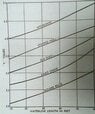
The diagram was in an old book on boat design, that gave a guide to hull speeds for powers, with different types of hull and mode of operation. I will see if I can find it again. There are probably better references now.
 
  • Like
Likes   Reactions: sami173
@sami173 Welcome to PF.

Fast Boats. A Guide to Speed Under Sail and Power.
By John Teale. 1961. Diagram is on page 27.
For a 25 foot water line length, the rounded hull had k = 2.4 while the hard chine had k = 2.9
I conservatively reduced the speed estimate for power by using the lower k value for a rounded hull.
 

Attachments

  • Fast Boats.jpg
    Fast Boats.jpg
    31.8 KB · Views: 123
  • Informative
  • Like
Likes   Reactions: sami173 and berkeman
Can i get value of k for a pontoon
 
sami173 said:
Can i get value of k for a pontoon
It depends on the section, and how fast you push the pontoon.
At slow speeds, it will act like a rounded hull or a hard chine, depending on the section.
If it planes, with the nose out of the water, it becomes a sea sled.
 

Similar threads

  • · Replies 20 ·
Replies
20
Views
2K
  • · Replies 19 ·
Replies
19
Views
4K
  • · Replies 24 ·
Replies
24
Views
3K
  • · Replies 4 ·
Replies
4
Views
4K
  • · Replies 1 ·
Replies
1
Views
5K
  • · Replies 2 ·
Replies
2
Views
5K
  • · Replies 12 ·
Replies
12
Views
3K
  • · Replies 1 ·
Replies
1
Views
2K
  • · Replies 58 ·
2
Replies
58
Views
9K
  • · Replies 8 ·
Replies
8
Views
7K