Discussion Overview
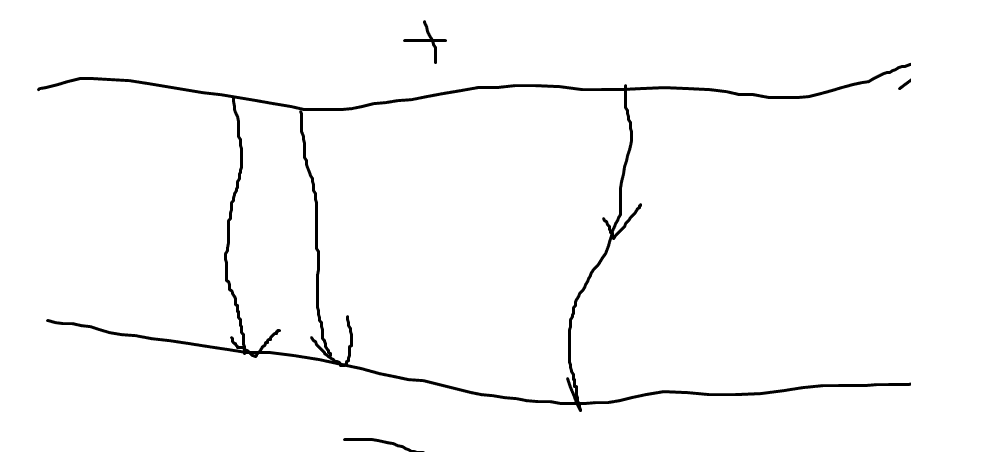
The discussion revolves around the conventions for drawing electric field lines and vectors, particularly in the context of parallel plate capacitors. Participants explore the representation of field lines, the placement of arrows, and the significance of fringe fields in diagrams.
Discussion Character
- Conceptual clarification
- Debate/contested
Main Points Raised
- One participant questions whether there is a convention for field line arrows touching the plates or if it is merely a preference.
- Another participant states that field lines are curves tangent to the vector field and do not necessarily require arrows, although arrows can clarify representation.
- Some participants note that they have seen arrows placed both at the end and in the middle of lines for different contexts, such as electric fields in capacitors versus magnetic fields around dipoles.
- A participant mentions that the "fringe field" outside the capacitor plates is relevant only when the plate separation is comparable to the plate size, suggesting that its contribution to capacitance is usually negligible.
- There is a discussion about whether arrows represent field vectors or field lines, with a focus on the importance of field lines touching the plates rather than the position of arrowheads.
- One participant emphasizes that field lines must start and end on the plates due to the presence of charges, referencing the divergence of the electric field.
Areas of Agreement / Disagreement
Participants express differing views on the conventions for drawing field lines and the significance of arrow placement, indicating that multiple competing views remain without a consensus.
Contextual Notes
Participants highlight the importance of context in determining how field lines and vectors should be represented, suggesting that assumptions about the relevance of fringe fields and the placement of arrows may vary based on specific scenarios.