Phase and amplitude spectrum of signal

Click For Summary
SUMMARY

This discussion focuses on calculating the amplitude and phase spectrum of a periodic signal using complex Fourier series. The formula for the Fourier coefficients is given as $$Fn=\frac{1}{T}\int_{0}^{T}f(t)e^{-j\frac{2n\pi t}{T}} dt$$, leading to the expressions for amplitude $$|Fn|$$ and phase $$\Theta n$$ spectra. Participants emphasize the importance of treating the DC term at $$n=0$$ separately and discuss the implications of time shifts on the phase spectrum. The consensus is that the amplitude spectrum remains unchanged, while the phase spectrum is modified by a complex exponential factor.

PREREQUISITES
  • Complex Fourier series
  • Understanding of periodic signals
  • Mathematical rigor in evaluating limits and integrals
  • Knowledge of phase and amplitude spectrum concepts
NEXT STEPS
  • Study the derivation of complex Fourier series coefficients in detail
  • Learn about the implications of time shifts on Fourier transforms
  • Explore the application of L'Hôpital's rule in continuous versus discrete contexts
  • Investigate the properties of periodic signals and their Fourier representations
USEFUL FOR

Students and professionals in engineering, particularly those focusing on signal processing, Fourier analysis, and related mathematical concepts.

etf
Messages
179
Reaction score
2
Hi!

1. Homework Statement


My task is to calculate amplitude and phase spectrum of this signal:
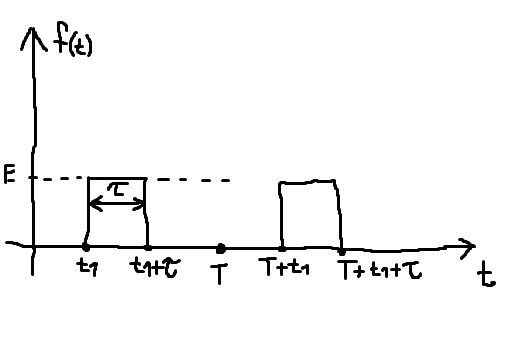
postavka1.jpg


Homework Equations


My idea is to calculate complex Fourier series of this signal, $$f(t)=\sum_{n=-\infty}^{n=+\infty}Fne^{j\frac{2n\pi t}{T}},$$ where $$Fn=\frac{1}{T}\int_{0}^{T}f(t)e^{-j\frac{2n\pi t}{T}}. $$Fn will be some complex number, which can be written as $$|Fn|e^{j\Theta n},$$ where $$|Fn|$$ is amplitude spectrum and $$\Theta n$$ is phase spectrum.

The Attempt at a Solution


I got $$Fn=\frac{E\tau }{T}\frac{\sin{(nw0\tau /2)}}{nw0\tau /2}e^{-jnw0(t1+\tau /2)}, $$ where w0=2*pi/T. We see that phase spectrum is $$\Theta n=-nw0(t1+\tau /2)$$ and amplitude spectrum is $$|Fn|=\frac{E\tau }{T}\frac{\sin{(nw0\tau /2)}}{nw0\tau /2}.$$ Now for some values of $$\tau, $$ $$E$$ and $$T$$ I can plot amplitude and phase spectrum as function of n?

[/B]
 
Last edited:
Physics news on Phys.org
Yeah, that looks right to me. :)

The assumption of course is that f(t) is periodic, and that same period repeats itself from -infinity to infinity. (Otherwise you need to use the Fourier transform instead.)

By the way, notation wise, you forgot your dt when setting up your integral, and I'm also assuming that several times when you wrote Fn you actually meant F_n. Other than stuff like that, it looks good to me.
 
  • Like
Likes etf
What about the value at n=0 ?
 
  • Like
Likes etf
There must be a dc term too.
 
lazyaditya said:
What about the value at n=0 ?

lazyaditya said:
There must be a dc term too.

Yes, that's right. Perhaps one could try to evaluate the limit of \frac{\sin x}{x} as x \rightarrow 0.

(Hint: l'Hôpital to the rescue)

[Edit: btw, lazyaditya, recall that n goes from -\infty to \infty. So n = 0 is in the middle there somewhere. :)]
 
Last edited:
L'hospital rule can't be applied to discrete sequence and since Fourier series of a periodic signal is discrete in nature thus dc term need to be calculated by keeping n=0 in the equation used for calculating Fourier series coefficient .
 
lazyaditya said:
L'hospital rule can't be applied to discrete sequence and since Fourier series of a periodic signal is discrete in nature thus dc term need to be calculated by keeping n=0 in the equation used for calculating Fourier series coefficient .

Correct, if you want to be mathematically rigorous about it, one cannot technically use l'Hopital's rule for a discrete value, as you say. This thread was posted in the engineering section though. We're not the most rigorous bunch.

[Edit, But yes, lazyaditya's method is preferred; it is mathematically better and less likely to get you into trouble in future problems. Treat n = 0 differently than all the other ns, if you would otherwise find yourself in a divide by 0 situation. Evaluate the integral substituting 0 for n in the original integral to produce F_0 specifically. It turns out in this case the answer you get is the same either way (such as using the non-rigorous \frac{\sin x}{x} =1, when x approaches 0) in this particular problem, but the rigorous approach is better in general.]
 
Last edited:
@collinsmark
Yes, I forgot dt and I didn't know how to write "n" in index :)
@https://www.physicsforums.com/members/lazyaditya.394087/
I didn't notice that for n=0, Fn is undefined. With substitution n=0 in Fn I got F0=E*tau/T.

 
And that's general rule when Fn is undefined for some value n, I put n in original formula and calculate?
 
  • #10
One more question: If I have $$|Fn|$$ and $$\Theta n$$ of some signal $$f(t),$$ and I want to calculate phase and amplitude spectrum of $$f(t+t1),$$ where t1 is some time shift, can I use phase and amplitude spectrum which I have already found for $$f(t)$$ to calculate phase and amplitude shift for $$f(t+t1)$$, or I have to start with calculation from beginning (Represent f(t+t1) in terms of complex Fourier series, calculate |Fn| etc)?
 
  • #11
Yes, you can use it.
 
  • #12
So if $$f(t)=\sum_{n=-\infty }^{n=\infty }Fne^{jnw0t}, $$ $$f(t+t1)$$ will be $$\sum_{n=-\infty }^{n=\infty }Fne^{jnw0(t+t1)}$$ and it will have same amplitude and phase spectrum as $$f(t)$$? I'm sorry to bother you but I have exam very soon and I'm trying to learn it...
 
  • #13
Yes it is correct and you are not bothering anyone .
 
  • #14
etf said:
One more question: If I have $$|Fn|$$ and $$\Theta n$$ of some signal $$f(t),$$ and I want to calculate phase and amplitude spectrum of $$f(t+t1),$$ where t1 is some time shift, can I use phase and amplitude spectrum which I have already found for $$f(t)$$ to calculate phase and amplitude shift for $$f(t+t1)$$, or I have to start with calculation from beginning (Represent f(t+t1) in terms of complex Fourier series, calculate |Fn| etc)?

Changing f(t) \rightarrow f(t + t_1) will cause a difference in the phase response. Specifically, the new result will be the old result multiplied by a complex spiral, sometimes called a corkscrew function, of the form e^{j n \{ \mathrm{something} \} t_1}. In other words, F_n \rightarrow F_n e^{j n \{ \mathrm{something} \} t_1}. I'll let you work out what that something is.
 
Last edited:
  • #15
I think I got it :) I created new thread with some problem which involve time shift...
 

Similar threads

  • · Replies 12 ·
Replies
12
Views
3K
  • · Replies 8 ·
Replies
8
Views
3K
  • · Replies 1 ·
Replies
1
Views
1K
  • · Replies 6 ·
Replies
6
Views
2K
  • · Replies 18 ·
Replies
18
Views
3K
  • · Replies 6 ·
Replies
6
Views
5K
  • · Replies 3 ·
Replies
3
Views
2K
  • · Replies 1 ·
Replies
1
Views
2K
  • · Replies 8 ·
Replies
8
Views
2K
Replies
19
Views
3K