Plane Waves vs. Waves on a String

Click For Summary

Discussion Overview

The discussion revolves around the nature of plane waves and electromagnetic (EM) waves, particularly in the context of photons and their associated electric (E) and magnetic (B) fields. Participants explore the conceptual differences between idealized plane waves and real-world wave phenomena, including their oscillatory behavior and representation in diagrams.

Discussion Character

  • Conceptual clarification
  • Debate/contested
  • Technical explanation

Main Points Raised

  • One participant expresses confusion about the representation of photons and the nature of E and B fields, questioning how these fields behave as a photon travels past a point.
  • Another participant challenges the interpretation of a diagram, asking if it represents a single photon or a ray of light, indicating a potential misunderstanding of the visual representation.
  • Some participants clarify that the more energetic photons correspond to faster oscillations of the E and B fields, linking energy to frequency.
  • A participant explains that a plane wave is a mathematical construct that does not correspond to reality, using the analogy of water waves to illustrate how real waves behave differently from idealized models.
  • There is a discussion about the oscillation of E and B fields at each point along the wave, with participants noting that these fields oscillate back and forth perpendicular to the direction of wave propagation.

Areas of Agreement / Disagreement

Participants generally agree on the oscillatory nature of E and B fields in electromagnetic waves, but there is some disagreement regarding the interpretation of diagrams and the distinction between photons and rays of light. The discussion remains unresolved on certain conceptual clarifications.

Contextual Notes

Some limitations include the dependence on idealized models versus real-world phenomena, and the potential confusion arising from visual representations of waves. The discussion does not resolve the complexities of these concepts.

WarPhalange
I already took 3 quarters of EM and I'm ashamed to say I didn't learn anything the final quarter, where we covered the most interesting topics. Bah.

One thing that I'm still confused about are plane waves. I understand the description of a regular sine wave on string. If you wiggle it once, you'll get a single wave traveling along the string and I can tell you the amplitude and how fast it's going and where it is.

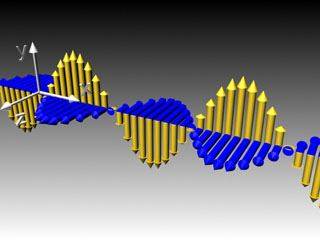
I've also seen pictures like this depicting a photon:
07-EB_Light_320.jpg


Where E and B are perpendicular to one another and the photon is traveling in the direction of propagation of both. But what I don't get are the E and B fields actually. A more energetic photon will have higher frequencies for the E and B fields, correct?

But where are these fields? Let me explain. I'll take the Yellow arrows as being the E field, and I am standing at a point where E = 0. Then, as a photon zooms by me, will I gradually feel the E-field increase to a maximum and then decrease back to 0, then go negative, and finally back to 0 and then it will stay at 0 forever? Where the time it takes for this to happen is the 1/frequency of the photon (so one wavelength).

Because that picture makes it seem like the E and B fields extend infinitely in the x direction, which is where the photon is traveling.
 
Science news on Phys.org
WarPhalange said:
I've also seen pictures like this depicting a photon:

Do the MIT pages really claim that this represents a single photon? Can you give a link to a page that states that? That diagram looks like the ones that you find in many textbooks describing classical electromagnetic waves.
 
Well then that's where my confusion stems from I suppose. That's not a single photon, but a ray of light, then?

And the EM wave will always stay the same because that's just the phase that the light is in? Or will the EM fields still oscillate?
 
You're correct in your original post: the more energetic photons would have E and B fields oscillating faster. Afterall, energy of a photon is defined by the frequency of oscillations of E/B fields.
MIT page is showing you a continuous monochromatic (single frequency) electromagnetic wave. You can also have pulsed electromagnetic waves (like the ones I'm sending and receiving right now through my wireless connection on my laptop). In a way you can think of these pulses of EM field as photons, then many of these pulses (with proper phase relationship maintained) would form the wave shown on MIT page.

As for plane wave - its a mathematical construct only. Albeit being useful, it does not correspond to reality, because it extends to infinity - i.e. it comes from infinite source. Here's helpful physical model (which works for this demonstration): the disturbance of water surface due to dropped pebble is circular (such wave is called a spherical wave originating from a point-source). Now, if we drop a stick into the water, you'll notice that disturbance propagates perpendicular to stick (close to the middle of the stick) but there is more circular-looking disturbance closer to the edges. Of course, if you drop an 'infinite' stick you'll get rid of these edge-effects and hence obtain your mathematical equivalent of the (unrealistic) plane wave. Close to the middle of the stick though, plane wave looks like a good approximation of the disturbance however, so that's why we use it.

I hope this is clear and addresses your questions!
Cheers
 
WarPhalange said:
That's not a single photon, but a ray of light, then?

A plane EM wave is an idealization, but it approximately represents the field from a monochromatic point source, far away from the source. Or more practically, inside a laser beam, not too close to the edge of the beam.

And the EM wave will always stay the same because that's just the phase that the light is in? Or will the EM fields still oscillate?

At each point along the wave, the E and B fields oscillate back and forth, perpendicular to the propagation direction of the wave, in such a way that the envelope moves forward with speed c.
 
jtbell said:
At each point along the wave, the E and B fields oscillate back and forth.

At each point along the wave's propagation, the E and B fields have a value. The E and B fields oscillate with distance as the wave propagates.

I'm sure that's what you meant. :smile:

Regards,

Bill
 

Similar threads

  • · Replies 13 ·
Replies
13
Views
3K
  • · Replies 1 ·
Replies
1
Views
2K
  • · Replies 6 ·
Replies
6
Views
2K
Replies
8
Views
2K
  • · Replies 4 ·
Replies
4
Views
2K
  • · Replies 4 ·
Replies
4
Views
3K
  • · Replies 8 ·
Replies
8
Views
2K
  • · Replies 2 ·
Replies
2
Views
1K
  • · Replies 20 ·
Replies
20
Views
3K
  • · Replies 11 ·
Replies
11
Views
2K