Pressure gradient in wakes around a cylinder

Click For Summary

Discussion Overview

The discussion revolves around the application of the Navier-Stokes equations to fluid flow around an infinite cylinder. Participants explore the implications of pressure gradients, particularly static and dynamic pressures, and their roles in the equations governing fluid motion. The conversation includes attempts to clarify the definitions and relationships between these pressures, as well as the derivation of specific equations related to the flow dynamics.

Discussion Character

  • Technical explanation
  • Debate/contested
  • Mathematical reasoning

Main Points Raised

  • One participant presents a simplified form of the Navier-Stokes equations, questioning the treatment of pressure gradients in the context of flow around a cylinder.
  • Another participant challenges the initial formulation, asserting that the pressure term in the Navier-Stokes equations refers only to static pressure and not dynamic pressure, and highlights potential misunderstandings of these concepts.
  • A participant expresses confusion regarding the definitions of static and dynamic pressure as presented in their professor's book, suggesting that the definitions may be unconventional.
  • There is a discussion about the stress tensor definition for Newtonian fluids, with participants debating the correct formulation and its implications for the Navier-Stokes equations.
  • Participants explore the consequences of neglecting pressure gradients and how this affects the derivation of equations for two-dimensional stationary flow.
  • One participant raises concerns about the logical consistency of neglecting certain terms while deriving equations, questioning the validity of the approach taken in the professor's material.

Areas of Agreement / Disagreement

Participants do not reach a consensus on the definitions of static and dynamic pressure or the validity of the equations derived from the professor's book. Multiple competing views remain regarding the interpretation and application of the Navier-Stokes equations in this context.

Contextual Notes

There are unresolved issues regarding the assumptions made in the derivation of equations, particularly concerning the treatment of pressure gradients and the definitions of pressure types. The discussion reflects a lack of clarity in the material provided by the professor, which may contribute to the confusion among participants.

dRic2
Gold Member
Messages
887
Reaction score
225
Hi,

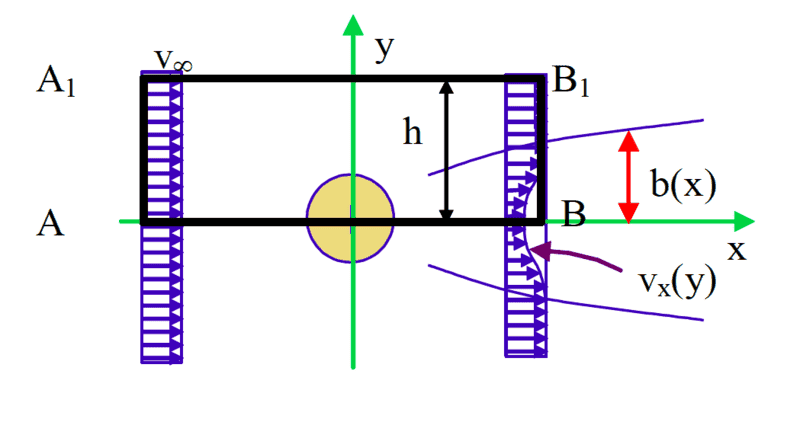
Let's consider a cylinder of infinite length and fluid flowing "over" (I'm not sure of which words I should use, sorry) it like in the figure:
scia.png


Let's consider x>>D in order to neglect what's happening near the rear surface of the cylinder.

Let's get rid of static pressure which doesn't play a role here:

$$\nabla P = \nabla P_{s} + \nabla P_{d}$$

(where ##P_s## refers to static pressure while ##P_d## refers to dynamic pressure)

$$ \frac {D \mathbf v} {Dt} = \nabla \tau - \nabla P_{s} - \nabla P_{d} + \rho \mathbf g $$

Being ##\nabla P_s = -\rho \mathbf g##:

$$ \frac {D \mathbf v} {Dt} = \nabla \tau - \nabla P_{d} $$

Okay, now I found on a book that since x>>D the influence of the object on the flow is minimum so the small changes in the velocity profile suggest that ##\nabla P_{d} = 0##, obtaining the simplified equation:

$$ \frac {D \mathbf v} {Dt} = \nabla \tau $$

Well, it is not clear to me this last step. If ##\nabla P = 0## how is the fluid supposed to move?? Wouldn't ##\frac {D \mathbf v} {Dt}## and ##\nabla \tau## be ##0## as well (##0=0##)?
 

Attachments

  • scia.png
    scia.png
    13.3 KB · Views: 1,006
Physics news on Phys.org
I am a little confused about what you are doing here. It appears that you tried to write down the Navier-Stokes equations but it isn't correct. First, there should be a ##\rho## term over by your velocity derivative. That could just be a typo, however, but the rest of it has more fundamental problems. In particular, the pressure term in the Navier-Stokes equations has nothing to do with dynamic pressure. It refers only to the thermodynamic (or static) pressure. Further, you somehow equated the static pressure gradient with the negative of the gravitational body force, which doesn't seem to make sense in the context of this problem.

I have a feeling you have a fundamental misunderstanding of what static and dynamic pressure actually are. The momentum equation should be
\rho\dfrac{D\vec{v}}{Dt} = \nabla \cdot \tau + \rho \vec{g} = -\nabla p + \nabla \cdot \tau_v + \rho \vec{g}.
Here I made the distinction between ##\tau##, the stress tensor, and ##\tau_v##, the viscous stress tensor. The important thing here is that, again, the ##p## referenced here is thermodynamic (static) pressure. Any talk of the dynamic pressure is wrapped up in that ##\vec{v}## term on the left-hand side (and its components inside of ##\tau_v## of course).

With all that in mind, I don't think your question makes sense.

Also note that a fluid can flow while ##\nabla p=0##. It just can't accelerate (and will likely decelerate if the flow is viscous).
 
  • Like
Likes   Reactions: dRic2
Well thank you very much. You just confirmed the fact that I'm totally lost. The problem is that this is exactly what is written in my professor's book (it's in italian though).

First of all the pressure. I know this is illogical but my prof. does this very often. Here I post a scan of his "book" so you can see (although it's in italian you can still understand the formulas):

Schermata 2018-02-27 alle 20.33.00.png
See? If you want to know what he says in between I can translate but I think it is useless
 

Attachments

  • Schermata 2018-02-27 alle 20.33.00.png
    Schermata 2018-02-27 alle 20.33.00.png
    31.7 KB · Views: 495
It's possible he is defining static and dynamic pressure in an unconventional way. Usually static pressure, ##p##, is taken to mean the thermodynamic pressure and the dynamic pressure is taken to mean
q = \dfrac{1}{2}\rho |\vec{v}|^2.
Total pressure is then usually
p_t = p + q.
I can make out some of the text based on my familiarity with Spanish, but a fair bit eludes me as well. It doesn't look like it contains the information required to figure out what he means, though.
 
boneh3ad said:
It doesn't look like it contains the information required to figure out what he means, though.
It doesn't for sure ahaha

BTW, as you said, in NS equation ##P## refers to static pressure so I still don't understand
 
@boneh3ad I don't want to bother you, but I'm a bit confused right now. Since you said ##\nabla P## refers only to static pressure in NS equations,
image1.png

is this wrong?
 

Attachments

  • image1.png
    image1.png
    1.7 KB · Views: 365
Without knowing the full context of that equation I don't think I could say for sure. It does seem wrong, though.
 
boneh3ad said:
Without knowing the full context

There isn't very much to say... It's just NS equations and he wants to apply them to this case. From what I understood the aim is to say ##\nabla P## and ##\rho \mathbf g## are negligible and write (for bi dimensional and stationary flow):

$$v_x \frac {\partial v_x} {\partial x} + v_y \frac {\partial v_x} {\partial y} = \frac {\partial \tau_{xx}} {\partial x} + \frac {\partial \tau_{xy}} {\partial y}$$
$$v_x \frac {\partial v_y} {\partial x} + v_y \frac {\partial v_y} {\partial y} = \frac {\partial \tau_{yx}} {\partial x} + \frac {\partial \tau_{yy}} {\partial y}$$

My problem is that I don't know how to reach this equation since I don't understand what he's doing to get it
 
Right but he may have a nonstandard definition of his stress tensor. How does he define ##\underline{\underline{\tau}}##?

Sorry for the weird double underline. Apparently that's just how this site's LaTeX interpreter operates.
 
  • #10
Apparently he defines the stress tensor (for Newtonian fluids) as ## \tau = -\mu \left ( \frac {\partial v_i} {\partial x_j} + \frac {\partial v_j} {\partial x_i} \right ) ## (I'm not sure about the sign though) which is the standard way I think

I don't know how to write tensors either...EDIT: I think ## \tau = \mu \left ( \frac {\partial v_i} {\partial x_j} + \frac {\partial v_j} {\partial x_i} \right ) ## is the correct one, since then he writes NS equations as ## \rho \frac {D \mathbf v} {Dt} = \mu \nabla^2 \mathbf v - \nabla P + \rho \mathbf g##
 
Last edited:
  • #11
He would need the negative sign since he has a negative in the original equation to make the sign work out. Anyway, if he insists on using "total" pressure in that pressure term, that could be split up into static and dynamic, that would look like
\nabla p_t = \nabla p + \dfrac{V^2}{2}\nabla\rho + \rho\vec{v}\cdot\nabla\vec{v}
So, assuming ##\nabla\rho = 0##, the form he uses almost makes sense, but only if the LHS had a simple partial derivative with respect to time and not a material derivative. That is, assuming he is using standard definitions of total, static, and dynamic pressure.

I don't think I've missed anything here, but I can't rule it out. At the very least, his method of working with this seems to be rather unusual.
 
  • #12
I thought of that, but if we accept the mistake and use ##\frac {\partial v} {\partial t} ## then there is an other problem. Since he neglects pressure (later on) he would also have to neglect ##\rho v ⋅ \nabla v##, but then he can't write

$$v_x \frac {\partial v_x} {\partial x} + v_y \frac {\partial v_x} {\partial y} = \frac {\partial \tau_{xx}} {\partial x} + \frac {\partial \tau_{xy}} {\partial y}$$
$$v_x \frac {\partial v_y} {\partial x} + v_y \frac {\partial v_y} {\partial y} = \frac {\partial \tau_{yx}} {\partial x} + \frac {\partial \tau_{yy}} {\partial y}$$

because it would be

$$ 0 = \frac {\partial \tau_{xx}} {\partial x} + \frac {\partial \tau_{xy}} {\partial y}$$
$$ 0 = \frac {\partial \tau_{yx}} {\partial x} + \frac {\partial \tau_{yy}} {\partial y}$$

I'm lost and I don't want to abuse your patience ,but is there an other method to reach the above equation?
 
  • #13
Not that I see clearly.
 
  • #14
I'll try to contact him, I don't see an other way...
 

Similar threads

  • · Replies 7 ·
Replies
7
Views
2K
  • · Replies 3 ·
Replies
3
Views
1K
  • · Replies 67 ·
3
Replies
67
Views
6K
  • · Replies 6 ·
Replies
6
Views
1K
  • · Replies 6 ·
Replies
6
Views
2K
  • · Replies 4 ·
Replies
4
Views
6K
  • · Replies 5 ·
Replies
5
Views
2K
  • · Replies 5 ·
Replies
5
Views
1K
  • · Replies 4 ·
Replies
4
Views
2K
  • · Replies 4 ·
Replies
4
Views
2K