Required Strength of a Strap connecting 2 Rolls

Click For Summary

Discussion Overview

The discussion focuses on determining the strength required for a strap to securely connect two large rolls of plastic sheets, each weighing 1000 lbs, for shipping purposes. Participants explore various scenarios and factors that could affect the strap's strength, including angles of tension and the potential for movement during transport.

Discussion Character

  • Exploratory
  • Technical explanation
  • Debate/contested
  • Experimental/applied

Main Points Raised

  • Some participants suggest that the application context is crucial, questioning whether the rolls are stationary or subject to movement during transport.
  • One participant proposes that if the rolls are simply sitting, minimal strength is needed, while another emphasizes the need for a strap capable of withstanding forces due to potential angles of tension.
  • A participant outlines worst-case scenarios where one roll could hang at an angle, estimating forces on the strap at 707 lbs for a 45-degree angle and 1000 lbs for a 60-degree angle.
  • Another participant raises the importance of material properties and friction, suggesting that the coefficient of friction between the rolls could affect the required strap strength.
  • Some participants inquire about the packaging and handling of the rolls, as well as the need for joining them instead of crating them together.
  • There is a suggestion to consider the impact of shipping conditions, such as g-forces during air transport, on the strap's strength requirements.
  • One participant introduces the idea of strapping three rolls together in a triangular formation to enhance stability and reduce reliance on surface friction.

Areas of Agreement / Disagreement

Participants express various viewpoints on the factors influencing strap strength, with no consensus reached on a definitive solution or approach. The discussion remains open-ended with multiple competing ideas and scenarios presented.

Contextual Notes

Participants note that additional information about the specific application, materials, and handling processes is necessary to refine their assessments. The discussion highlights the complexity of the problem, including the interplay of forces and material properties.
anima
Messages
3
Reaction score
0
TL;DR
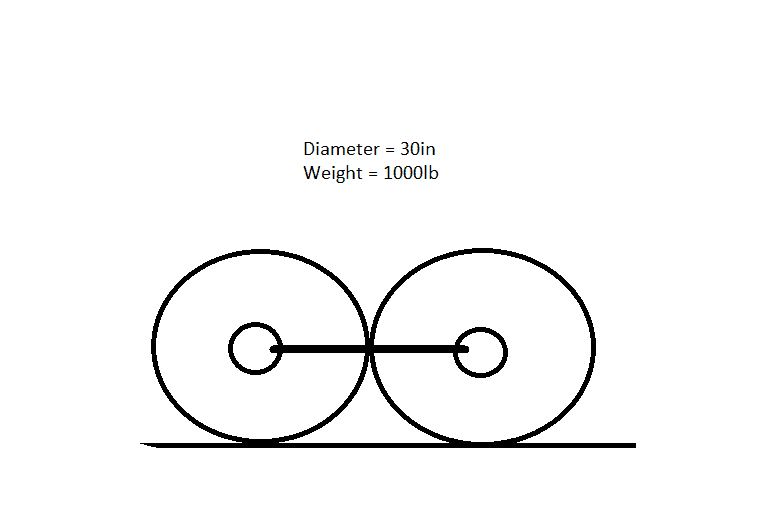
Hello, I am trying to figure the strength (in lbs) of a strap needed to attach 2 Rolls together without breaking. Each wheel has a weight of 1000lbs and a diameter of 30in. Assume each roll is a perfect circle.
Hello, I am trying to figure the strength (in lbs) of a strap needed to attach 2 Rolls together without breaking. Each wheel has a weight of 1000lbs and a diameter of 30in. If there is required information missing, let me know.
Untitled.png
 
Physics news on Phys.org
Welcome to PF!

We need to know what they are and what they are doing. If they are just sitting there, for example, Scotch Tape will work.
 
russ_watters said:
Welcome to PF!

We need to know what they are and what they are doing. If they are just sitting there, for example, Scotch Tape will work.
They are big rolls of plastic sheets. They are usually sitting there but I wanted to know the breaking strength of the straps (in lbs) needed in order to prevent them from separating as they will eventually be shipped via trucks.
 
anima said:
They are big rolls of plastic sheets. They are usually sitting there but I wanted to know the breaking strength of the straps (in lbs) needed in order to prevent them from separating as they will eventually be shipped via trucks.
What would cause any side-to-side motion that would stress the strap? How are the rolls packaged for lifting into the trucks? Why do you need to join pairs of them instead of crating several all together? How are they unloaded at the destination? Have you discussed this with the trucking company to get their ideas?
 
  • Like
Likes   Reactions: russ_watters
berkeman said:
What would cause any side-to-side motion that would stress the strap? How are the rolls packaged for lifting into the trucks? Why do you need to join pairs of them instead of crating several all together? How are they unloaded at the destination? Have you discussed this with the trucking company to get their ideas?
Understood. Without external forces, anything would hold them together. Now, what if the question was changed where there is a third wheel stacked on top of the other two. What forces would be acting on each wheel on the bottom.
 
We would prefer to get right to the actual application, instead of playing 20 questions. Please outline the project parameters and give all of the details so we can try to help you do this safely. Also, what is your background in Engineering, Math and Physics? Knowing that will help us to help you. Thank you.
 
  • Like
Likes   Reactions: hutchphd
Let me try this way: describe a specific scenario you expect would cause them to separate if not strapped together.
 
The worst-case scenario could be one roll hanging in the air from the next one located at certain angle.

If that angle is estimated to be 45 degrees, the force on each leg of the strap should reach 707 lbs.
If that angle is estimated to be 60 degrees from vertical, the force on each leg of the strap should reach 1000 lbs.

The length of each roll should be above 33 inches.
Do you have a suitable flexible strap that can be wrapped around a length of above 130 inches (11 feet)?

Plastic rolls.jpg
 
Last edited:
  • Like
Likes   Reactions: russ_watters
Lnewqban said:
The worst-case scenario could be one roll hanging in the air from the next one located at certain angle.
You forgot to draw the little stick figure person below that roll with a very scared look on their face... :wink:
 
  • Like
Likes   Reactions: russ_watters and Lnewqban
  • #10
Lnewqban said:
The worst-case scenario could be one roll hanging in the air from the next one located at certain angle.
I was thinking something similar, but I don't know shipping: is there an impact scenario where they have to remain attached? What if they are shipped by air, and the g-forces from the plane have to be included?
 
  • Like
Likes   Reactions: Lnewqban
  • #11
anima said:
If there is required information missing, let me know.
The material and the wrapping are very important.

Analyse the system as a pair of meshed gears. If one can rotate, the other must rotate backwards on the storage surface.

The coefficient of friction, CoF, is important. If the rolls are low CoF against each other, then they should first be wrapped in a high CoF material. For example, steel-steel should become steel-paper against paper-steel.

The strap must hold the rolls together, so friction between rolls is greater than the friction due to the weight of one roll on the storage surface.

An alternative would be to strap three rolls together, locked in an equilateral triangle, so the storage surface no longer plays a part in preventing rolling. Strap tension should prevent the two lower rolls separating due to the weight of the upper roll.
 
  • Like
Likes   Reactions: Lnewqban

Similar threads

  • · Replies 19 ·
Replies
19
Views
2K
  • · Replies 24 ·
Replies
24
Views
3K
  • · Replies 22 ·
Replies
22
Views
5K
  • · Replies 15 ·
Replies
15
Views
5K
  • · Replies 116 ·
4
Replies
116
Views
13K
  • · Replies 5 ·
Replies
5
Views
2K
  • · Replies 16 ·
Replies
16
Views
3K
Replies
9
Views
2K
  • · Replies 25 ·
Replies
25
Views
2K
  • · Replies 1 ·
Replies
1
Views
1K