Resonant frequency of an annular ring? Hookes Law?

Click For Summary
SUMMARY

The resonant frequency of an annular ring can be determined using principles similar to those applied in tuning forks, specifically through the equation f=(1/l²)√(AE/p), where l is the length of the prongs, A is the area, E is Young's modulus, and p is the density of the material. The thickness of the ring and its elastic modulus are critical factors influencing the resonant frequency. Additionally, Bessel functions are necessary for analyzing cylindrical harmonics, which are relevant in the study of musical instruments like cymbals. Understanding these concepts is essential for accurately calculating the resonant frequency of annular rings.

PREREQUISITES
  • Understanding of Hooke's Law and its application in elasticity
  • Familiarity with Young's modulus and material properties
  • Basic knowledge of Bessel functions and their role in cylindrical harmonics
  • Experience with resonant frequency calculations in mechanical systems
NEXT STEPS
  • Research Bessel functions and their applications in cylindrical harmonics
  • Study the effects of material properties on resonant frequency
  • Explore advanced topics in vibrational analysis of mechanical structures
  • Investigate the relationship between geometry and resonant frequency in annular rings
USEFUL FOR

Mechanical engineers, materials scientists, and anyone involved in the design and analysis of resonant systems, particularly in applications related to musical instruments and mechanical vibrations.

antsknee
Messages
6
Reaction score
0
Hi,

I am trying to work out the resonant frequency of an annular ring, does anyone know a general equation for it?

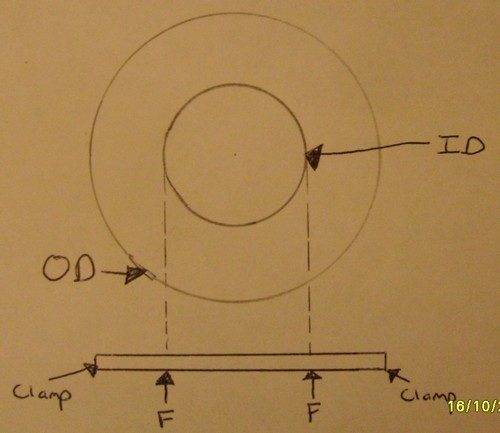
For example the ring has an outside diameter = OD and inside diameter = ID. The ring is gently clamped at the outside diameter and a force F applied evenly at the inside diameter. At a particular frequency the amplitude of displacement will be maximum.

I believe it would be something like hookes law. The thickness of the ring would be a factor as well as the elastic modulus of the ring.

Thanks,

Anthony.
attachment.php?attachmentid=29088&d=1287267394.jpg
 

Attachments

  • S6309531.JPG
    S6309531.JPG
    20.5 KB · Views: 472
Physics news on Phys.org
I have been looking at tuning forks for inspiration.

The resonant frequency of a tuning fork is:

f=(1/l2)\sqrt{}(AE/p)

l=length of the prongs
A=area of prongs
E=youngs modulus of material
p=density of material

I will return with more thoughts as I have them.
 
Last edited:
I have been searching these forums and it seems I need a Bessel function for cylindrical harmonics. They are used to understand musical instruments such as cymbals. The wikipedia page looks very complicated, I bet I won't get any replies to this thread :)

http://en.wikipedia.org/wiki/Bessel_function
 

Similar threads

Replies
4
Views
3K
  • · Replies 9 ·
Replies
9
Views
3K
  • · Replies 1 ·
Replies
1
Views
1K
  • · Replies 9 ·
Replies
9
Views
5K
  • · Replies 14 ·
Replies
14
Views
3K
  • · Replies 4 ·
Replies
4
Views
3K
  • · Replies 3 ·
Replies
3
Views
4K
  • · Replies 12 ·
Replies
12
Views
6K
  • · Replies 2 ·
Replies
2
Views
3K
  • · Replies 2 ·
Replies
2
Views
2K