Reverse-Flow Protection Mosfet Control?

  • Thread starter Thread starter M de L
  • Start date Start date
  • Tags Tags
    Mosfet
Click For Summary

Discussion Overview

The discussion revolves around the design and functionality of a solar-powered synchronous Buck converter circuit, specifically focusing on the role of an additional MOSFET (Q1) intended for reverse current protection. Participants explore how Q1 operates in conjunction with the high-side MOSFET (Q2) and the implications of its configuration for circuit reliability.

Discussion Character

  • Technical explanation
  • Debate/contested
  • Exploratory

Main Points Raised

  • Some participants propose that Q1 serves as a reverse polarity protection mechanism, functioning as an "idiot diode" to prevent current flow from the battery back to the solar panel.
  • Others express uncertainty about how Q1 is turned on and off by the high-side MOSFET's gate drive signal, questioning the voltage conditions required for Q1 to conduct.
  • A participant mentions that Q1's body diode will conduct if polarity is correct, but will turn off during reverse polarity, thus protecting the circuit.
  • Concerns are raised about the effectiveness of the circuit design, with one participant noting that Q1 may conduct even without solar input, indicating potential flaws in the design.
  • Another participant questions the functionality of Q2, specifically regarding the gate-source voltage requirements for proper operation, suggesting that the circuit may not dissipate heat effectively.
  • Some participants discuss alternative designs for reverse current protection, indicating that there are multiple approaches to achieve this functionality.

Areas of Agreement / Disagreement

Participants express a mix of agreement and disagreement regarding the circuit's design and functionality. While some acknowledge the potential role of Q1 in reverse polarity protection, others raise concerns about its operation and the overall effectiveness of the circuit. There is no consensus on the reliability of the design or the best approach to reverse current protection.

Contextual Notes

Participants note limitations in the provided circuit diagram, including unclear documentation and potential misrepresentation of component types. There are unresolved questions about the voltage conditions necessary for Q1 and Q2 to operate correctly, as well as the implications of the circuit's design choices.

Who May Find This Useful

Electronics enthusiasts, engineers working on power management circuits, and individuals interested in solar energy systems may find this discussion relevant.

M de L
Messages
7
Reaction score
1
TL;DR
Can anyone please explain how this circuit's reverse-flow protection Mosfet is turned on and off?
Hi,

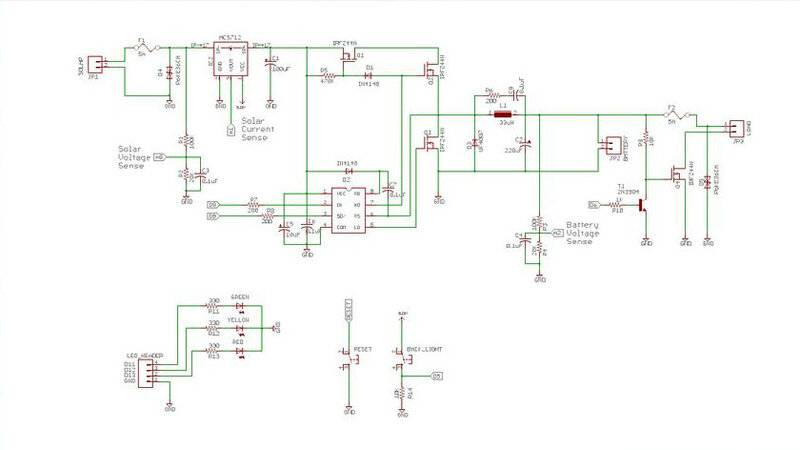
Attached is a circuit diagram for a solar powered, synchronous Buck converter. It appears to have and extra Mosfet, Q1, that is intended to prevent the flow of current, out from the battery, and back toward the unlit solar panel, via the body diode of Q2. Q2, being the regulator's high-side Mosfet.

I'm okay with how the synchronous Buck converter works, including the bootstrap drive from the Mosfet driver chip. What I don't get, is how Q1 is turned on and off, from the high-side Mosfet's gate drive signal.

Can anyone please explain this to me? Is this a conventional, and reliable configuration?

M.
FL22QOII6EXG10K.jpg
 
Engineering news on Phys.org
M de L said:
What I don't get, is how Q1 is turned on and off, from the high-side Mosfet's gate drive signal.
Can anyone please explain this to me? Is this a conventional, and reliable configuration?
The picture is a bit blurry, but I believe the designer of that circuit knew exactly what they were doing. The clue is in an N-channel device, weirdly, (though not irrationally), connected to the positive supply input.

Q1 appears to be there to protect the circuit from a reversed polarity supply, in effect, an efficient "idiot diode". The gate resistor can be a few kΩ, as it does not need to change the gate voltage of Q1 rapidly.

If polarity is OK, the Q1 (normally reversed) body-diode will turn on, then the MOSFET will begin to conduct due to the gate signal, effectively shorting the body-diode to reduce Q1 device power and voltage drop.

If polarity is reversed, Q1 will operate normally, by turning off. The body-diode will be reverse biased, as expected. The circuit is then protected from the reversed input connection.

It may at first seem counterintuitive, but that is a "more than reliable" connection of a MOSFET, that protects the following circuit from reversal of the input connections.
 
  • Like
Likes   Reactions: M de L and Nik_2213
Ah, Thank you, Baluncore. Q1's value as a reverse polarity protection hadn't occurred to me. Okay, how it turns off during reverse polarity connection seems to make sense. Very clever.

How Q1 then turns on, depending on the gate signal through D1 is a mystery? I get that Q1 can conduct current from source to drain when turned on (opposite to how it's usually used), but how we arrive at a sufficiently positive voltage, from the gate to the source, to turn Q1 on, defies my understanding?

Suppose the high-side Mosfet gate drive signal is low, relative to the half bridge's switched pole. Is it true that current cannot then flow backwards from the battery, to a non-illuminated solar panel? It would just be very convenient if the reverse polarity protecting isolator, Q1, could double as an isolator to prevent any reverse current flow, through the high-side Mosfet's body diode as well?
 
If possible I'd like to see a clearer image. Thank you.
 
Okay, seems the part of the circuit of interest, doesn't actually work. From the Instructables article:

"The other problem was that MOSFET Q1 ( in V-3.0) conduct even when there is no solar input."

Identical 'protective' mechanisms appears in a number of similar solar charger projects, so maybe it's been propagated.

Yet other projects leverage an anti-reverse current flow control Mosfet, gate-driven by an isolated DC supply that can be switched. Maybe that's the way to go, and there are no easy shortcuts?
 
Yes, a better schematic would be nice. It looks to me like this one has Q1 drawn incorrectly. It looks like it's drawn as a P-Channel MOSFET, But I agree with @Baluncore's description since the source is on the wrong side. So, anyway, we'll just chalk this up to poor documentation, which is common on DIY style web sites.

As an aside, this is a good description of "normal" reverse polarity protection schemes. It all seems sort of confused in this example. Just pick a version yourself a stick it in place of that stuff.

So, the answer to your question "how does Q1 get the bias voltage needed to turn on?" is that the half-bridge gate drive IC provides this with a bootstrap circuit. This is a capacitor charge pump like a voltage multiplier. This is also needed to turn on the high side MOSFET (Q2?). Read the data sheet for the IC, it should explain it.
 
M de L said:
there are no easy shortcuts?
If you mean that you have to understand each part of your circuit, then, yes, I agree. If you mean reverse polarity protection isn't easy, then I think your wrong. You can figure it out.
 
I question the functionality of Q2 specifically. Doesn't the gate-source voltage need to be several volts apart before the mosfet turns on hard? The way it is, the gate can go no higher than the drain unless I've missed something. This implies the source will never make it all the way to the drain voltage meaning heat dissipation in Q2. Have I missed something here?
 
  • #11
Thanks @DaveE. I was wondering about the D2-C7 pair formed a voltage doubler but I expected a larger capacitor. Guess the .1 uF is adequate. As well as the little 1N4148 diode.
 
  • Like
Likes   Reactions: DaveE

Similar threads

  • · Replies 13 ·
Replies
13
Views
3K
Replies
80
Views
5K
Replies
39
Views
6K
  • · Replies 1 ·
Replies
1
Views
2K
  • · Replies 12 ·
Replies
12
Views
3K
  • · Replies 1 ·
Replies
1
Views
5K
  • · Replies 11 ·
Replies
11
Views
3K
Replies
7
Views
15K
Replies
6
Views
5K
  • · Replies 9 ·
Replies
9
Views
12K