Rolling without Slipping - axes of rotation and centripital acceleration

Click For Summary
SUMMARY

The discussion focuses on the calculation of centripetal acceleration at the top of a rolling wheel, specifically addressing the relationship between translational velocity, angular velocity, and centripetal acceleration. The formula derived for centripetal acceleration at the top of the wheel is confirmed as ##a_{c(top)} = 2ω^2r##. The conversation also explores the implications of calculating angular velocity (##ω##) and angular acceleration (##α##) relative to the center of the wheel, emphasizing that the accelerations must remain consistent in both the ground frame and the wheel center frame.

PREREQUISITES
  • Understanding of angular velocity (##ω##) and angular acceleration (##α##)
  • Familiarity with centripetal acceleration concepts
  • Basic knowledge of kinematics and rotational motion
  • Ability to interpret mathematical equations related to motion
NEXT STEPS
  • Research the derivation of centripetal acceleration in non-inertial frames
  • Study the relationship between translational and rotational motion in wheels
  • Explore advanced topics in rotational dynamics, including torque and moment of inertia
  • Learn about the applications of centripetal acceleration in real-world scenarios, such as vehicle dynamics
USEFUL FOR

Physics students, mechanical engineers, and anyone interested in the principles of rotational motion and dynamics of rolling objects.

lightlightsup
Messages
100
Reaction score
11
Therefore, if someone were to ask what the magnitude of centripetal acceleration is at the top of the wheel at a given instant (relative to the ground):
##v_{cm} = v_{translational, center-of-mass/wheel}##
##ω = ω_{point-of-contact}##
##v_{top} = 2(v_{cm}) = 2(rω)##
##a_{c(top)} = \frac{v_{top}^2}{R} = \frac{(2v_{cm})^2}{2r} = \frac{2(v_{cm})^2}{r} = \frac{2(ωr)^2}{r} = 2ω^2r##
I think this is correct.

But, what is the ##ω## and ##α## about the center of the wheel?
Also, what is the ##a_{c(top)}## relative to the center of wheel? Would that even make sense?See this image:
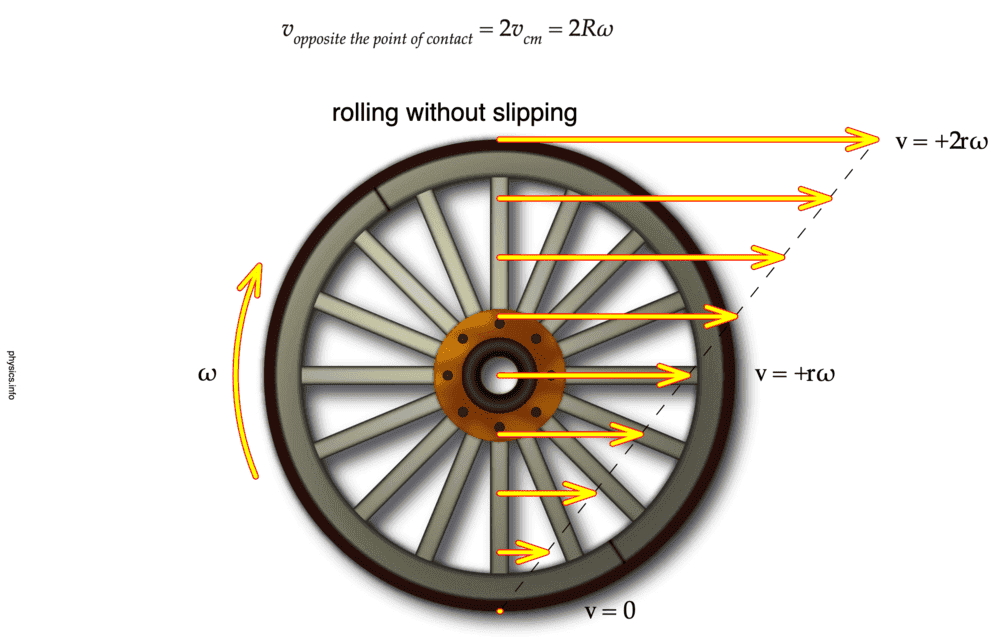
Rolling without slipping down an Incline.png
 
Last edited:
Physics news on Phys.org
lightlightsup said:
Therefore, if someone were to ask what the magnitude of centripetal acceleration is at the top of the wheel at a given instant (relative to the ground):
##v_{cm} = v_{translational, center-of-mass/wheel}##
##ω = ω_{point-of-contact}##
##v_{top} = 2(v_{cm}) = 2(rω)##
##a_{c(top)} = \frac{v_{top}^2}{R} = \frac{(2v_{cm})^2}{2r} = \frac{2(v_{cm})^2}{r} = \frac{2(ωr)^2}{r} = 2ω^2r##
I think this is correct.
For a wheel rolling at constant speed, the accelerations at the rim must be same in the ground frame and in the wheel center frame: ##ω^2r##. You cannot derive the acceleration in the ground frame like you did, by using a moving center for the centripetal acceleration.

See also:
https://www.raeng.org.uk/publications/other/20-wheels-bssc
 
Last edited:

Similar threads

  • · Replies 4 ·
Replies
4
Views
2K
  • · Replies 7 ·
Replies
7
Views
3K
  • · Replies 41 ·
2
Replies
41
Views
6K
  • · Replies 42 ·
2
Replies
42
Views
3K
Replies
12
Views
5K
  • · Replies 37 ·
2
Replies
37
Views
4K
  • · Replies 2 ·
Replies
2
Views
2K
  • · Replies 7 ·
Replies
7
Views
2K
Replies
12
Views
4K
Replies
4
Views
3K