Short circuit's effect on a voltage source and a resistor

Click For Summary

Discussion Overview

The discussion revolves around the effects of applying a short circuit in parallel to a voltage source and a resistor in series. Participants explore the implications of this configuration on voltage and current in the circuit, addressing both theoretical and practical aspects of circuit behavior.

Discussion Character

  • Exploratory
  • Technical explanation
  • Debate/contested
  • Conceptual clarification

Main Points Raised

  • One participant questions whether the voltage source and resistor would experience 0 V and 0 current due to the short circuit applied in parallel.
  • Another participant requests clarification and a schematic to better understand the circuit configuration.
  • Concerns are raised about the concept of infinite current in the circuit, with some arguing that real-world factors like wire resistance must be considered.
  • There is a discussion about the ambiguity in language used to describe the circuit, with suggestions to clarify the arrangement of components.
  • Some participants assert that the circuit does not actually contain a short circuit and that the current through the resistor and voltage source would not be infinite or large.
  • One participant expresses confusion regarding the schematic, interpreting the short circuit differently than intended.
  • There are comments about misconceptions related to the ground symbol in circuit diagrams and its implications for current flow.
  • Participants discuss the potential downsides of relying on simulation software for circuit analysis, particularly regarding the necessity of ground connections.

Areas of Agreement / Disagreement

Participants do not reach a consensus on the interpretation of the circuit configuration or the implications of the short circuit. Multiple competing views remain regarding the presence of a short circuit and the behavior of current and voltage in the described scenario.

Contextual Notes

There is ambiguity in the language used to describe the circuit, which may lead to different interpretations among participants. The discussion also highlights the importance of clear schematic representation to avoid confusion.

garr6120
Messages
42
Reaction score
0
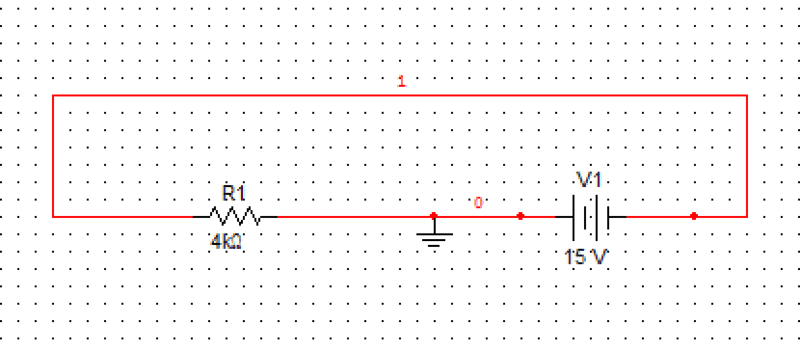
If I have a resistor and a voltage source in series but then I apply a short circuit in parallel to both of them would the voltage source and resistor not receive 0 V? Thus having 0 current. What would change in the circuit?
Screen Shot 2017-10-09 at 2.57.58 PM.png
 
Engineering news on Phys.org
Your description is not entirely clear to me, please draw the shorted circuit (and perhaps check if the voltage source is not burning).
 
Borek said:
Your description is not entirely clear to me, please draw the shorted circuit (and perhaps check if the voltage source is not burning).

Would the infinite current in the series circuit run through the transistor and voltage source causing them both to have a voltage value of 0?

Screen Shot 2017-10-09 at 3.12.26 PM.png
 
It seems like you have a very fundamental misunderstanding of circuitry...
the current through both elements is I=V/R : I=-15/4000
 
What you call shorting is just closing a circuit.
 
  • Like
Likes   Reactions: NascentOxygen
garr6120 said:
infinite current

Do you really think there would be infinite current? Think in terms of the real world - even copper wires have some resistance, for example.

garr6120 said:
transistor

What transistor? Slow down and take things step by step.

The voltage source would ‘see’ a current path through the 4k resistor and through the short.

[an erroneous statement has been removed by a moderator]
 
Last edited by a moderator:
garr6120 said:
then I apply a short circuit in parallel to both of them
There is a language ambiguity here, you need to be aware of it and modify your wording so as to eliminate any ambiguity. Taking it as you have written, most readers would probably think of an arrangement of 3 elements, all in parallel. The figure you provided differs from this, and clarifies what you [probably] intended. Though if this wording was provided for you as a homework question and without a schematic, then I think you may not have deduced the arrangement to be as the examiner actually intended.

A circuit comprising nothing else but a parallel connection of two elements is actually a series connection, because every electron passing through one must also pass through the other.
 
I must say I’m a little confused by the schematic in the OP - my interpretation was that the short, effectively across the 4k resistor, is denoted by the ground symbol at ‘0’. If this is the case, then my ‘erroneous’ statement stands (!).
 
@garr6120 needs to highlight the wire that is the short-circuit he's asking about

screen-shot-2017-10-09-at-3-12-26-pm-png.png
 
  • Like
Likes   Reactions: jim hardy
  • #10
garr6120 - the reason for the confusion is that the circuit currently shows a voltage source, resistor and wire all in series with each other.

The wire is parallel with the resistor and voltage _graphically_ but not _electrically_.
 
  • #11
I agree with the other posters, there's no short circuit and there's no infinite (or even large) current.

We had a thread a while back about series and parallel connections that i think OP should study
https://www.physicsforums.com/threads/series-and-parallel-components.920751/#post-5811195
i gave this example which is same as @garr6120 's circuit just different voltage and resistance
jim hardy said:
..some wise guy will hand you this

series_parallel2-jpg.jpg


and ask you
"Are that battery and that resistor in series or are they in parallel ?"

.........................

Perhaps garr6120 is confused by the ground symbol in his drawing.
It should be erased because no current flows there. I could add one to my sketch and nothing would change.
We have lots of threads on the concept (and misconceptions) of "ground" .
 
  • #12
Downside of using spice for everything - people think every circuit needs a ground... argh...
 
  • #13
Windadct said:
Downside of using spice for everything - people think every circuit needs a ground... argh...

I don’t use it for every circuit only ones that I use voltmeters for. Was to lazy to take it out
 
  • #14
garr6120 said:
I don’t use it for every circuit only ones that I use voltmeters for. Was to lazy to take it out
So I was using artistic license in thinking that ground was the short?

Where was the short you intended - between 1 and 0?
 

Similar threads

  • · Replies 5 ·
Replies
5
Views
2K
  • · Replies 44 ·
2
Replies
44
Views
8K
Replies
7
Views
1K
  • · Replies 3 ·
Replies
3
Views
2K
Replies
20
Views
4K
  • · Replies 78 ·
3
Replies
78
Views
6K
Replies
93
Views
8K
  • · Replies 19 ·
Replies
19
Views
4K
  • · Replies 1 ·
Replies
1
Views
2K
Replies
7
Views
2K