Engineering Sketching output waveforms while considering slew rate

Click For Summary
The discussion focuses on sketching output waveforms while considering the slew rate and duty cycle of an input waveform. The time period of the waveform is established as 1 millisecond, with a 50% duty cycle resulting in a pulse width of 1 V. The slew rate of 0.5 volts per microsecond indicates that the output voltage transitions from -1 V to +1 V in 4 microseconds. Participants note that the gain has not been accounted for, and there are concerns about the scale of the horizontal axis in the waveform representation. Suggestions are made for accurately depicting rise and fall times in relation to the input waveform period, particularly in the context of digital oscilloscope observations.
JC2000
Messages
186
Reaction score
16
Homework Statement
Sketch the output voltage when input voltage applied to non inverting amplifier with gain 10 for a square wave input signal with peak to peak voltage ##2 V##, ##50 %## duty cycle and frequency ##1## kHz. Supply Voltage is +12 V and -12V, the op amp has slew rate 0.5 V/ microsecond and the op amp is nulled initially.
Relevant Equations
Time Period = 1 / Frequency

Duty Cycle = (Pulse Width *100)/ Time Period
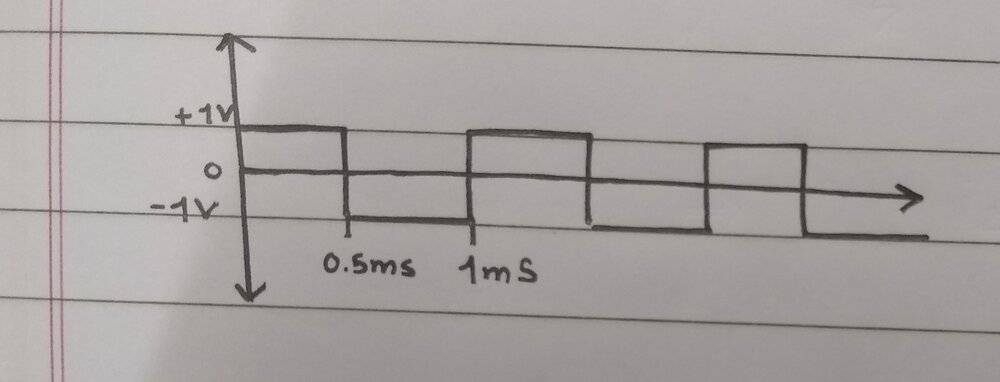
1. Using the frequency equation I know the time period is 1 millisecond.

2. The duty cycle (50%) equation tells me that the pulse width and the amplitude is 1 V.

3. Thus the input waveform looks like this : (?)
IMG_20200601_170230027_2.jpg


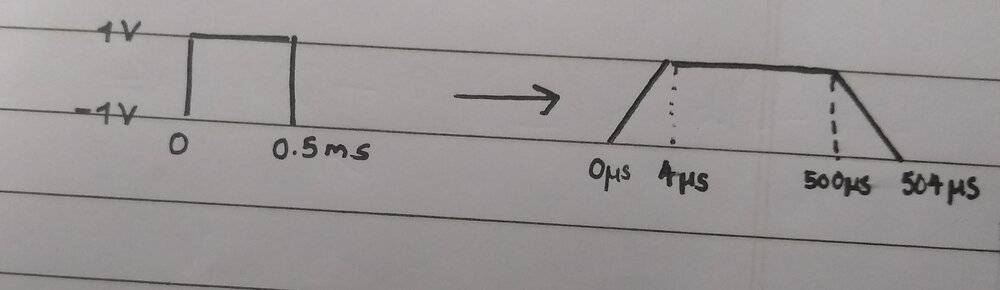
4. As the slew rate is 0.5 volts per microsecond, the output voltage would take 4 microseconds to go from -1 V to + 1V (?)

5. Thus the output waveform for one pulse should look like :
IMG_20200601_170746425_2.jpg


(I converted milliseconds to microseconds)

Is this correct?
 
Physics news on Phys.org
JC2000 said:
5. Thus the output waveform for one pulse should look like :
You have not considered the gain.
 
cnh1995 said:
You have not considered the gain.
Oof! Careless of me. Other than that bit is the rest fine?
 
JC2000 said:
Oof! Careless of me. Other than that bit is the rest fine?
The horizontal axis is not to scale, even ignoring the voltage gain issue. The rise/fall times are on the order of a few us, while the period of the square wave input is on the order of a ms. Do you have any ideas for how to represent that on a plot? How would you observe this on a digital oscilloscope, for example?
 
  • Like
Likes JC2000 and cnh1995

Similar threads

  • · Replies 29 ·
Replies
29
Views
4K
Replies
15
Views
2K
  • · Replies 11 ·
Replies
11
Views
4K
  • · Replies 3 ·
Replies
3
Views
2K
  • · Replies 2 ·
Replies
2
Views
2K
  • · Replies 4 ·
Replies
4
Views
2K
  • · Replies 3 ·
Replies
3
Views
2K
  • · Replies 2 ·
Replies
2
Views
3K
  • · Replies 3 ·
Replies
3
Views
5K
  • · Replies 13 ·
Replies
13
Views
3K