Stresses Caused By Deformation For Bending

Click For Summary
SUMMARY

The discussion centers on the stresses caused by deformation in bending beams, particularly focusing on the necessity of radial stresses in curved beams. Participants confirm that while radial stresses are often small compared to circumferential stresses, they are crucial for maintaining static equilibrium in curved beams. The conversation highlights that traditional beam bending formulas are approximations and that a more comprehensive understanding requires knowledge of the theory of elasticity, specifically referencing Timoshenko's work. The importance of considering deformation-induced stresses in engineering applications is emphasized.

PREREQUISITES
  • Understanding of beam mechanics and bending theory
  • Familiarity with stress distribution in materials
  • Knowledge of the theory of elasticity
  • Basic principles of static equilibrium in structural analysis
NEXT STEPS
  • Study Timoshenko's "Theory of Elasticity" for advanced stress analysis
  • Research hyperbolic stress distribution in curved beams
  • Learn about Poisson's ratio effects in beam deformation
  • Explore the differences between linear and hyperbolic stress distributions in engineering applications
USEFUL FOR

Structural engineers, mechanical engineers, and students studying material mechanics who are interested in the complexities of stress analysis in bending beams.

person123
Messages
326
Reaction score
52
TL;DR
I was wondering if the deformation of a bending beam would lead to normal stress perpendicular to the applied stress and if deformation causing stress is common and important to consider.
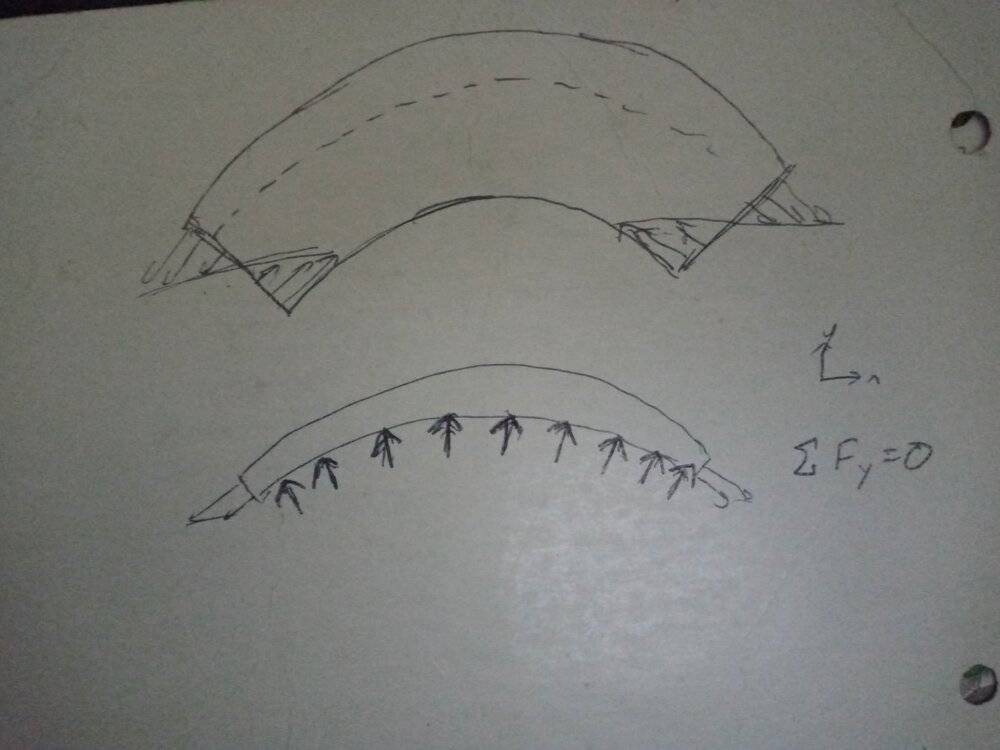
Hi. Say you apply a moment on a beam and bend it into an arch. If you take a free body diagram of a section of the beam you would need normal stresses in the radial direction to balance the forces:
20200803_023426.jpg

I have never seen this brought up before though -- is it correct logic? Also, is this sort of situation where deformation leads to other stresses common? Thanks!
 
  • Like
Likes   Reactions: etotheipi
Physics news on Phys.org
From your diagram, I don't see why you would need forces in the y-direction. It seems to me, the y components of the loadings at the ends balance out.
 
Chestermiller said:
From your diagram, I don't see why you would need forces in the y-direction. It seems to me, the y components of the loadings at the ends balance out.

As far as I could tell, OP is making a slice through the beam so as to consider the top half or so of the beam in isolation, in which case the loading at either end is exclusively in the negative ##\hat{y}## direction. Then, wouldn't internal stress forces need to be applied on the upper section by the lower section (and vice versa) in order to satisfy static equilibrium?
 
  • Like
Likes   Reactions: person123
Curved beams have a hyperbolic stress distribution, where straight beams have a linear stress distribution. The published analyses of curved beam stresses do not include stresses in the radial direction. Search terms bending curved beams brings up a number of good sites.

A close look at a stress element in a curved beam shows that radial stress is needed to balance the normal stress. More advanced analyses include these radial stresses. Search term bending curved beam stress element brings up this hit: http://courses.washington.edu/me354a/chap4.pdf, from which the following is quoted:

It is worth noting that due to the curvature of the beam a compressive radial stress (acting in the direction of r) will also be developed. Typically the radial stress is small compared to the circumferential stress and can be neglected, especially if the cross section of the member is a solid section. Sometimes, such as the case of thin plates or thin cross sections (e.g., I-beam), this radial stress can become large relative to the circumferential stress.

The OP has the right idea, but these radial stresses are not on the surface of the beam. They show up on a stress element inside the beam.
 
  • Like
Likes   Reactions: person123 and Lnewqban
person123 said:
Summary:: I was wondering if the deformation of a bending beam would lead to normal stress perpendicular to the applied stress and if deformation causing stress is common and important to consider.
...
I have never seen this brought up before though -- is it correct logic? Also, is this sort of situation where deformation leads to other stresses common? Thanks!
This type of stress is common and extremely important.
It can be combined with other loads (shear, compression, tension) that act simultaneously on the bending element, inducing more complicated internal reactions.

Please, see:
https://en.wikipedia.org/wiki/Bending

:cool:
 
The usual beam bending formulas are not the exact solution to the stress equilibrium equation. They are only a Strength of Materials approximation to the full solution of the theory of elasticity equations. In the direction normal to the beam, there are Poisson ratio effects that come in, that give rise to the normal stress effect (spread over the long length of the beam) to balance the forces you are referring to. For the complete exact treatment of the problem, see Timoschenko, theory of elasticity.
 
  • Like
Likes   Reactions: etotheipi
jrmichler said:
Curved beams have a hyperbolic stress distribution, where straight beams have a linear stress distribution.
In what way is it hyperbolic? One thing I can imagine is taking the magnitude of the largest traction vector on any surface. Then going across the beam, that value varies hyperbolically. Is this what that means?
 

Similar threads

Replies
3
Views
1K
  • · Replies 9 ·
Replies
9
Views
2K
  • · Replies 1 ·
Replies
1
Views
1K
  • · Replies 69 ·
3
Replies
69
Views
5K
  • · Replies 5 ·
Replies
5
Views
6K
  • · Replies 30 ·
2
Replies
30
Views
8K
  • · Replies 9 ·
Replies
9
Views
3K
Replies
6
Views
2K
  • · Replies 2 ·
Replies
2
Views
2K
  • · Replies 8 ·
Replies
8
Views
2K