Franklie001
- 49
- 7
Summary:: Having the following dates:
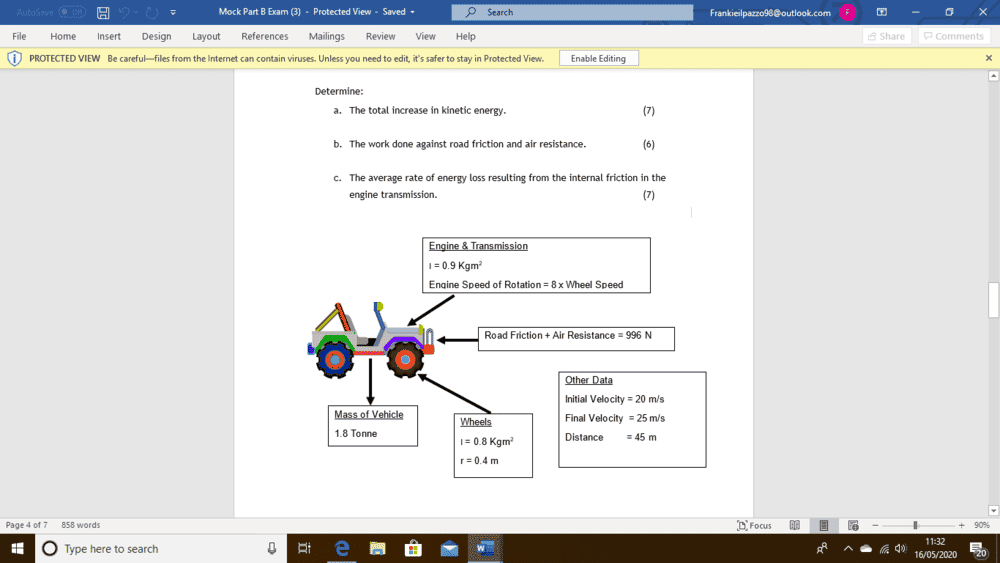
The discussion focuses on calculating the average rate of energy loss due to internal friction in a motor vehicle's engine transmission. Key data includes a vehicle mass of 1.8 tonnes, an effective moment of inertia for the engine and transmission of 0.9 kgm², and an average indicated power of 160 kW. The kinetic energy increase during acceleration from 20 m/s to 25 m/s is calculated to be 245,250 J, while the work done against road friction and air resistance is 44,820 N*m. The participants emphasize the importance of showing work for homework help and provide guidance on converting energy to power.
PREREQUISITESStudents studying physics, particularly those focusing on mechanics and energy dynamics, as well as engineers involved in automotive design and performance analysis.

 . Hold on...
 )
) ! Finally reproduced your a) result
  (had a typo in excel...)..