Thevenin's and Norton's Theorem

Click For Summary

Discussion Overview

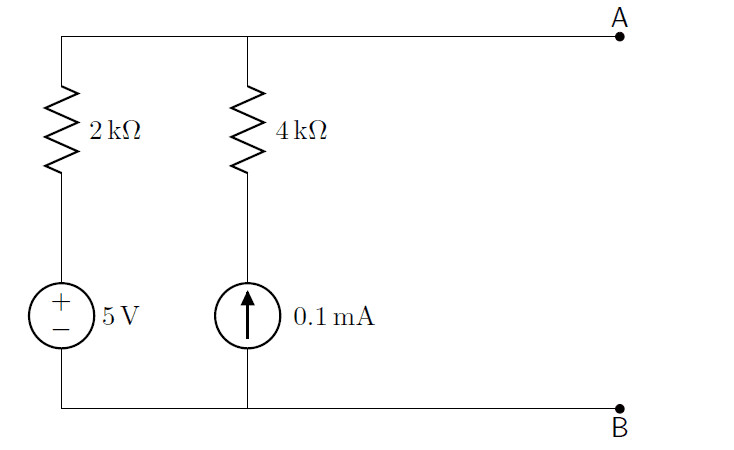
The discussion revolves around Thevenin's and Norton's theorem, focusing on finding the Thevenin voltage (Vth) and Thevenin resistance (Rth) for a given circuit. Participants explore methods for solving the circuit when a 2000Ω resistor is connected between points A and B, including the application of superposition.

Discussion Character

  • Technical explanation
  • Mathematical reasoning
  • Homework-related

Main Points Raised

  • One participant proposes that Rth can be calculated by treating the voltage source as a short circuit and the current source as an open circuit, arriving at Rth = 2000Ω.
  • The same participant calculates Vth as Voc, using KCL to derive Vth = 5.2 V.
  • Another participant agrees with the calculations and asks about the Norton equivalent of the circuit.
  • A different participant suggests using superposition as an alternative method to find Vth, noting the complexity of the current source's contribution to the voltage across the resistors.
  • One participant expresses uncertainty about the methods discussed and mentions difficulties in understanding the theorems due to the pace of instruction in class.

Areas of Agreement / Disagreement

Participants generally agree on the calculations for Rth and Vth, but there is some uncertainty regarding the application of superposition and the interpretation of voltages across different branches in the circuit. The discussion remains unresolved regarding the Norton equivalent and the best method to approach the problem.

Contextual Notes

Some participants express confusion about the application of superposition and the relationship between voltages in parallel branches, indicating a need for further clarification on these concepts.

ichabodgrant
Messages
48
Reaction score
0
Hi. It's me again. Right now I have some troubles with Thevenin's and Norton's theorem.
Here is the circuit.
problem_4_0.png

I have to find the thevenin voltage Vth and thevenin resistance Rth and solve the circuit when there is a 2000Ω resistor connected to A and B.
Then, I try to solve it...

First, for the Rth, I just treat the voltage source as a short circuit and current source as an open circuit. So, the 4000Ω resistor is disconnected.

Rth = 2000Ω

Then, for the Vth, Vth = Voc.
By using KCL,

5/2000 + 0.1×10-3 = Voc/Rth

5/2000 + 0.1×10-3 = Voc/2000

∴ Voc = 5.2 V
i.e. Vth = 5.2 V
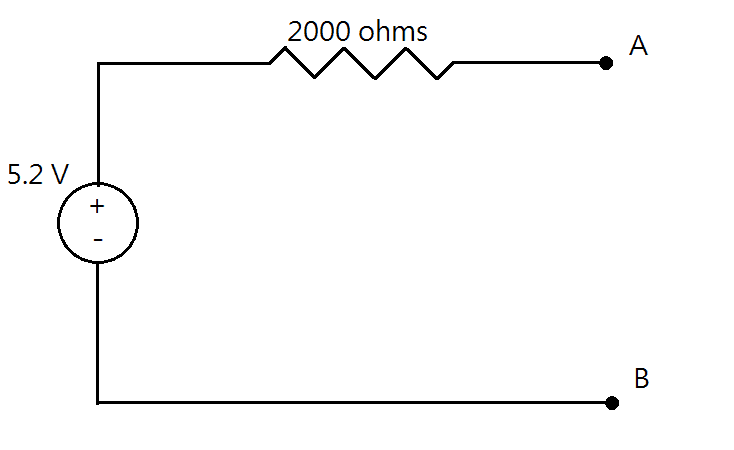
problem_4_2.png


Is this correct?
 
Last edited:
Physics news on Phys.org
ichabodgrant said:
Rth = 2000Ω

Then, for the Vth, Vth = Voc.
By using KCL,

5/2000 + 0.1×10-3 = Voc/Rth

5/2000 + 0.1×10-3 = Voc/2000

∴ Voc = 5.2 V
i.e. Vth = 5.2 V
Looks right. :smile:

So what will the Norton equivalent be?
 
Is this correct?

Your answer is correct, I'm not sure I understand your method.

You could also use superposition as well. The voltage source is straight forward at 5 volts (open current source)

The current source is a bit more tricky( short voltage source). .1 amp thru 4K resistor is .4 volts...but you then put it thru the 2K resistor and its .2 volts in th opposite direction.

How can you have two different voltages in two parallel branches?

Must mean there is .2 volts across the current source in the opposite direction of the 4K resistor.
5 +.2 = 5.2 Volts. Or you could do the way above, but superposition is just another way to enjoy and undestand the problem.
 
IN = 2.6 x 10⁻³ A and RN = Rth

I had thought about using superposition...
But when I attempted to do this question, I hadn't clearly understood these theorems.
My lecturer just taught too fast... I couldn't really get myself familiar with these theorems just from what he taught in class. So I spent a few hours on youtube, watching some lecture videos... and also asking for your kindly help :P

Thank you very much
 

Similar threads

  • · Replies 10 ·
Replies
10
Views
4K
  • · Replies 5 ·
Replies
5
Views
2K
  • · Replies 7 ·
Replies
7
Views
3K
  • · Replies 10 ·
Replies
10
Views
3K
  • · Replies 4 ·
Replies
4
Views
2K
  • · Replies 8 ·
Replies
8
Views
3K
  • · Replies 15 ·
Replies
15
Views
12K
  • · Replies 42 ·
2
Replies
42
Views
7K
  • · Replies 7 ·
Replies
7
Views
1K
  • · Replies 35 ·
2
Replies
35
Views
5K