Three plate capacitor and charge distribution

Click For Summary

Discussion Overview

The discussion revolves around the charge distribution in a three-plate capacitor setup, specifically addressing how the charges are allocated across the plates when connected to a battery. The scope includes conceptual understanding of capacitors and charge behavior in electrical circuits.

Discussion Character

  • Conceptual clarification
  • Debate/contested

Main Points Raised

  • One participant suggests that the middle plate, being isolated, should have +Q on one side and -Q on the other, questioning the charge distribution on the remaining plates connected to the battery.
  • Another participant states that plates A and C are connected to the positive terminal of the battery and acquire positive charge, while plate B is connected to the negative terminal and acquires negative charge.
  • A participant expresses confusion about whether both sides of plate B would have -Q charge, noting that capacitor plates should have opposite charges.
  • Another participant confirms that plates A and C are positively charged and plate B is negatively charged, questioning the expectation of different charge behavior.
  • One participant explains that the negative charge on plate B repels negative charges off plates A and C, leaving them positively charged.
  • A participant reflects on their confusion regarding the expected charge distribution on capacitor plates.

Areas of Agreement / Disagreement

There is no consensus on the charge distribution, as participants express differing views and confusion regarding the behavior of charges on the plates. Some participants assert specific charge distributions while others question these assertions.

Contextual Notes

Participants have not fully resolved the assumptions regarding charge distribution and the implications of connecting plates to different terminals of the battery. There is a lack of clarity on how the charges interact across the plates.

Who May Find This Useful

This discussion may be useful for individuals studying capacitors, charge distribution in electrical circuits, or those seeking clarification on related concepts in electronics and physics.

aashutosh
Messages
4
Reaction score
0
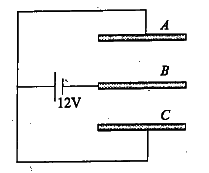
In the figure given the capacitance for the two pair would be same. Can anybody please explain me how the charge would be distributed across each plate?
I think that the middle plate being isolated should have +Q on one side and -Q on other, but how would be the charge distribution about the remaining plates as both of them are connected to the positive terminal of the battery.
1.png
 
Physics news on Phys.org
?
A and C are connected to the positive terminal of the battery and acquire positive charge. B is connected to the negative terminal and acquire negative charge.
 
  • Like
Likes   Reactions: davenn
zoki85 said:
?
A and C are connected to the positive terminal of the battery and acquire positive charge. B is connected to the negative terminal and acquire negative charge.
1.png
so will the charge distribution on the plates be as shown in the figure? If B is connected to the negative terminal then will both the sides of the plates will have -Q charge. But the pair of capacitor plates should have opposite charges right? Please i am a little confused with this. Correct me if i am wrong.
 
aashutosh said:
so will the charge distribution on the plates be as shown in the figure? If B is connected to the negative terminal then will both the sides of the plates will have -Q charge. But the pair of capacitor plates should have opposite charges right? Please i am a little confused with this. Correct me if i am wrong.

no, Plates A and C are positively charged and Plate B is negatively charged

1a.GIF


Why would you expect it to be any different to this ?
you cannot get a excess negative charge on a plate connected to the battery positive ;)
Dave
 
Last edited:
davenn said:
no, Plates A and C are positively charged and Plate B is negatively charged

View attachment 78672

Why would you expect it to be any different to this ?
you cannot get a excess negative charge on a plate connected to the battery positive ;)
Dave
Ok thank you. I thought that the capacitor plates should have + charge on one side and - on other side. May be i got confused.
 
aashutosh said:
Ok thank you. I thought that the capacitor plates should have + charge on one side and - on other side. May be i got confused.

No Problems

Just consider that the negative charge on plate B is going to "drive off " ( repel) negative charges off plates A and C and thereby leaving them positively charged :)

Dave
 
keep up the learning and questions
studying and learning about electronics and its related physics will keep you going for a lifetime
I have been at it for 40+ years and there's still so much I don't know haha ... its just such a huge subject
 

Similar threads

  • · Replies 1 ·
Replies
1
Views
2K
  • · Replies 16 ·
Replies
16
Views
3K
  • · Replies 7 ·
Replies
7
Views
2K
  • · Replies 2 ·
Replies
2
Views
2K
  • · Replies 9 ·
Replies
9
Views
2K
  • · Replies 11 ·
Replies
11
Views
2K
  • · Replies 7 ·
Replies
7
Views
2K
  • · Replies 101 ·
4
Replies
101
Views
10K
  • · Replies 7 ·
Replies
7
Views
3K
  • · Replies 2 ·
Replies
2
Views
2K