Two different equations of motion from the same Lagrangian?

AI Thread Summary
The discussion centers on the differing equations of motion for a pendulum with a horizontally oscillating support, derived from the same Lagrangian. One participant derives an equation using the Euler-Lagrange equation, leading to a different solution for the pendulum's motion compared to the provided equation. The discrepancy arises because the participant mistakenly treats the support's motion as unknown rather than predetermined. This misinterpretation alters the nature of the system being analyzed. Ultimately, the two solutions represent different physical scenarios, emphasizing the importance of correctly defining the system's parameters.
Happiness
Messages
686
Reaction score
30
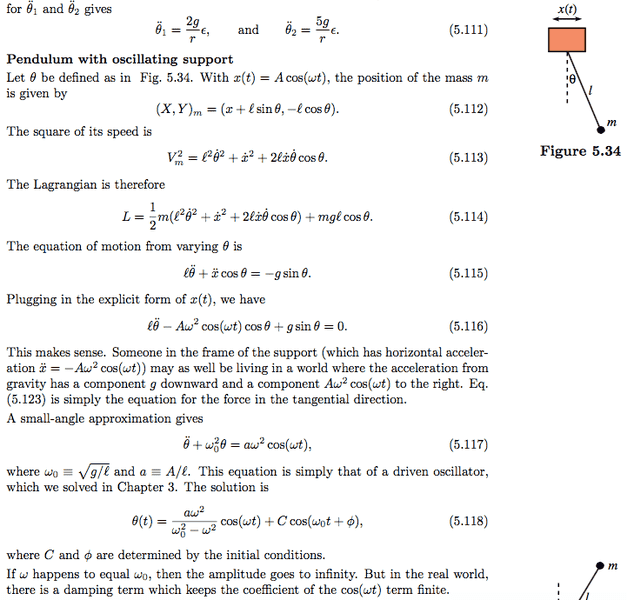
The equation of motion of a pendulum with a support oscillating horizontally sinusoidally with angular frequency ##\omega## is given by (5.116). (See attached.)

I get a different answer by considering the Euler-Lagrange equation in ##x## and then eliminating ##\ddot{x}## in (5.115):

Referring to (5.114), we have
##\frac{d}{dt}\frac{\partial L}{\partial\dot{x}}=\frac{\partial L}{\partial x}##
##\frac{d}{dt}(m\dot{x}+ml\dot{\theta}\cos\theta)=0##
##m\ddot{x}+ml\ddot{\theta}\cos\theta-ml\dot{\theta}^2\sin\theta=0##
##\ddot{x}=l\dot{\theta}^2\sin\theta-l\ddot{\theta}\cos\theta##

Substituting this into (5.115), we have
##l\ddot{\theta}+l\dot{\theta}^2\sin\theta\cos\theta-l\ddot{\theta}\cos^2\theta=-g\sin\theta##
##l\ddot{\theta}\sin\theta+\dot{\theta}^2\cos\theta=-g##

The solution ##\theta (t)## would in general be different from the solution ##\theta (t)## of (5.116). Why are there two solutions? What does the former solution represent?
Screen Shot 2016-08-06 at 2.00.02 am.png
 
Last edited:
Physics news on Phys.org
The reason you're getting a different answer is because you are not solving the same system. The problem gives you x (t), but you are trying to solve for it as though it is an unknown. By doing this you are changing the support from moving at a known oscillation to having its oscillating based on the swinging of the pendulum. Hope that helps
 
  • Like
Likes vanhees71, Dale and Happiness
The rope is tied into the person (the load of 200 pounds) and the rope goes up from the person to a fixed pulley and back down to his hands. He hauls the rope to suspend himself in the air. What is the mechanical advantage of the system? The person will indeed only have to lift half of his body weight (roughly 100 pounds) because he now lessened the load by that same amount. This APPEARS to be a 2:1 because he can hold himself with half the force, but my question is: is that mechanical...
Some physics textbook writer told me that Newton's first law applies only on bodies that feel no interactions at all. He said that if a body is on rest or moves in constant velocity, there is no external force acting on it. But I have heard another form of the law that says the net force acting on a body must be zero. This means there is interactions involved after all. So which one is correct?
Thread 'Beam on an inclined plane'
Hello! I have a question regarding a beam on an inclined plane. I was considering a beam resting on two supports attached to an inclined plane. I was almost sure that the lower support must be more loaded. My imagination about this problem is shown in the picture below. Here is how I wrote the condition of equilibrium forces: $$ \begin{cases} F_{g\parallel}=F_{t1}+F_{t2}, \\ F_{g\perp}=F_{r1}+F_{r2} \end{cases}. $$ On the other hand...
Back
Top