Happiness
- 686
- 30
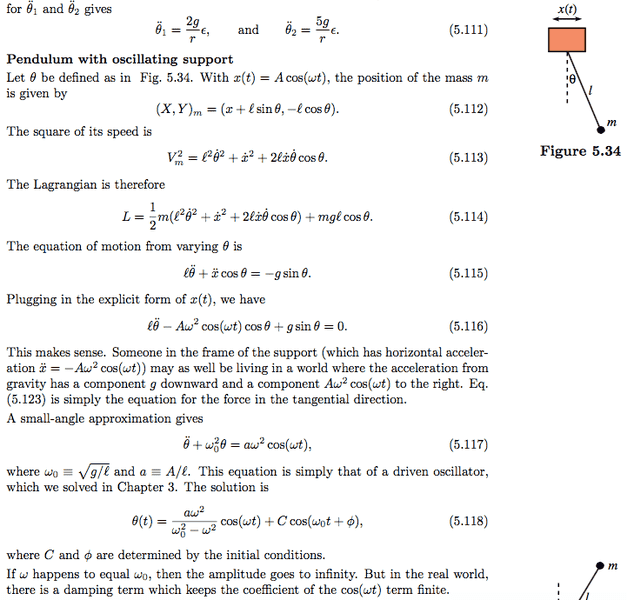
The equation of motion of a pendulum with a support oscillating horizontally sinusoidally with angular frequency ##\omega## is given by (5.116). (See attached.)
I get a different answer by considering the Euler-Lagrange equation in ##x## and then eliminating ##\ddot{x}## in (5.115):
Referring to (5.114), we have
##\frac{d}{dt}\frac{\partial L}{\partial\dot{x}}=\frac{\partial L}{\partial x}##
##\frac{d}{dt}(m\dot{x}+ml\dot{\theta}\cos\theta)=0##
##m\ddot{x}+ml\ddot{\theta}\cos\theta-ml\dot{\theta}^2\sin\theta=0##
##\ddot{x}=l\dot{\theta}^2\sin\theta-l\ddot{\theta}\cos\theta##
Substituting this into (5.115), we have
##l\ddot{\theta}+l\dot{\theta}^2\sin\theta\cos\theta-l\ddot{\theta}\cos^2\theta=-g\sin\theta##
##l\ddot{\theta}\sin\theta+\dot{\theta}^2\cos\theta=-g##
The solution ##\theta (t)## would in general be different from the solution ##\theta (t)## of (5.116). Why are there two solutions? What does the former solution represent?
I get a different answer by considering the Euler-Lagrange equation in ##x## and then eliminating ##\ddot{x}## in (5.115):
Referring to (5.114), we have
##\frac{d}{dt}\frac{\partial L}{\partial\dot{x}}=\frac{\partial L}{\partial x}##
##\frac{d}{dt}(m\dot{x}+ml\dot{\theta}\cos\theta)=0##
##m\ddot{x}+ml\ddot{\theta}\cos\theta-ml\dot{\theta}^2\sin\theta=0##
##\ddot{x}=l\dot{\theta}^2\sin\theta-l\ddot{\theta}\cos\theta##
Substituting this into (5.115), we have
##l\ddot{\theta}+l\dot{\theta}^2\sin\theta\cos\theta-l\ddot{\theta}\cos^2\theta=-g\sin\theta##
##l\ddot{\theta}\sin\theta+\dot{\theta}^2\cos\theta=-g##
The solution ##\theta (t)## would in general be different from the solution ##\theta (t)## of (5.116). Why are there two solutions? What does the former solution represent?
Last edited: