Two EE questions - nodal analysis and circuit modeling

Click For Summary

Discussion Overview

The discussion revolves around two electrical engineering questions related to nodal analysis and circuit modeling, specifically focusing on energy associated with circuit elements and the behavior of a diode arrangement. Participants are exploring how to approach the integration of current over specified time intervals to determine energy dissipation in resistors.

Discussion Character

  • Homework-related
  • Technical explanation
  • Mathematical reasoning

Main Points Raised

  • One participant is uncertain about the integration limits for calculating energy associated with current Iα(t) and asks whether to integrate from 50μs to 100μs or from 0μs to 200μs.
  • Another participant suggests that once voltage and current are known for each circuit element, the product gives power, and integrating power leads to energy.
  • A participant provides calculated values for currents (I1, I2, I3) and voltages (V1, V2) in terms of Iα, indicating a method for finding power in R1.
  • There is a mention of needing to evaluate integrals in pieces due to changes in the circuit when R2 is shorted out.

Areas of Agreement / Disagreement

Participants express uncertainty about the correct integration limits and the approach to calculating energy, indicating that there is no consensus on how to proceed with the problem.

Contextual Notes

Participants highlight the need to consider different time intervals for integration due to changes in circuit conditions, but the specific assumptions and definitions for the energy calculations remain unresolved.

ming2194
Messages
31
Reaction score
0
Two EE questions -- nodal analysis and circuit modeling

Homework Statement


Photo 11-4-14 1 16 49 pm.jpg

Photo 11-4-14 1 17 20 pm.jpg

Photo 11-4-14 1 17 49 pm.jpg


Homework Equations


I was given R1, R2, and Iα(t), the time for the switch to closed (50μs<=t<=100μs)
The question is asking about the energy associated with 2 sources and dissipated in R1, R2.

The Attempt at a Solution


For the 1st question, part should be ok for me. But i have no idea on how to start the part b).take integration for Iα(t) (since Iα(t)=da/dt) , then obtain a i=(-1/5)e^-500t
but what value for the integrals? integrated from t = 50μs to 100μs? or from t = 0μs to 200μs ? then "I" can be found?
E=Pt, = (IV)t. What value of t will be used here for each source and resistor to find the energy?

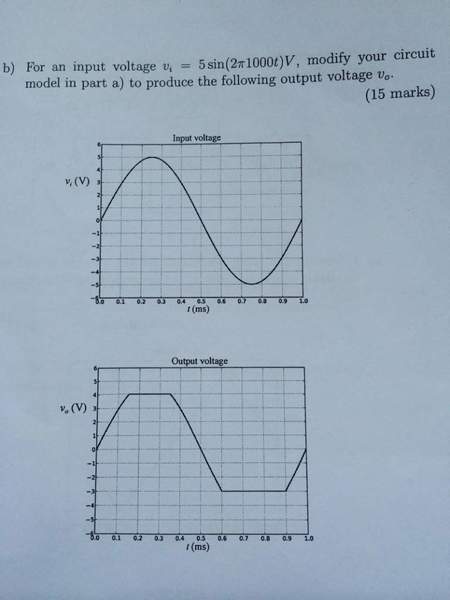
For Q4, totally no idea on it. It is about the topic of diode?
 
Physics news on Phys.org
In Q3, once you know the voltage & current associated with each element, the product of the two will be its power. Integration of power leads to energy.

Q4 does call for a diode arrangement.
 
NascentOxygen said:
In Q3, once you know the voltage & current associated with each element, the product of the two will be its power. Integration of power leads to energy.

Q4 does call for a diode arrangement.


Thanks so much for your reply.
After calculation I find :
I1: 2/7(ia)
I2: 5/7(ia)
I3= -5/7 ia
V1= 20/7 (ia)
V2= 100/7 ia

Then , power of R1 = v1 i1
I get 4000/49 e^-5000t
Then I need to integral it to find energy but what should I set for the upper and Lower intergal? Since the switch is closed for 50u<T< 100u, but the question asks for the energy for 0<T<200u, so which range should I use ?
And why?
 
You will have to evaluate the integral in pieces, until you have covered the full interval. The circuit changes when R2 is shorted out.
 

Similar threads

  • · Replies 1 ·
Replies
1
Views
2K
  • · Replies 7 ·
Replies
7
Views
2K
  • · Replies 15 ·
Replies
15
Views
4K
  • · Replies 16 ·
Replies
16
Views
2K
  • · Replies 6 ·
Replies
6
Views
2K
  • · Replies 1 ·
Replies
1
Views
2K
  • · Replies 187 ·
7
Replies
187
Views
59K
  • · Replies 4 ·
Replies
4
Views
2K
  • · Replies 6 ·
Replies
6
Views
2K
Replies
3
Views
2K