U substitution and integration by parts

Join the discussion
Ask a follow-up here, or get your own question answered by working scientists, mathematicians and engineers — people, not an autocomplete.
Real named experts · corrections over time · the nuance an AI answer skips
5 replies · 3K views
robertjford80
Messages
388
Reaction score
0
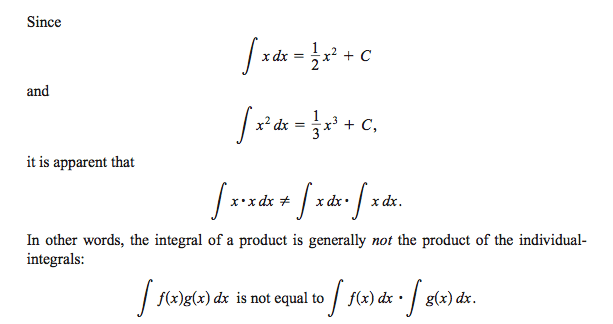
I would think because of this

Screenshot2012-05-23at73955PM.png


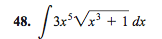
The following problem:

Screenshot2012-05-23at72700PM.png


At this stage they should use integration by parts:

Screenshot2012-05-23at74154PM.png


However, maybe integration by parts is only useful when one of the parts is e^x ln or a trigonometric formula.
 
Last edited:
Physics news on Phys.org
Integration by parts can be useful whenever the integrand is a product of two functions. But it is not always the easiest method to use. For instance, the integral [itex]\int(u-1)\sqrt{u}du=\int(u^{3/2}-u^{1/2})du[/itex] can easily be solved using the power rule in reverse. Of course, you could solve it using integration by parts as well, but it's just more work than is necessary.
 
What would be your u and what would be your dv?

Using integration by parts might work, but I feel that even if it does work it will be much more work than using u substitution.Is the problem here that you don't find the u substitution they used to be 'legal'?
 
Yea, it doesn't seem legal, because I thought you couldn't take the product of two functions in an integrand.
 
robertjford80 said:
Yea, it doesn't seem legal, because I thought you couldn't take the product of two functions in an integrand.

You need to work on being more precise. The integrand of [itex]\int_0^1 x^2 \mathrm{d}x[/itex] is the product of two functions but is clearly integrable.