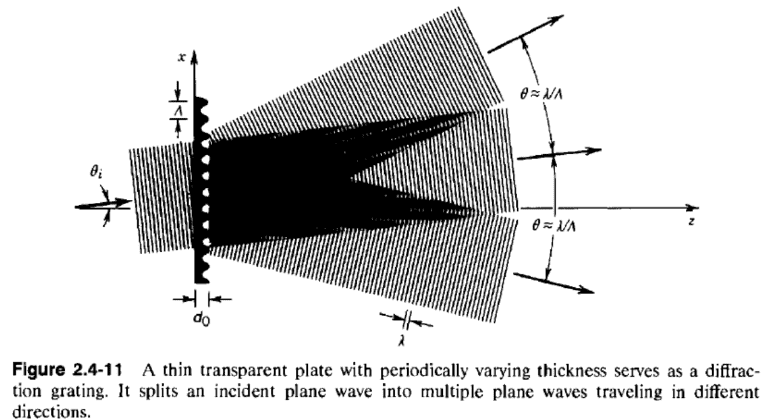
It's a picture of a diffraction grating. The maxima are in the directions where the contributions from each of the strips on the plate are in phase. It works for opaque strips, as with a conventional diffraction grating and for any other periodic variation across the aperture.
Look up Young's Slits for the basic way that a diffraction / interference pattern is formed and then look up Diffraction Grating, which is basically no more than multiple Young's Slits. A normal diffraction grating blocks at least half of the incident light and what's left will form the diffraction pattern. Using periodic thickness variations will produce phase variations of contributions from all parts of the surface through. Instead of just blocking half of the light, the variations in thickness phase over different paths allow constructive interference from all over the surface.
That diagram is really not very good at demonstrating the effect and it doesn't make clear that the 'lenses' need to be the right depth for it to work best. It would require the path lengths through the lenses to give an appropriate phase variation over each element - perhaps in the order of a fraction of a wavelength (?) i.e. very shallow thickness variations.