What are C code and No. in buck converter datasheets?

11 replies · 3K views · last reply
Mzzed
Messages
67
Reaction score
5
I have recently come across a datasheet for a buck converter regulator that uses the terms "c code" and "No." for certain capacitors but when going to the manufacturer datasheets for these capacitors they make no reference to any "c code" or one single number for a capacitor. If anyone could help me understand what these mean and how to find these specific capacitors from the manufacturers capacitor datasheet I would really appreciate it. The image bellow is where I have been reading these terms.
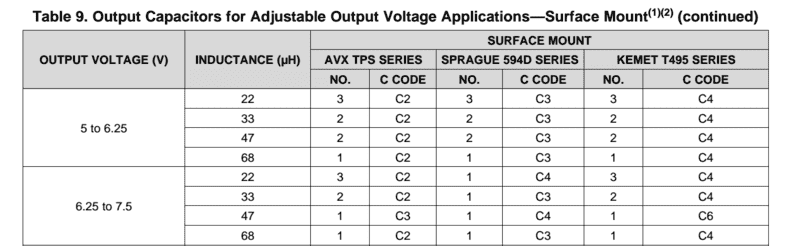
Table 9 of output capacitors for adjustable output voltage applications, surface mount, listing inductance in µH, and for AVX TPS, Sprague 594D and KEMET T495 series the No. and C code for output voltages 5 to 6.25 V and 6.25 to 7.5 V.
 
Thanks I did see this website before however I'm not sure how to relate that to C code or the single digit number. The closest thing to C code was the letter that gives tolerance but it's definitely not that.
 
  • Like
Likes   Reactions: davenn
Mzzed said:
I have recently come across a datasheet for a buck converter regulator that uses the terms "c code" and "No." for certain capacitors

I have never heard of that C code
can you please link to the specific datasheet you were looking at so we can see the context
in which they are referred to
 
I looked up that Sprague 594D series capacitor's datasheet.

http://www.vishay.com/docs/40002/293d.pdf EDIT WRONG LINK
use

https://www.vishay.com/docs/40006/594d.pdf

They pack a lot of information in them so you have to acquire a knack for reading tech writers' minds...

I think they're using those two characters for case size and termination type.
Table excerpt from a Vishay 594D capacitor datasheet listing part numbers, case codes, capacitance, ESR and ripple values, with the 22 uF row C case outlined in red and a handwritten note: I'll wager a guess that your C 4 code means case size C, gold plated terminations.
Perhaps you can study the AVX and KEMET datasheets to support or refute my hypothesis ?

It's curious your source sorts capacitors by inductance...
Cropped table excerpt titled 'Capacitors for Adjustable' with columns for voltage (V) and inductance (µH), listing inductance values 22, 33, 47 and 68 µH in two groups.


just how credible are those folks ?

old jim
 
Last edited:
  • Like
Likes   Reactions: Mzzed
jim hardy said:
It's curious your source sorts capacitors by inductance...
LOL :smile:
 
I suspect it just giving you options. For example if the voltage is 7v and you fit a 33u inductor then you fit...

Two capacitors in position C2 if using AVX capacitors or
One capacitor in position C3 if using Sprague or
Two capacitors in position C4 if using Kemet.

This might be necessary if the caps are physically a different size and have a different ESR.

But I might be wrong.
 
  • Like
Likes   Reactions: Mzzed
Sorry I should have included the entire datasheet for the buck converter regulator : http://www.ti.com/lit/ds/symlink/lm2678.pdf

The datasheet sorts the capacitor selection table by inductance because they are recommending certain capacitor values depending on the inductance you have chosen to place on the output of the circuit.

CWatters said:
I suspect it just giving you options. For example if the voltage is 7v and you fit a 33u inductor then you fit...

Two capacitors in position C2 if using AVX capacitors or
One capacitor in position C3 if using Sprague or
Two capacitors in position C4 if using Kemet.

This might be necessary if the caps are physically a different size and have a different ESR.

But I might be wrong.

It would have helped if I had linked the datasheet in the first place but I believe the c codes and number refer to a specific capacitor value as they choose some for part of an example circuit.

Thanks for all the responses though, they are much better ideas than what I had come up with myself haha
 
If you look at the footnotes for that table you will find the meaning of the numbers.

BoB
 
  • Like
Likes   Reactions: Mzzed
rbelli1 said:
If you look at the footnotes for that table you will find the meaning of the numbers.

BoB
Yeah sorry I discovered I made a mistake and there's actually a table at the beginning of the datasheet that gives the values hahah