mulothecook
- 6
- 0
Hello there.
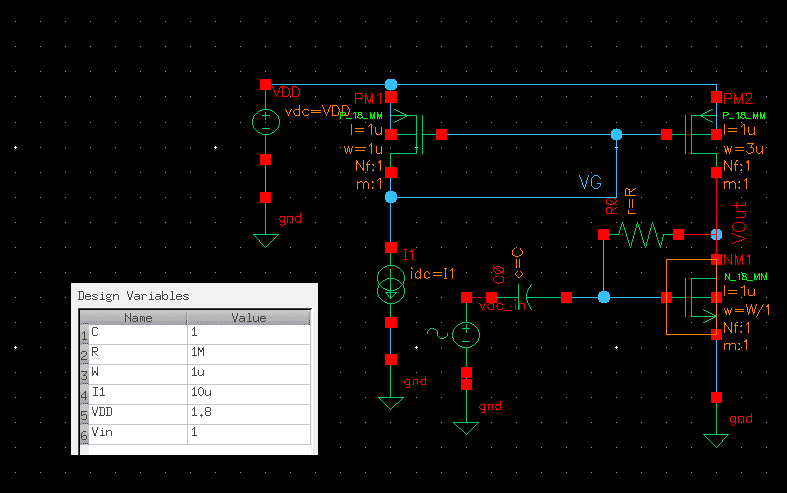
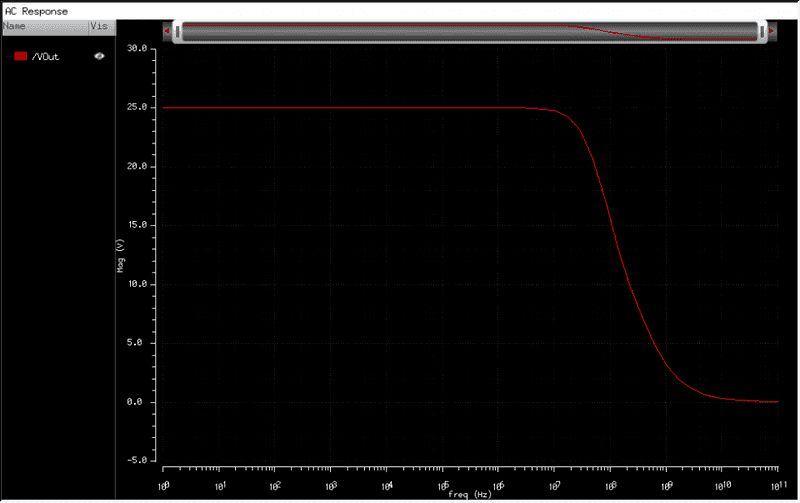
I am taking a closer look at the small-signal behavior of a common source amplifier with active load (see image) and I wonder which capacitances cause the decrease in gain for high frequencies (beyond 106 Hz). I do not know about the magnitudes of the input and output capacitances of the transistors, so it's hard for me to do estimates of any kind. CADENCE doesn't tell me anything either and I am not familiar with the exact models that are being used.
So my question is: Which capacitances in the circuit shown dominate the high-frequency behaviour and are thus responsible for the limited bandwidth (disregarding any external load for now)?
Circuit: (The capacitor 'C' and the resistor 'R' are used to guarantee proper biasing. As far as I understand they can be disregarded since their values are very large (or can they?))
Small signal ac-behavior of the output voltage:
Any help is appreciated. Thank you.
I am taking a closer look at the small-signal behavior of a common source amplifier with active load (see image) and I wonder which capacitances cause the decrease in gain for high frequencies (beyond 106 Hz). I do not know about the magnitudes of the input and output capacitances of the transistors, so it's hard for me to do estimates of any kind. CADENCE doesn't tell me anything either and I am not familiar with the exact models that are being used.
So my question is: Which capacitances in the circuit shown dominate the high-frequency behaviour and are thus responsible for the limited bandwidth (disregarding any external load for now)?
Circuit: (The capacitor 'C' and the resistor 'R' are used to guarantee proper biasing. As far as I understand they can be disregarded since their values are very large (or can they?))
Small signal ac-behavior of the output voltage:
Any help is appreciated. Thank you.
Attachments

