Discussion Overview
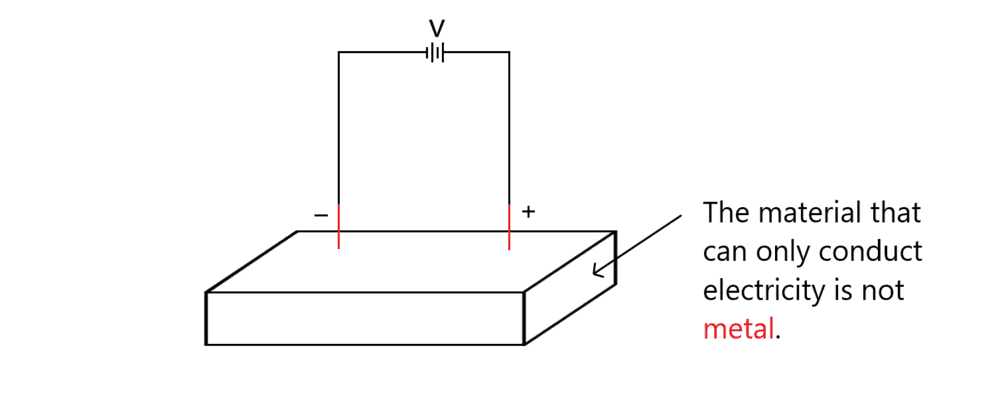
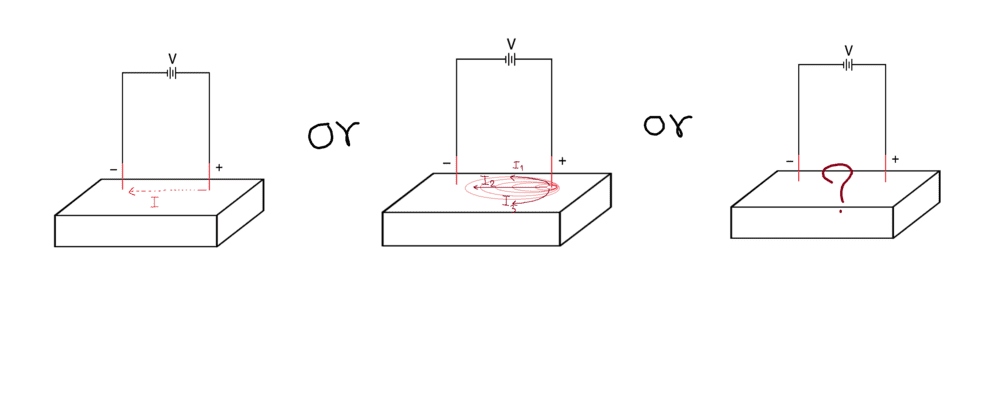
The discussion revolves around the behavior of electric current as it is distributed within various materials, particularly focusing on the travel characteristics of electric currents and the potential differences at different positions within those materials. The scope includes theoretical considerations, practical applications, and modeling approaches related to both conductive and non-conductive materials.
Discussion Character
- Exploratory
- Technical explanation
- Debate/contested
- Mathematical reasoning
- Experimental/applied
Main Points Raised
- Some participants inquire about the travel characteristics of electric currents and how potential differences are distributed within materials, noting that the shape and state of the material can influence these characteristics.
- One participant suggests applying the vector form of Ohm's law in conjunction with Ampere's circuital law to describe current density and electric field relationships in resistive materials.
- Another participant shares an anecdote about using electric current principles to detect internal cracks in oil pipes, indicating practical applications of current distribution concepts.
- It is noted that the question of current distribution is complex, especially in three-dimensional objects, and semiconductor device designers specifically consider these factors.
- One participant proposes using equivalent circuit simulations to model materials as 3D resistor networks to approximate current distribution data.
- A point is made regarding the limitations of point contacts in measuring current density, emphasizing the need for defined contact areas and idealized geometries for analytic solutions.
- Participants mention that real-world electric field patterns and current flow are often analyzed using finite element numerical techniques, highlighting the complexity of the topic.
Areas of Agreement / Disagreement
Participants express a range of views on the complexity of the topic, with no consensus on a single approach or solution. Multiple competing models and methods for understanding current distribution are discussed.
Contextual Notes
Limitations include the dependence on material properties, the influence of external conditions, and the need for idealized geometries in analytical solutions. The discussion acknowledges the complexity of transient effects and the challenges in modeling real-world scenarios.