What is this -- can you figure it out? (identify this piece of equipment)
Click For Summary
Discussion Overview
The discussion revolves around identifying a piece of equipment based on images provided. Participants explore various hypotheses regarding its function and origin, considering it within the contexts of mechanical devices, motors, and household appliances.
Discussion Character
- Exploratory
- Debate/contested
- Technical explanation
Main Points Raised
- Some participants suggest it could be a piece of surveying equipment due to the lack of scale and orientation in the images.
- Others propose it is a motor, possibly for a handheld electric mixer, citing visible components like field laminations and a commutator.
- A participant speculates it might be the motor for an ancient clothing wringer, noting the presence of a worm gear driving two shafts.
- Some express skepticism about the clothing wringer theory, arguing that the motor appears too fast for such a device.
- There are conflicting views about whether it could be part of a television, with one participant dismissing this idea based on the absence of heavy-duty components in TVs.
- Several participants discuss the potential for reusing the motor in an industrial mixer or other applications, though specifics on how to make it work are unclear.
- Questions arise about the nature of the drives from the motor, with some suggesting they indicate different speeds and torque capabilities.
- Participants express curiosity about the original purpose of the equipment and the possibility of finding a part number for further identification.
Areas of Agreement / Disagreement
Participants do not reach a consensus on the identity of the equipment, with multiple competing views and hypotheses remaining throughout the discussion.
Contextual Notes
Participants note limitations in the provided images, such as the lack of scale and orientation, which complicate the identification process. There are also unresolved questions about the mechanical design and functionality of the equipment.

Engineering news on Phys.org
DaveC426913
Gold Member
2025 Award
- 24,567
- 8,920
Nothing to show scale, nothing to show normal orientation, not a very elucidating viewing angle.
My first thought was a piece of surveying equipment.
My first thought was a piece of surveying equipment.
Averagesupernova
Science Advisor
Gold Member
- 4,920
- 1,570
A motor of some sort. I see field laminations, a commutator and brushes. I see what is most likely a fan on the right side. Looks like maybe the guts for a handheld electric mixer.


Averagesupernova
Science Advisor
Gold Member
- 4,920
- 1,570
Electric mixer. Obvious now.
DaveC426913
Gold Member
2025 Award
- 24,567
- 8,920
That worm gear will drive two gears sitting in those encasements in opposite directions, surely attached to shafts. So, two shafts, just a few inches apart driving in opposite directions.
I say it's the motor for an ancient clothing wringer. Otherwise known as a child-hand-and-arm-flattener.
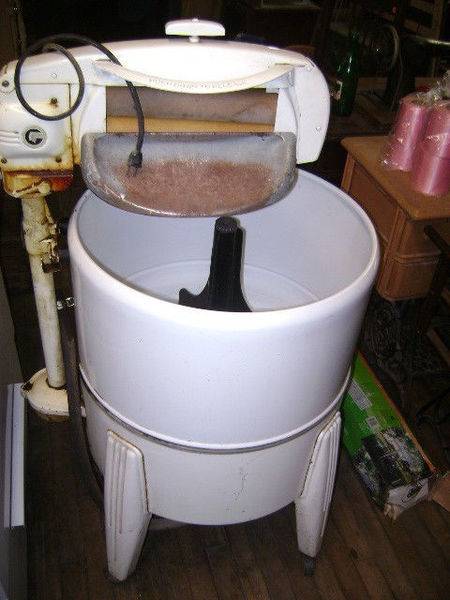
I say it's the motor for an ancient clothing wringer. Otherwise known as a child-hand-and-arm-flattener.
Averagesupernova
Science Advisor
Gold Member
- 4,920
- 1,570
They will spin too fast for any clothing wringer I have been around.
DaveC426913
Gold Member
2025 Award
- 24,567
- 8,920
Valid point. I don't see any gearbox that would reduce revs, but I won't rule it out.Averagesupernova said:They will spin too fast for any clothing wringer I have been around.
Mixer is good too.
giokrutoi
- 128
- 1
mixer may be but I think it may be part of tv
can it be so?
can it be so?
DaveC426913
Gold Member
2025 Award
- 24,567
- 8,920
No way. There are no heavy-duty, mechanical, moving components in a TV of any decade.giokrutoi said:mixer may be but I think it may be part of tv
That is most definitely a heavy-duty motor driving two shafts in opposite directions in close proximity.
giokrutoi
- 128
- 1
and in what can I use it
DaveC426913
Gold Member
2025 Award
- 24,567
- 8,920
Well, in an industrial mixer. I think Average is correct.
If you wish to re-use it, you could take the head off, and you'd have a powerful electric motor for something. Don't know what the revs are.
If you wish to re-use it, you could take the head off, and you'd have a powerful electric motor for something. Don't know what the revs are.
giokrutoi
- 128
- 1
ok thanks very much
Averagesupernova
Science Advisor
Gold Member
- 4,920
- 1,570
A bit off topic but the old wringer washers had a shaft that run up through the pedestal that the wringer part mounted on. There was only one motor and it was underneath. Just gearing to get the power up to the wringer rollers.
Averagesupernova
Science Advisor
Gold Member
- 4,920
- 1,570
Just curious, why would you have thought surveying equipment? What made your mind go there?
giokrutoi
- 128
- 1
I love making new from old stuff that's allAveragesupernova said:Just curious, why would you have thought surveying equipment? What made your mind go there?
DaveC426913
Gold Member
2025 Award
- 24,567
- 8,920
Pretty sure this was directed at me.Averagesupernova said:Just curious, why would you have thought surveying equipment? What made your mind go there?

I didn't get a good look at the motor part until you pointed it out in the follow-up pix. My first look saw two circles about the size - and separation - of eyes, on a tall, tripod-like stock.
Jeff Rosenbury
- 746
- 145
I like the mixer idea. The spinning plastic part could (with gearing) spin a bowl. The fins could engage for different gear ratios.
Clearly it should be Aboveaveragesupernova.
Clearly it should be Aboveaveragesupernova.
Averagesupernova
Science Advisor
Gold Member
- 4,920
- 1,570
Clearly it should be Aboveaveragesupernova.
Well I used to be Superaveragenova but I decided I would rather be averagely super.
 LOL
LOL-
Strangely I don't recall how I really came up with the name. It just popped in my head. It is interesting to me in that it doesn't seem possible for an event like an exploding star to be 'average' and boring, but of course everything is relative and there are in fact actual average supernovas.
Last edited:
DaveC426913
Gold Member
2025 Award
- 24,567
- 8,920
I figure that's really more of the cooling mechanism for the motor.Jeff Rosenbury said:I like the mixer idea. The spinning plastic part could (with gearing) spin a bowl. The fins could engage for different gear ratios.
giokrutoi
- 128
- 1
and how can I make it work
rbelli1
Gold Member
- 1,092
- 446
sophiecentaur
Science Advisor
Homework Helper
- 30,537
- 7,518
The two different drives taken from the motor suggest a low speed, reversible, high torque drive at one end (as people have already said) and a high speed takeoff dog on the other end - could be a pump drive (not much torque transferred through that plastic piece but a pump wouldn't need it). Most washing machines would have two separate motors, in my experience, but an old design could have used just one. I'd love to see the controller / timer for it.
@Dave - you really are too, too good to your partner. Buying her all the latest white goods, as in the photo.
@Dave - you really are too, too good to your partner. Buying her all the latest white goods, as in the photo.
Jeff Rosenbury
- 746
- 145
Try to find a part number on the motor somewhere. from that you might be able to cross reference the equipment manufacturer.giokrutoi said:and how can I make it work
Shop garage sales and junk yards for old parts that might fix. Then design what you need to fill in the missing bits. There are websites that will do 3-D printing to order.
Windadct
- 1,452
- 411
I was thinking universal motor from a Vacuum Cleaner, but Mixer may be correct.
DaveC426913
Gold Member
2025 Award
- 24,567
- 8,920
I must have missed something.sophiecentaur said:The two different drives taken from the motor suggest a low speed, reversible, high torque drive at one end (as people have already said) and a high speed takeoff dog on the other end
When you say "two different drives", do you mean two drive shafts, one out each end?
And how do you figure one is low speed and the other is high-speed?
If there were a gearbox in there, that would lend credence to my suggestion of it being a low-speed wringer-dryer.
sophiecentaur
Science Advisor
Homework Helper
- 30,537
- 7,518
There is a worm gear on the left and a straight 'dog' on the other end; could be a 10:1 difference in final speeds of the two drives.DaveC426913 said:And how do you figure one is low speed and the other is high-speed?
I think the worm that you can see is all that's left of the low speed gearbox, with the two pinions missing. That could provide two directions for rotating some heavyish load.
Last edited:
DaveC426913
Gold Member
2025 Award
- 24,567
- 8,920
sophiecentaur said:There is a worm gear on the left and a straight 'dog' on the other end; could be a 10:1 difference in final speeds of the two drives.
 Of course. I wasn't even thinking of the worm gear as a reducer.
Similar threads
- · Replies 17 ·
- Replies
- 17
- Views
- 2K
- · Replies 9 ·
- Replies
- 9
- Views
- 2K
- Replies
- 18
- Views
- 2K
- · Replies 4 ·
- Replies
- 4
- Views
- 5K
- · Replies 11 ·
- Replies
- 11
- Views
- 6K
- · Replies 1 ·
- Replies
- 1
- Views
- 3K
- · Replies 5 ·
- Replies
- 5
- Views
- 2K
- Replies
- 3
- Views
- 2K
- · Replies 2 ·
- Replies
- 2
- Views
- 1K
- · Replies 4 ·
- Replies
- 4
- Views
- 2K