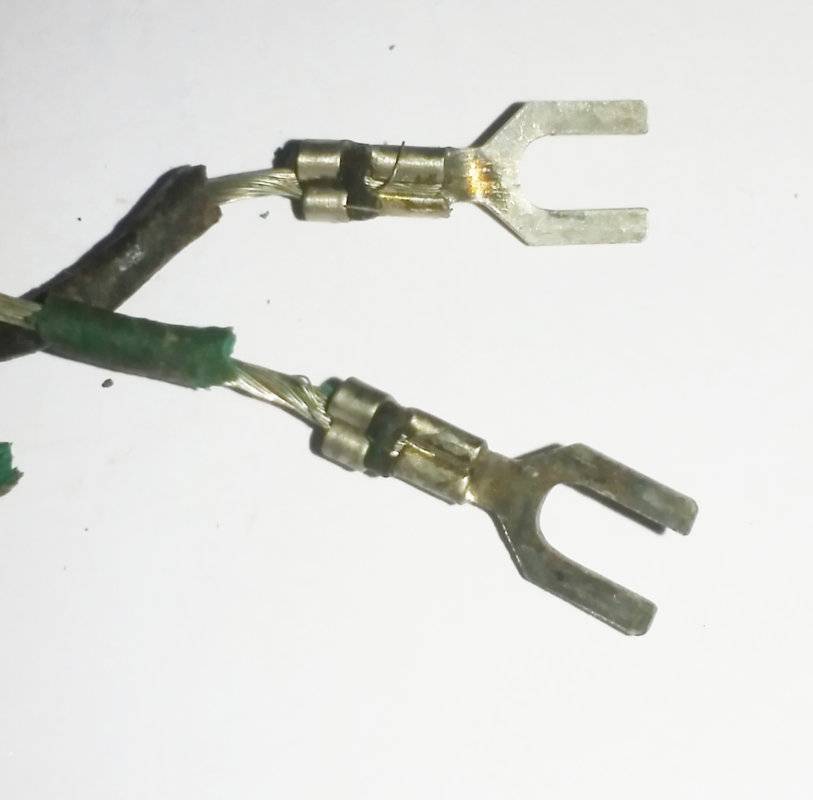
What type of electrical contact joint is this?

Click For Summary

Discussion Overview

The discussion revolves around identifying and understanding a specific type of electrical joint found in an old electric iron. Participants explore the nature of the joint, its construction, and considerations for replacing or repairing it, including safety and reliability aspects. The conversation includes technical details about crimping techniques and materials suitable for high-temperature applications.

Discussion Character

  • Technical explanation
  • Debate/contested
  • Experimental/applied

Main Points Raised

  • Some participants identify the joint as a spade lug or double crimp spade connector, describing its construction and function.
  • There are discussions about the quality of the crimping in the original joint, with some noting that it was poorly made and suggesting proper techniques for crimping.
  • Concerns are raised about the reliability of soldering after crimping, with differing opinions on whether soldering improves or reduces reliability.
  • Participants mention the importance of using high-temperature insulated wire for applications exposed to intense heat, with suggestions for specific materials like TGGT and MGT insulated wire.
  • Some participants discuss the potential issues with tinning wire before crimping, citing concerns about the softness of solder and its effects on joint stability.
  • There is a warning about the dangers of poorly made crimps, especially in high-voltage applications, and the need for thorough testing of the appliance before replacing wires.

Areas of Agreement / Disagreement

Participants express multiple competing views regarding the effectiveness of soldering in conjunction with crimping, as well as the best practices for preparing wires for crimping. The discussion remains unresolved on these technical points.

Contextual Notes

Limitations include the lack of consensus on the reliability of soldering after crimping and the best practices for tinning wire. There are also unresolved questions about the specific requirements for testing the appliance safely.

Who May Find This Useful

Individuals interested in electrical repair, particularly those working with high-temperature applications or crimping techniques, may find this discussion relevant.

Wrichik Basu
Science Advisor
Insights Author
Gold Member
Messages
2,188
Reaction score
2,694
While working on an old electric iron, I found this joint in the wires:
20190315_190536.jpg


Any idea what this joint is? Does it have a special name?

The wires are in a horrible condition, so I have to change them. How can I build this joint by myself? Or are such wires readily available in the market?
 

Attachments

  • 20190315_190536.jpg
    20190315_190536.jpg
    25.3 KB · Views: 850
Last edited by a moderator:
  • Like
Likes   Reactions: davenn
Engineering news on Phys.org
The metal piece is called a spade lug. It comes with the part on the left opened up. You slip the wires into the open part on the left and then crimp it shut. For better reliability you can then solder it together if you like.
 
  • Like
Likes   Reactions: Wrichik Basu
phyzguy said:
The metal piece is called a spade lug. It comes with the part on the left opened up. You slip the wires into the open part on the left and then crimp it shut. For better reliability you can then solder it together if you like.
Thanks.
 
Its called a double crimp spade connector.
One crimp captures the insulation the other crimp captures the bare wire.
Those in your image were poorly made.
The one on top has the wire too far into the crimp, while the one on the bottom does not have the wire sufficiently into the crimp.
The insulation should be cut to just protrude through the first crimp, and the bare wire should protrude just through the second crimp portion.

In the US these are available at any hardware store or electrical supply, along with the proper crimping tool.
These can be crimped using other tools but, there is a special tool designed to make sure these crimps are made correctly. Care should be taken to not over-crimp the one holding the insulation; and to tightly crimp the bare wire for good contact. The portion of the bare wire may also be soldered to the connector after crimping if desired, to insure a low resistance contact.

BTW- If that wire is subjected to intense heat, a high temperature insulated wire should be used; not a rubber compounded insulation.
 
Last edited:
  • Like
Likes   Reactions: Asymptotic, Wrichik Basu and phyzguy
AZFIREBALL said:
Its called a double crimp spade connector.
One crimp captures the insulation the other crimp captures the bare wire.
Those in your image were poorly made.
The one on top has the wire too far into the crimp, while the one on the bottom does not have the wire sufficiently into the crimp.
The insulation should be cut to just protrude through the first crimp, and the bare wire should protrude just through the second crimp portion.

In the US these are available at any hardware store or electrical supply, along with the proper crimping tool.
These can be crimped using other tools but, there is a special tool designed to make sure these crimps are made correctly. Care should be taken to not over-crimp the one holding the insulation; and to tightly crimp the bare wire for good contact. The portion of the bare wire may also be soldered to the connector after crimping if desired, to insure a low resistance contact.

BTW- If that wire is subjected to intense heat, a high temperature insulated wire should be used; not a rubber compounded insulation.

Thanks for clarifying. I wasn't aware of the double crimp function.
 
phyzguy said:
For better reliability you can then solder it together if you like.
If the crimp is done properly (as noted, not like this one), then soldering does not improve reliability.
 
  • Like
Likes   Reactions: Wrichik Basu, nsaspook and Rive
Good point by @AZFIREBALL.
TGGT (Teflon-Glass-Glass-Teflon) insulated wire ought to do.
MGT (Mica-Glass-Teflon) can operate at even higher temperatures, but the mica makes it more fragile.

Look for spade terminals made for high temperature operation. Regular ones are tinned copper; high temp parts are usually a nickel alloy.

High temp connectors require more force to crimp correctly. Sophisticated tools featuring interchangeable dies and other amenities are available, but something along the lines of a Thomas & Betts model WT111M will do the job.
 
  • Like
Likes   Reactions: Wrichik Basu
DaveE said:
If the crimp is done properly (as noted, not like this one), then soldering does not improve reliability.

If the crimp is done properly the soldering can actually reduce reliability.

BoB
 
Note there may be several different sizes of lug, and 'Murphy's Law' makes it probable those in a 'Handy Dandy Budget Set With Crimper Tool' will so be the other size...

FWIW, as you've not used crimpers before, please get enough lugs to practise on your stock wire. Budget 'scissor' crimpers are okay in skilled hands, but a double-jointed ratchet model is far, far more reliable...

As ever, 'Due Care, Please' ??
 
  • Like
Likes   Reactions: Wrichik Basu
  • #10
rbelli1 said:
If the crimp is done properly the soldering can actually reduce reliability.

BoB
Why is this? The only thing I can come up with is that the soldered part of the wire is stiffer, creating a stress riser where the wire is not soldered.

I have also heard that soldered wire is not suitable for screw clamps, since the solder creeps under pressure and loosens the joint.
 
  • #11
DaveE said:
If the crimp is done properly (as noted, not like this one), then soldering does not improve reliability.
rbelli1 said:
If the crimp is done properly the soldering can actually reduce reliability.

What about tinning the wire before the crimp - recommended or not?
Thanks.
 
  • #12
Guineafowl said:
The only thing I can come up with is that the soldered part of the wire is stiffer, creating a stress riser where the wire is not soldered.

Exactly that

256bits said:
What about tinning the wire before the crimp - recommended or not?

The problem with that is that the solder is generally very soft so small stresses to the joint will cause additional changes to the shape of the wire. This will tend to cause the joint to wiggle loose. The copper wire will spring back from those stresses. This is the same problem with tinning wire before installing in screw terminals and using copper only screw terminals with aluminum house wiring.

BoB
 
  • Like
Likes   Reactions: krater, Wrichik Basu, Asymptotic and 1 other person
  • #13
these two crimps as shown, are extremely poor
specially if carrying mains voltages/currents
 
  • #14
davenn said:
these two crimps as shown, are extremely poor
specially if carrying mains voltages/currents
Yeah, they are in very bad condition. The appliance itself is about 10 years old. The insulation of the wires is coming off the wires in bits and pieces. And yes, they are supposed to carry voltage from the mains. In fact, the neutral and the Earth were shorted due to wearing out of the insulation.

First I'll have to check whether the iron would work at all (testing continuity in the circuit of the heating element). Only then shall I put in new wires. Otherwise it will be a waste of money.
 
Last edited:
  • Like
Likes   Reactions: dlgoff, davenn and Nik_2213
  • #15
Wrichik Basu said:
First I'll have to check whether the iron would work at all (testing continuity in the circuit of the heating element). Only then shall I put in new wires. Otherwise it will be a waste of money.
sounds like a good plan :smile:
 
  • Like
Likes   Reactions: Wrichik Basu
  • #16
Wrichik Basu said:
testing continuity in the circuit of the heating element
If it is about mains then just continuity won't be enough. You have to check if it is shorted to the casing/earth anywhere and if the resistance is still within range (both cold and hot). Also, you have to be sure that it is assembled properly, so it is still up to standards.
 
  • Like
Likes   Reactions: Wrichik Basu

Similar threads

  • · Replies 30 ·
2
Replies
30
Views
5K
  • · Replies 9 ·
Replies
9
Views
2K
Replies
0
Views
2K
  • · Replies 5 ·
Replies
5
Views
1K
  • · Replies 16 ·
Replies
16
Views
5K
  • · Replies 17 ·
Replies
17
Views
2K
  • · Replies 1 ·
Replies
1
Views
1K
  • · Replies 4 ·
Replies
4
Views
2K
  • · Replies 3 ·
Replies
3
Views
4K
  • · Replies 1 ·
Replies
1
Views
6K