Why do objects always rotate about their centre of mass?
- Level: Undergrad
- Thread starter Leo Liu
- Start date
-
- Tags
- Centre of mass Mass Rotate
Join the discussion
Registration is free. Ask a follow-up in this thread, or start your own.
133 replies · 15K views
Physics news on Phys.org
Mentor
- 37,264
- 16,389
Why? Write down the math and the criteria you used. What do you mean when you say an object rotates around a point? Did you just randomly pick A or was there some reason you used?John Mcrain said:
Last edited:
John Mcrain
- 435
- 28
Because my eyes see this, same like I see that ocean is blue.Dale said:Why?
Isnt that so obvious?
Because if you swimm inside or outside of white circle(boat path),boat will not hit you, but if you swimm at white circle, boat will hit you.
Because centripetal force that keep boat rotating around point A is equal to m x v2 / r , where r is distance from A to boat...
etc
Mentor
- 37,264
- 16,389
So to determine the point something rotates around we have to submit a picture to @John Mcrain and get your eyes on it. That is a terrible rule.John Mcrain said:Because my eyes see this, same like I see that ocean is blue.
Isnt that so obvious?
Try again. What rule can you write that gives the unique point it rotates around?
You should have a single rule. Not multiple rules.John Mcrain said:Because if you swimm inside or outside of white circle(boat path),boat will not hit you, but if you swimm at white circle, boat will hit you.
Because centripetal force that keep boat rotating around point A is equal to m x v2 / r , where r is distance from A to boat...
You are trying to act like this is a trivial exercise, but it is quite difficult. If you actually made the effort here you might learn something.
Mentor
- 23,902
- 11,357
I'm disappointed it doesn't include "E" - about its center of mass!John Mcrain said:
Extra credit for mixing together rotation and revolution. The Webb telescope would like a word...
Last edited:
Science Advisor
- 13,480
- 4,347
John Mcrain said:About which point boat rotate? A,B,C,D or any point ?
My answer is A.
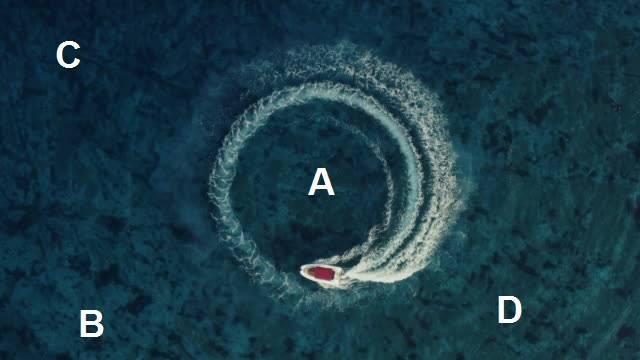
If you:
- choose to describe the motion in the rest frame of the water
- choose to describe the motion as pure rotation, without translation
then A is the center of rotation implied by your choices. But these are choices you make, not something absolute.
John Mcrain
- 435
- 28
Camera show reference frame of water, so I answer for this frame.A.T. said:If you:
- choose to describe the motion in the rest frame of the water
- choose to describe the motion as pure rotation, without translation
then A is the center of rotation implied by your choices. But these are choices you make, not something absolute.
Yes nothing is absolute, this boat move around Sun, but this is irrelvant for this case.
You mean roatition is spin around point(cm) inside object ,and translation along circular path is around point outside of object?A.T. said:You are confusing "rotation" with "translation along a circular path".
Isnt this game of words?
Last edited:
Mentor
- 23,902
- 11,357
A boat rotates while driving in a circular path, but in general rotation is not required while tracing/translating a circular path. A space telescope (my example) will move in a circle (orbit) without rotating.John Mcrain said:Dont understand..
What if you're driving the boat?Camera show reference frame of water, so I answer for this frame.
John Mcrain
- 435
- 28
Around what boat rotate?russ_watters said:A boat rotates while driving in a circular path, but in general rotation is not required while tracing/translating a circular path. A space telescope (my example) will move in a circle (orbit) without rotating.
What if you're driving the boat?
Mentor
- 23,902
- 11,357
As many others have said, you can choose anything you want. Me personally, since a speedboat's direction of motion isn't well tied to the direction it is pointing, I'd prefer describing the rotation as being about the center of mass (or helm). Especially if I'm the one driving it.John Mcrain said:Around what boat rotate?
Science Advisor
- 13,480
- 4,347
It's a still image, so you cannot tell anything about the reference frame of the camera.John Mcrain said:Camera show reference frame of water, so I answer for this frame.
That is one possible way to describe the motion.John Mcrain said:You mean roatition is spin around point(cm) inside object ,and translation along circular path is around point outside of object?
To communicate you need to agree on what words mean. Centripetal force on an object doesn't imply that the object is rotating (changing orientation), just that it's center of mass is translating along a non-linear path, in inertial frames of reference.John Mcrain said:Isnt this game of words?
Mentor
- 37,264
- 16,389
Yes! That is the issue indeed. You are making a claim that there is some unique point (but you cannot define it). We are telling you that it depends on how you define things.John Mcrain said:Isnt this game of words?
That is indeed the point of my challenge to define what you mean with full mathematical rigor. If you do so you will find that there is an element of choice in the definition or that it doesn’t produce a unique point.
snorkack
- 2,388
- 537
Let´s consider an example where discussing "axis" which does NOT contain the centre of mass is the natural convention...Vanadium 50 said:Bodies do not rotate about a point. They rotate about an axis.
Why does the axis contain the COM? It doesn't have to, but that's usually what we mwan by the word "rotation". The earth rotates about its axis (which contains the COM) but revolves around the sun. It's a convention to aid discussion.
Now one might say "yeah, but this is just terminology" and it is. But when trying to understand something, it's better to keep the potential miscommunications to a minimum.
Out of balance wheel. What is an out of balance wheel rotating around - the axis which is being held fixed, or some imaginary "axis" which goes through its centre of mass and moves around with it?
Now, a wheel still looks close to symmetrical. How about something conspicuously asymmetric to reflection?
Like a steelyard balance beam? One end thick and heavy. The other end thin and long.
How do you balance a steelyard balance beam?
In an uniform field of gravity, first find an axis around which the moments of two arms are equal. This way, the beam will not press against the spot whereby it is held horizontal, and stays horizontal when released to be supported by axis only.
But this has only given you the location of centre of mass along the beam. If your axis is above CoM, the beam returns to horizontal when slightly displaced. If your axis is below CoM, the beam tips over when slightly displaced from horizontal.
Thus adjust the axis position vertically until the beam rotates freely and will stay balanced in any angle from horizontal. This shows that the axis goes through CoM.
Now how about rotation?
When the beam is steady in uniform field of gravity, the momentum is integral of mass times leverage (times gravitational acceleration). But when the beam is rotating, the centrifugal force is integral of mass times leverage (this time times square of angular speed).
Therefore, if either of them balances, both do - and vice versa. Fix a beam, or any body, on an axis that does not pass through centre of mass, and when it rotates, it will exert centrifugal force on the axis that varies with the direction of the body. And at some position, the gravity will have momentum relative to axis. Pick the axis through CoM, and the centrifugal forces will balance, and the weight of the body will be constant and applied direct on the axis.
John Mcrain
- 435
- 28
If ask like this; in what point passes axis(perpendicular to water surface) of circular motion of the boat?Dale said:Yes! That is the issue indeed. You are making a claim that there is some unique point (but you cannot define it). We are telling you that it depends on how you define things.
That is indeed the point of my challenge to define what you mean with full mathematical rigor. If you do so you will find that there is an element of choice in the definition or that it doesn’t produce a unique point.
Is now answer only point A?
Science Advisor
Homework Helper
- 13,438
- 8,110
Who says that it is circular motion? It could be cycloidal or helical as well.John Mcrain said:If ask like this; in what point passes axis(perpendicular to water surface) of circular motion of the boat?
Is now answer only point A?
But you still have not defined what you mean by a center of rotation.
John Mcrain
- 435
- 28
White path at sea is circular, at the center of that circle passes axis of boat "circular motion"jbriggs444 said:Who says that it is circular motion? It could be cycloidal or helical as well.
But you still have not defined what you mean by a center of rotation.
Science Advisor
Homework Helper
- 13,438
- 8,110
The trajectory is only circular when projected onto a two dimensional surface in a particular way.John Mcrain said:White path at sea is circular, at the center of that circle passes axis of boat "circular motion"
Now you have to figure out how to nail down the details of that projection.
John Mcrain
- 435
- 28
In my task boat circle motion is known not something that I must find out..jbriggs444 said:The trajectory is only circular when projected onto a two dimensional surface in a particular way.
Now you have to figure out how to nail down the details of that projection.
Science Advisor
Homework Helper
- 13,438
- 8,110
Nobody but you is discussing the motion. Everyone else is discussing how to describe the motion.John Mcrain said:In my task boat circle motion is known not something that I must find out..
Mentor
- 37,264
- 16,389
This is a good start to a definition for the center. The velocity defines a unique direction in a given frame. Perpendicular to the velocity defines a plane. How are you planning on picking out a specific point in that plane? We don’t want to use the water since there are many scenarios with rotation but without water.John Mcrain said:If ask like this; in what point passes axis(perpendicular to water surface) of circular motion of the boat?
Is now answer only point A?
You see, it is not a trivial exercise to define the center.
John Mcrain
- 435
- 28
My answer is I dont know..and dont understand what is the point
Mentor
- 37,264
- 16,389
The point is that we choose the center of rotation (rather arbitrarily) in order to simplify the translation. The center of rotation is not something that is part of the world, it is part of the analysis.John Mcrain said:My answer is I dont know..and dont understand what is the point
John Mcrain
- 435
- 28
But if we relativize center of rotation/circular motion, that mean in real life this point dont exist in space.Dale said:The point is that we choose the center of rotation (rather arbitrarily) in order to simplify the translation. The center of rotation is not something that is part of the world, it is part of the analysis.
I mean boat really circle around point A, if you swimm at point A you will see that boat moves around you.
I dont understand this part.
Dale said:If they did not then the center of mass would not be traveling in a straight line. This would violate Newton’s first law.
Dale said:The point is that we choose the center of rotation (rather arbitrarily) in order to simplify the translation. The center of rotation is not something that is part of the world, it is part of the analysis.
Isnt this two answers in contradiction?
Last edited:
- 24,488
- 15,064
Indeed, you can choose any body-fixed reference point together with any body-fixed (Cartesian) basis to describe its motion. Of course you can choose a very stupid reference point to make simple problems unsolvable (or at least very hard to solve).Dale said:The point is that we choose the center of rotation (rather arbitrarily) in order to simplify the translation. The center of rotation is not something that is part of the world, it is part of the analysis.
Take a very simple example of the motion of a rigid body around a fixed axis. Of course, here you should choose the body-fixed origin of the body-fixed reference frame on this axis. In principle you could choose any other body-fixed origin, but then you get very complicated equations of motion. The proper choice of your reference frames is a big step towards the solution!
Science Advisor
- 13,480
- 4,347
These are two different things. You are confusing yourself by lumping them together. Rotation (changing orientation) and motion along a circle (translation) are two independent components of motion. You can have one without the other.John Mcrain said:But if we relativize center of rotation/circular motion,
Yes, A is the static point in the frame of the water that the boat translates around along a circle. But the rotation of the boat (changing orientation) is a separate issue, and the point A is not the only point that can be used as reference for rotation.John Mcrain said:if you swimm at point A you will see that boat moves around you.
- 24,488
- 15,064
As I tried to explain in #115 of course the choice of the body-fixed (which is usually non-inertial/rotating of course) as well as the space-fixed (usually inertial) reference frames is completely arbitrary, while of course the motion is uniquely determined by the dynamics and the initial conditions. Usually there's a "natural choice" for these reference frames, i.e., given by the physical situation you choose a convenient body-fixed origin and (Cartesian) basis for your body-fixed reference frame (e.g., given the origin the basis should chosen along the principle axes of the tensor of inertia, to make its body-fixed components diagonal).
A nice example is a cylinder with an off-axis center of mass. This you can describe using either the body-fixed origin on the axis or in the center of mass. You get of course the same results for the motion as a whole, but the decomposition into "translatorial" and "rotatorial" motions is different. See Sect. 4.3.3 in
https://itp.uni-frankfurt.de/~hees/publ/theo1-l3.pdf
(in German; if I find the time, I'll put it to my English translation of the rigid-body chapter of this manuscript, part of which can be found here:
https://itp.uni-frankfurt.de/~hees/pf-faq/spinning-top.pdf
but presently contains only the basics of the theory of the spinning top).
A nice example is a cylinder with an off-axis center of mass. This you can describe using either the body-fixed origin on the axis or in the center of mass. You get of course the same results for the motion as a whole, but the decomposition into "translatorial" and "rotatorial" motions is different. See Sect. 4.3.3 in
https://itp.uni-frankfurt.de/~hees/publ/theo1-l3.pdf
(in German; if I find the time, I'll put it to my English translation of the rigid-body chapter of this manuscript, part of which can be found here:
https://itp.uni-frankfurt.de/~hees/pf-faq/spinning-top.pdf
but presently contains only the basics of the theory of the spinning top).
John Mcrain
- 435
- 28
Boat moves in circle around point A, but boat do not rotate(change orientation) because allways same side of boat looking toward point A.A.T. said:These are two different things. You are confusing yourself by lumping them together. Rotation (changing orientation) and motion along a circle (translation) are two independent components of motion. You can have one without the other.Yes, A is the static point in the frame of the water that the boat translates around along a circle. But the rotation of the boat (changing orientation) is a separate issue, and the point A is not the only point that can be used as reference for rotation.
Boat dont spins around itself.
Mentor
- 37,264
- 16,389
Perhaps I shouldn’t have said “violates” Newton’s first law in the first. Something like “complicates” would have been better.John Mcrain said:Isnt this two answers in contradiction?
The point I was trying to make in that first quote is that the key to pay attention to is how that choice of center affects the translation. We want a center that simplifies the translation. That is the same point I am making later.
Mentor
- 23,902
- 11,357
Well that took a turn I didn't expect! This coordinate isn't a normal rectangular/Cartesian coordinate system centered on point A then, since the boat points up, then left, then down. You're trying to use polar coordinates.John Mcrain said:Boat moves in circle around point A, but boat do not rotate(change orientation) because allways same side of boat looking toward point A.
Boat dont spins around itself.
...but it turns out that's not sufficient. Rotation is absolute. You can measure it independent of other motion. The boat is rotating at a rate of one rotation per revolution (like the moon).
Similar threads
- user079622
- · Replies 141 ·
- Mechanics
- Replies
- 141
- gge
- · Replies 27 ·
- Mechanics
- Replies
- 27
- Stephanus
- · Replies 23 ·
- Special and General Relativity
- Replies
- 23
- eightsquare
- · Replies 20 ·
- Quantum Physics
- Replies
- 20